THE CLASSIC COLLECTION✦The Shield of LoveCLASSIC FREE BOOKS
The Shield of Love
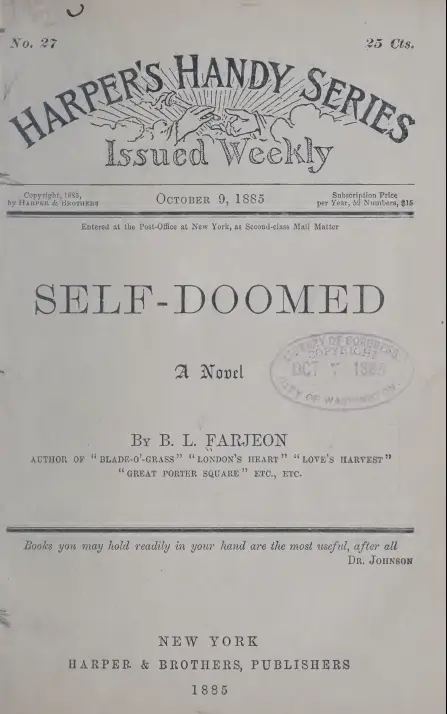
B. L. (Benjamin Leopold) Farjeon
THE CLASSIC COLLECTION · 1885
"The Nine of Hearts: A Novel" by B. L. Farjeon is a fiction work written in the late 19th century. The story revolves around Edward Layton, who stands trial for the murder of his wife, Agnes Layton, raising suspicions and intrigue as the courtroom drama unfolds. The narrative explores themes of love, betrayal, and the complexities of human relationships, particularly in the context of a troubled marriage. At the start of the novel, the courtroom is abuzz with tension as Edward Layton is on trial for the alleged murder of his wife, found dead from poisonous narcotics. His choice to represent himself rather than be defended by his counsel raises questions about his state of mind and the circumstances surrounding the incident. Witnesses provide testimony that paints a complicated picture of Edward’s relationships, revealing the discord between him and Agnes, heightened by revelations of previous engagements and motives tied to inheritance. This opening sets the stage for a gripping legal drama marked by emotional conflict and moral ambiguity.
Introduction adapted from the source catalogue; source summaries may be automatically generated.
Free to read · English · 45,690 words · No account needed
MAKE TIME FOR A GOOD BOOK
On by default. Untick to stop anonymous reading totals. Each page counts after 10 seconds in view. How this works.
Anonymous counting is on unless you have switched it off.
"Never in a criminal court, in the case of a man arraigned upon so grave a charge, has there been heard a defence so weak and strange; but it is nevertheless a fact that the prisoner's earnest and, to all appearance, ingenuous manner produced a deep impression upon all who heard him; and when he ceased speaking there was, in the murmurs of astonishment that followed, an unmistakable note of sympathy.
"After a slight pause the Attorney-general rose to sum up the case against the prisoner, and his incisive judicial utterances soon dispelled the impression which the prisoner's earnestness had produced. He said that in the circumstances of the case his speech would be briefer than it otherwise would have been. He had a duty to perform, and he would perform it, without, he hoped, any undue severity or harshness. Unhappily the evidence was only too clear against the prisoner, and unhappily the prisoner had strengthened the case against himself. This was not a matter of sentiment it was a matter of justice, and justice must be done. With slight limitations, around which the prisoner threw a veil of silence, contenting himself to cast suspicion upon them by some kind of mysterious implication which no person could understand, and not venturing to give them a distinct and indignant denial--with slight limitations, then, the prisoner had admitted the truthfulness of the evidence brought against him. As the prisoner had not directly referred to these doubtful points in the evidence, he would himself do so, and endeavor to clear away any latent doubt--if such existed--in the minds of the jury. First, with respect to the ulster. The prisoner did not deny that he wore this ulster on the whole of the day his coachman, James Moorhouse, was driving him to various places, and it was only upon his arrival home at midnight that he endeavored to shake the coachman's evidence as to whether, when he entered the carriage, upon leaving Prevost's Restaurant, and upon his issuing from the carriage when the coachman drew up at his house, he still had this ulster on. What his motive was in endeavoring to shake the coachman's testimony upon this point it was impossible to say. He (the learned counsel) had most carefully considered the matter, and the only conclusion he could arrive at was that the prisoner was anxious to instil a doubt into the minds of the jury, that it was not he who left the restaurant at ten minutes to twelve and entered his carriage, and that it was not he who alighted from the carriage and opened his street door. But supposing, for instance, that this argument had a foundation in fact, was it not easy for the prisoner to prove what he had done with himself between ten minutes to twelve on the night of the 25th of March and seven o'clock on the morning of the 26th? Surely some person or persons must have seen him, and had he produced those persons there would have been a reasonable alibi set up, which it would be the duty of every one engaged in this case seriously to consider. Indeed, he would go so far as to say that, admitting such evidence to be brought forward and established, there could not be found a jury who would convict the prisoner of the charge brought against him. It would then have been proved that the prisoner had not seen his wife from eleven o'clock on the morning of the 25th of March until seven o'clock on the morning of the 26th, and as it was during the night of those days that the unhappy lady met her death, it would have been impossible to bring the prisoner in guilty. But, easy as this evidence must have been to produce, there is not only no attempt to produce it, but in his lamentably impotent speech the prisoner does not even refer to it. In his mind, then, and in the minds of all reasonable men, there could not be a doubt that this was the case of one who, in despair, was catching at a straw to save himself. The learned counsel touched briefly but incisively upon every point in the evidence concerning which the prisoner had maintained silence, and had made no endeavor to confute. For instance, there was the lady whom he had met in Bloomsbury Square, whom he took to Prevost's Restaurant, whom he regaled with a supper which neither he nor she touched--a distinct proof that they were otherwise momentously occupied. The evidence with respect to this lady is irrefragable. She was no shadow, no myth, no creation of the imagination; she was a veritable being of flesh and blood. All the efforts of the prosecution had failed to trace her, and the just deduction was that she was somewhere in biding, afraid to come forward lest she should be incriminated and placed side by side with the prisoner in the dock. The prisoner did not deny her existence, nor that she and he were for several hours in company with each other. Were he innocent, what possible doubt could exist that he would bring her forward to establish his innocence? Were both innocent, would not she of her own accord step forward to prove it? The prisoner, in his address, made certain allusions to honor and conscience, by which he would make it appear that he was guided by his honor and his conscience in the singular method of his defence; and it may be that there existed in him some mistaken sense of chivalry which induced him to do all in his power to screen the partner in his crime. It would have been better for him had he brought his honor and his conscience to bear in the unhappy engagement into which he entered with the unfortunate lady who afterwards became his wife; but it had been amply proved that the marriage was not, on his side at least, a marriage of affection. Distinctly he married her for her money, and distinctly he would be a great gainer by her death. Thus, then, there existed a motive, and not a novel one--for the tragedy has been played many times in the history of crime--for his getting rid of her. He (the counsel for the prosecution) did not wish to press hardly upon the prisoner, who was a man of culture and education, and must feel keenly the position in which he stood, whatever might be his outward demeanor. But it devolved upon him to impress upon the jury not to allow any false sentiment to cause them to swerve from the straight path of duty. They must decide by the evidence which had been presented to them, and it was with a feeling the reverse of satisfactory that he pointed out to them that this evidence could lead to but one result.
Your reading position is saved on this browser. Take it to another device with a library code. Reading pages adapt to text, rather than matching a printed edition.
B. L. (Benjamin Leopold) Farjeon
B. L. (Benjamin Leopold) Farjeon
B. L. (Benjamin Leopold) Farjeon
B. L. (Benjamin Leopold) Farjeon
BEHIND THE BOOK
This eBook is for the use of anyone anywhere in the United States and most other parts of the world at no cost and with almost no restrictions whatsoever. You may copy it, give it away or re-use it under the terms of the Project Gutenberg License included with this eBook or online at www.gutenberg.org. If you are not located in the United States, you will have to check the laws of the country where you are located before using this eBook. Read the source licence.
The original source file, including credits and licence, is retained by this library. Request an original-format copy at no charge. Please include the book title and Project Gutenberg identifier #53085.
KEEP YOUR CURIOSITY GOING
Coulson Kernahan

Maurice Baring
Frances Wright
Cécile Tormay

Frederic Jesup Stimson

W. H. P. (William Henry Pope) Jarvis