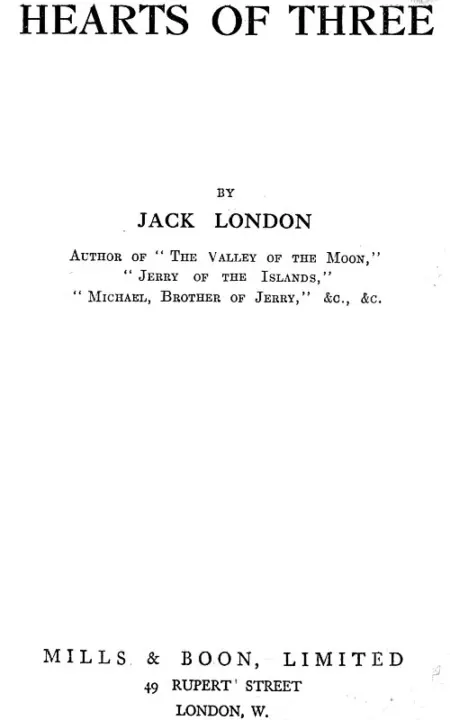
Hearts of three
Jack London
THE CLASSIC COLLECTION · 1913
"The Night-Born" by Jack London is a collection of short stories written in the early 20th century. The stories delve into themes of human nature, survival, and the primal instincts that emerge in the face of adversity. The opening story introduces Trefethan, an old man reminiscing about his youth as he reflects on the ideals and experiences that have shaped his life, hinting at explorations of love, loss, and the raw essence of human experience. The beginning of "The Night-Born" sets the stage in a lively San Francisco bar, where characters engage in deep discussions surrounding society's corruption and the recent death of a young boxer, O'Brien. Trefethan recounts a pivotal moment from his youth when he encountered an extraordinary woman, Lucy, among Native American tribes in an untouched valley. His narrative evokes a sense of nostalgia and longing for the vigor and romance of youth while contrasting it with his current state of being. The tension builds as he reveals the contrasting worlds of the "day-born" and the "night-born," setting the thematic tone for the stories within the collection. This exploration of duality and the character's introspection captivates the reader, inviting them to reflect on the complexities of their own existence.
Introduction adapted from the source catalogue; source summaries may be automatically generated.
Free to read · English · 52,088 words · No account needed
MAKE TIME FOR A GOOD BOOK
On by default. Untick to stop anonymous reading totals. Each page counts after 10 seconds in view. How this works.
Anonymous counting is on unless you have switched it off.
“This came in the morning post,” he ventured apologetically and with the hint of a titter. “Of course it doesn't amount to anything, but I thought you would like to see it.”
“Read it,” Peter Winn commanded, without opening his eyes.
The secretary cleared his throat.
“It is dated July seventeenth, but is without address. Postmark San Francisco. It is also quite illiterate. The spelling is atrocious. Here it is:
“Mr. Peter Winn, SIR: I send you respectfully by express a pigeon worth good money. She's a loo-loo--”
“What is a loo-loo?” Peter Winn interrupted.
The secretary tittered.
“I'm sure I don't know, except that it must be a superlative of some sort. The letter continues:
“Please freight it with a couple of thousand-dollar bills and let it go. If you do I wont never annoy you no more. If you dont you will be sorry.
“That is all. It is unsigned. I thought it would amuse you.”
“Has the pigeon come?” Peter Winn demanded.
“I'm sure I never thought to enquire.”
“Then do so.”
In five minutes the secretary was back.
“Yes, sir. It came this morning.”
“Then bring it in.”
The secretary was inclined to take the affair as a practical joke, but Peter Winn, after an examination of the pigeon, thought otherwise.
“Look at it,” he said, stroking and handling it. “See the length of the body and that elongated neck. A proper carrier. I doubt if I've ever seen a finer specimen. Powerfully winged and muscled. As our unknown correspondent remarked, she is a loo-loo. It's a temptation to keep her.”
The secretary tittered.
“Why not? Surely you will not let it go back to the writer of that
letter.”
Peter Winn shook his head.
“I'll answer. No man can threaten me, even anonymously or in foolery.”
On a slip of paper he wrote the succinct message, “Go to hell,” signed it, and placed it in the carrying apparatus with which the bird had been thoughtfully supplied.
“Now we'll let her loose. Where's my son? I'd like him to see the
flight.”
“He's down in the workshop. He slept there last night, and had his breakfast sent down this morning.”
“He'll break his neck yet,” Peter Winn remarked, half-fiercely, half-proudly, as he led the way to the veranda.
Standing at the head of the broad steps, he tossed the pretty creature outward and upward. She caught herself with a quick beat of wings, fluttered about undecidedly for a space, then rose in the air.
Again, high up, there seemed indecision; then, apparently getting her bearings, she headed east, over the oak-trees that dotted the park-like grounds.
Your reading position is saved on this browser. Take it to another device with a library code. Reading pages adapt to text, rather than matching a printed edition.
Jack London
Jack London
Jack London
Jack London
BEHIND THE BOOK
This eBook is for the use of anyone anywhere in the United States and most other parts of the world at no cost and with almost no restrictions whatsoever. You may copy it, give it away or re-use it under the terms of the Project Gutenberg License included with this eBook or online at www.gutenberg.org. If you are not located in the United States, you will have to check the laws of the country where you are located before using this eBook. Read the source licence.
The original source file, including credits and licence, is retained by this library. Request an original-format copy at no charge. Please include the book title and Project Gutenberg identifier #1029.
KEEP YOUR CURIOSITY GOING
Coulson Kernahan

Maurice Baring
Frances Wright
Cécile Tormay

Frederic Jesup Stimson

W. H. P. (William Henry Pope) Jarvis