
The Writing of News A Handbook with Chapters on Newspaper Correspondence and Copy Reading
Charles G. (Charles Griffith) Ross
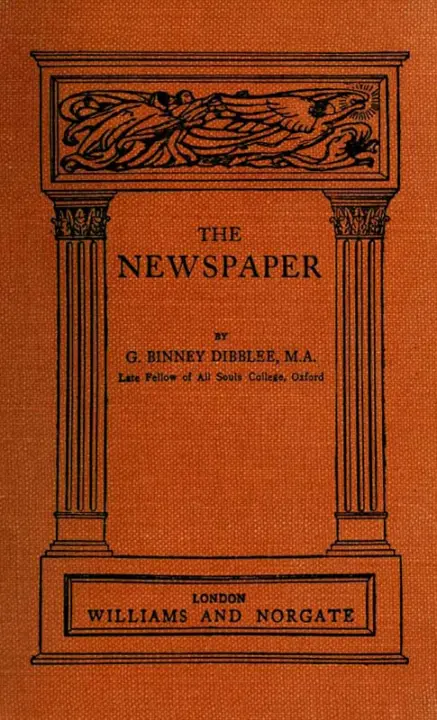
THE CLASSIC COLLECTION · 1912
"The Newspaper" by G. Binney Dibblee is an analytical treatise on the structure, function, and significance of the newspaper industry, likely written in the early 20th century. The work explores the multifaceted roles that newspapers play in society, touching on aspects of news collection, reporting, and the economics of the press. The text aims to provide insights into what makes newspapers tick, laying bare the organization behind their daily operations and how they influence public opinion and business. The opening of the work discusses the various perspectives through which people view newspapers, emphasizing that each individual often focuses on different aspects depending on their interests. Dibblee argues for a deeper examination of the underlying mechanisms that allow newspapers to function, which typically go unnoticed by the general public. He highlights the three essential roles of newspapers: as collectives of news, as conduits of opinion, and as business entities that facilitate transactions and communications among various stakeholders. By setting the stage for a comprehensive analysis of the newspaper's operational dynamics, Dibblee invites readers to reflect on the true impact and complexity of the press in shaping societal narratives.
Introduction adapted from the source catalogue; source summaries may be automatically generated.
Free to read · English · 52,942 words · No account needed
MAKE TIME FOR A GOOD BOOK
On by default. Untick to stop anonymous reading totals. Each page counts after 10 seconds in view. How this works.
Anonymous counting is on unless you have switched it off.
Taking the press not only as the great news-distributor of the world, but also as almost the most powerful existing mechanism for the moulding of opinion, I do not hesitate to declare that for the last half of the Victorian century the British press held a position demonstrably superior to the press of any other country. Although in many respects, and some of them important ones, of which I have already mentioned a few, we ought freely to acknowledge our inferiority, in the two most vitally important attributes of journalism I believe we have long been unrivalled. The first is good professional judgment in selecting and absolute faithfulness in presenting the news of our own country and the most important news of the world. The second is the spirit of independence and contempt for corruption, either through the channels of power or by the pulling of financial strings, which makes it inconceivable for even the smallest newspaper here to boast of its honesty, an experience, which is a common enough occurrence, when one travels in any other country. Whenever corruption or blackmail occasionally finds an unsafe footing in one of the side-walks of journalism it is looked upon as a crime, both morally and professionally, which every one must stamp out, wherever found. Any manager or journalist of experience will tell you that the suggestion of bribery either at headquarters or with one of the ordinary daily staff of a newspaper is an experiment of the utmost danger to any one attempting it. It would most probably be followed by the instant occurrence of the disaster, which there was an endeavour to avert; in fact the only chance of escape for the offender would be the extreme insignificance of his affairs.
But while in many respects much of this stubborn virtue is still a characteristic of the British press, especially in the professional sense, yet it is questionable whether, looking at the independence of our press in the broadest sense, we are not in the course of a transition to a less desirable state of affairs. It is a matter on which I should be very reluctant to pronounce a responsible opinion. All I can see clearly is that a very important change is in progress, the final result of which it is still too early to forecast. The critical date of the change was almost exactly at the end of the last century with the outbreak of the Boer war and the tariff controversy, which followed. Those two events, while they left the country press in very much the same position as before, profoundly modified the position of the richer and more influential daily papers in London. The bitter controversies, which commenced with those issues, have practically thrown the great majority of the well-to-do classes in the kingdom on to one side in politics. Nearly all the richer newspapers, including one or two influential provincial dailies, naturally followed this lead and we have the remarkable spectacle of practically the whole of the important daily press in the metropolis being influenced by the aspirations, prejudices and casual opinions of only one of the great political parties. Now without suggesting the slightest imputation on the professional honour of these great journals nor impeaching their straightforward honesty, it is clear to me that the relative value of truth in all controversial matter has been dangerously disturbed. The mirror of the London press reflects only the drab colours of any presentation of one aspect of society, reserving all the hues of sunset for any little feature of the other. The resulting picture is produced unconsciously and in good faith, but it is none the less subject to dangerous distortion of the truth. This prevailing misfortune is growing worse daily and already we have lost the chastening memory of days, when impartiality was more strictly maintained in our press as a whole by the adequate representation of both sides. Society with a big S, has gone entirely on to one side and has imposed on its press that most hopeless form of provincialism, which already prevails in high circles in Berlin, of merely refusing to recognize as possible the existence of culture, good faith and even of common honesty in those who do not adopt the opinions prevailing in its own ranks. From this blindness I see no ordinary means of deliverance.
Your reading position is saved on this browser. Take it to another device with a library code. Reading pages adapt to text, rather than matching a printed edition.
BEHIND THE BOOK
This eBook is for the use of anyone anywhere in the United States and most other parts of the world at no cost and with almost no restrictions whatsoever. You may copy it, give it away or re-use it under the terms of the Project Gutenberg License included with this eBook or online at www.gutenberg.org. If you are not located in the United States, you will have to check the laws of the country where you are located before using this eBook. Read the source licence.
The original source file, including credits and licence, is retained by this library. Request an original-format copy at no charge. Please include the book title and Project Gutenberg identifier #56551.
KEEP YOUR CURIOSITY GOING
Charles G. (Charles Griffith) Ross
Hannah Webster Foster

Emily Lawless
Edwin Hamlin Carr

Charles De Lano Hine
Andrew Ure