THE CLASSIC COLLECTION✦An outlaw’s diary: the CommuneCLASSIC FREE BOOKS
An outlaw’s diary: the Commune
Cécile Tormay
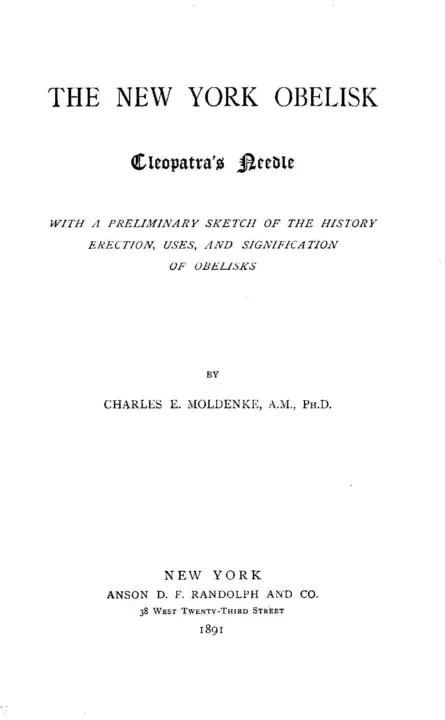
THE CLASSIC COLLECTION · 1891
"The New York Obelisk: Cleopatra's Needle" by Charles E. Moldenke is a historical account written in the late 19th century. This work delves into the fascinating history, significance, and particulars surrounding the famous obelisk known as Cleopatra's Needle, which stands in New York City. The author presents the ancient origins of the obelisk, its transportation to America, and its cultural context within ancient Egypt. At the start of the book, Moldenke introduces the reader to the majestic obelisk and the historical backdrop from which it originates. He reflects on the obelisk's journey through time, from its erection by the Pharaohs, the pompous celebrations surrounding its creation, to its survival through invasions and natural deterioration. The opening portion sets a tone of wonder, inviting the reader to explore not just the physical structure of the monument but also the rich historical and societal narratives it embodies.
Introduction adapted from the source catalogue; source summaries may be automatically generated.
Free to read · English · 46,618 words · No account needed
MAKE TIME FOR A GOOD BOOK
On by default. Untick to stop anonymous reading totals. Each page counts after 10 seconds in view. How this works.
Anonymous counting is on unless you have switched it off.
PORTA DEL POPOLO OBELISK. Another name of the Esmeade Obelisk, which see.
^{11}
PRIOLI OBELISK. A small obelisk in the gardens of the Sultan in Constantinople. Nothing is known of it, as its inscriptions have never been published. ^{9}
PSAMETIK II. A king of the XXVIth dynasty, the son of Psametik I. He conquered Ethiopia and reigned for six years. His son Hophra is mentioned in the Bible. His name in Egyptian is ^{7 9 10 22}
suten-kaut? Nefer-ab-Râ sa Râ Psemthek
The king of Upper "the kind-hearted the Sun's "Psametik." and Lower Egypt, Sun", offspring,
PSEUDO-EGYPTIAN, that is, having the appearance of being Egyptian, but not so in reality. A number of the extant obelisks belong in this category. ^{4}
{142}PTHAH [pronounced tá]. The chief deity of Lower Egypt, an emanation of Râ. He is generally represented as a deformed child holding two serpents and stepping on two crocodiles. In Upper Egypt he was worshipped under the form of an upright mummy ([glyphs]). His name in Egyptian is [glyphs] PTAH. ^{65 69 90}
PTAH-SOKAR-OSIRIS. A form of Ptah, peculiar to Memphis, and represented as a deformed child. His Egyptian name is [glyphs] PTAH-SEKER-USAR. ^{29}
PTAH-TATHUNEN. A title of Ptah of Memphis. The Egyptian form of the word is [glyphs] PTAH-TATHUNEN, meaning perhaps "Ptah of the stable earth". ^{65}
PTOLEMIES. The descendants of Ptolemy Sôtêr, a general of Alexander the Great, and forming the XXXIIId dynasty of Egyptian kings. Each of them married his sister. Their reign extended from 305 to 30 B. C., and was characterized by infamy, tyranny, murder, and poisoning. ^{9 21 22}
PTOLEMY IX. EUERGETES II. A weak king of the XXXIIId dynasty, married to and reigning for a time with his sister Cleopatra II. and his niece Cleopatra III. His name in Egyptian is ^{7 10}
suten-kaut? Nuter-per-ââ-en-Ptah-sotep-en-âr-maâ-Amen-Râ-sekhem-ânkh The king of "The Epiphanes, the heir of Ptah, the chosen of Amen-Ra, Upper and dispenser of justice, conqueror, living", Lower Egypt,
sa Râ Ptûlmîs-ânkh-zeta-Ptah-mer
the Sun's "Ptolemy, living forever, beloved of Ptah."
offspring,
PUNT. The Egyptian name of the southern part of Arabia, which see.
{143}PYLON. The large mass of masonry of an Egyptian temple, resembling two truncated pyramids with the gate between them. A picture of one is given on page 20. Its hieroglyph is perhaps [glyphs]. ^{20 24}
PYRAMIDION. The apex of an obelisk which resembles a miniature pyramid. It was sometimes inscribed with pictures and hieroglyphs, and covered with a capping of gold-metal or electrum (which see). ^{18 19 21 22 26 47 50 51 52 53 54 55}
Your reading position is saved on this browser. Take it to another device with a library code. Reading pages adapt to text, rather than matching a printed edition.
BEHIND THE BOOK
This eBook is for the use of anyone anywhere in the United States and most other parts of the world at no cost and with almost no restrictions whatsoever. You may copy it, give it away or re-use it under the terms of the Project Gutenberg License included with this eBook or online at www.gutenberg.org. If you are not located in the United States, you will have to check the laws of the country where you are located before using this eBook. Read the source licence.
The original source file, including credits and licence, is retained by this library. Request an original-format copy at no charge. Please include the book title and Project Gutenberg identifier #47273.
KEEP YOUR CURIOSITY GOING
Cécile Tormay

Moritz Busch
John L. Ransom
Frances Wright
Cécile Tormay

Mabel Potter Daggett