THE CLASSIC COLLECTION✦An outlaw’s diary: the CommuneCLASSIC FREE BOOKS
An outlaw’s diary: the Commune
Cécile Tormay
THE CLASSIC COLLECTION · 1891
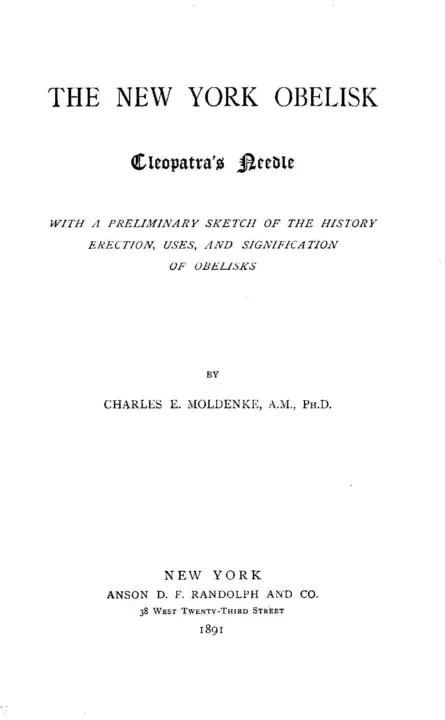
"The New York Obelisk: Cleopatra's Needle" by Charles E. Moldenke is a historical account written in the late 19th century. This work delves into the fascinating history, significance, and particulars surrounding the famous obelisk known as Cleopatra's Needle, which stands in New York City. The author presents the ancient origins of the obelisk, its transportation to America, and its cultural context within ancient Egypt. At the start of the book, Moldenke introduces the reader to the majestic obelisk and the historical backdrop from which it originates. He reflects on the obelisk's journey through time, from its erection by the Pharaohs, the pompous celebrations surrounding its creation, to its survival through invasions and natural deterioration. The opening portion sets a tone of wonder, inviting the reader to explore not just the physical structure of the monument but also the rich historical and societal narratives it embodies.
Introduction adapted from the source catalogue; source summaries may be automatically generated.
Free to read · English · 46,618 words · No account needed
MAKE TIME FOR A GOOD BOOK
On by default. Untick to stop anonymous reading totals. Each page counts after 10 seconds in view. How this works.
Anonymous counting is on unless you have switched it off.
"Beloved of Amen, Nekht-Her-Heb."
NEGATIVE CONFESSION. A passage in the 125th chapter of the Book of the Dead, where the deceased gives an account of his life and begs to be admitted into paradise. To that end he states that he has not committed the forty-two great sins. (^{98})
NEITH. The Egyptian goddess of the lower heavens, the sister of Isis and Nephthys. She is generally represented holding a bow and arrows in her hand. The Greeks identified her with their Athêné (Minerva). In Egyptian her name is [glyphs] NET. ^{92}
NEKHEB. The goddess of Eileithyia and identified by the ancients with their Lucina, the goddess of childbirth. Little is known of her. The Egyptian form of her name is [glyphs] NEKHEB·T. ^{87}
NEKHEB·T. The Egyptian name of Eileithyiapolis, which see. ^{87}
NERO. The fifth Roman emperor [54-68 A. D.]. His full name is Nero Claudius Cæsar Drusus Germanicus. On the Egyptian monuments he is called ^{11}
hez-desher heq-hequ-sotep-en-Ptah-mer-As·t sa Râ Autugreder neb taui neb khâu Narani
The possessor of "The prince of the Sun's the red and white princes, chosen offspring, "Autocrator crowns, lord of the of Ptah, beloved lord of Nero." two countries, of Isis", diadems.
NEW YORK OBELISK. It is usually, but incorrectly, called "Cleopatra's Needle". ^{20 23 25 49 72 73 81 91}
{137}NILE. The ancient Egyptians venerated it as a special deity, giving him the epithet [glyphs] S·ÂNKH, "he who produces life". He was generally represented thus [glyphs], and his name was [glyphs] HÂP. ^{2 4 16 27 84 86 88 90 92}
NILOMETER. This was erected by the Pharaohs on the island of Elephantine, to enable them to measure the height of the inundation. It was restored in 1870 by the Khedive Ishmaël. Another Nilometer is at present on the island of Rhôda at Cairo. The Egyptian sign of the Nilometer is [glyphs] DED, which means "stability". ^{86}
NINEVEH. The capital of the Assyrian empire. It was taken by several Pharaohs in their Asiatic campaigns, especially by Thothmes III., Amenôphis II., and Seti I. ^{36}
NOME. The Greek word for "province". There were 22 nomes in Upper and 20 nomes in Lower Egypt. The Egyptian word is [glyphs] HESP, "the province". ^{84 90}
NUBIA. It is also called Ethiopia, and was incorporated into the Egyptian empire at the time of the XVIIIth dynasty. Its capital was Napata, now Jebel Barkal, which even became the capital of the whole empire during the XXVIth dynasty. The Egyptian name of Nubia is [glyphs] Kush, the biblical [Hebrew: KWSH] [kûsh]. ^{86}
NUBηT. The Egyptian name of Ombos, at present Kôm-Omboo (which see). ^{86}
OASIS. There were seven oases in the Libyan desert, to the west of Egypt. The Egyptian word is [glyphs] UT, "the oasis". ^{89}
OMBOS. The modern Kôm-Omboo, which see. ^{29 86}
Your reading position is saved on this browser. Take it to another device with a library code. Reading pages adapt to text, rather than matching a printed edition.
BEHIND THE BOOK
This eBook is for the use of anyone anywhere in the United States and most other parts of the world at no cost and with almost no restrictions whatsoever. You may copy it, give it away or re-use it under the terms of the Project Gutenberg License included with this eBook or online at www.gutenberg.org. If you are not located in the United States, you will have to check the laws of the country where you are located before using this eBook. Read the source licence.
The original source file, including credits and licence, is retained by this library. Request an original-format copy at no charge. Please include the book title and Project Gutenberg identifier #47273.
KEEP YOUR CURIOSITY GOING
Cécile Tormay

Moritz Busch
John L. Ransom
Frances Wright
Cécile Tormay

Mabel Potter Daggett