THE CLASSIC COLLECTION✦An outlaw’s diary: the CommuneCLASSIC FREE BOOKS
An outlaw’s diary: the Commune
Cécile Tormay
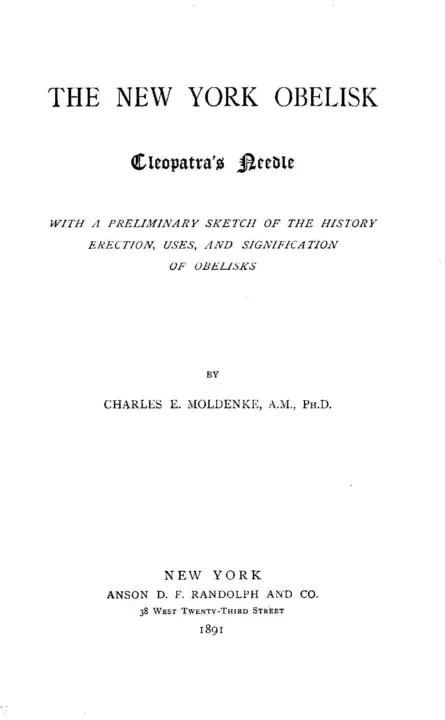
THE CLASSIC COLLECTION · 1891
"The New York Obelisk: Cleopatra's Needle" by Charles E. Moldenke is a historical account written in the late 19th century. This work delves into the fascinating history, significance, and particulars surrounding the famous obelisk known as Cleopatra's Needle, which stands in New York City. The author presents the ancient origins of the obelisk, its transportation to America, and its cultural context within ancient Egypt. At the start of the book, Moldenke introduces the reader to the majestic obelisk and the historical backdrop from which it originates. He reflects on the obelisk's journey through time, from its erection by the Pharaohs, the pompous celebrations surrounding its creation, to its survival through invasions and natural deterioration. The opening portion sets a tone of wonder, inviting the reader to explore not just the physical structure of the monument but also the rich historical and societal narratives it embodies.
Introduction adapted from the source catalogue; source summaries may be automatically generated.
Free to read · English · 46,618 words · No account needed
MAKE TIME FOR A GOOD BOOK
On by default. Untick to stop anonymous reading totals. Each page counts after 10 seconds in view. How this works.
Anonymous counting is on unless you have switched it off.
MENES. According to tradition the first Egyptian king, the founder of the Egyptian empire, and the builder of Memphis. In Egyptian his name is written [glyphs] [glyphs] or [glyphs] (as on the necklace in the possession of the New York Historical Society) SUTEN-KAUT? MENA, "the King of Upper and Lower Egypt, Menes". ^{89}
MEN-KHEPER-RÂ. The royal name of Thothmes III. ^{36 47 48 49 50 52 53 54 55
56 58 59 60}
MENTHU. The Egyptian god of war, identified by the Romans with their Mars. He is usually represented with the head of a hawk surmounted by the disk of the sun and two feathers ([glyphs]). He was only a form {133}of Amen-Râ, and was worshiped in the district round about Thebes. His name in Egyptian is [glyphs] MENTHU. ^{87}
MENZALEH LAKE. A large and shallow tract of water in the north-east corner of Egypt, extending from Damietta to the Suez Canal. ^{92}
MER-AB. A son of Khufu of the fourth dynasty. The architect and builder of the Great Pyramid. ^{5}
MERÌ·T. The Egyptian name of the Mareotis Lake. ^{91}
MER-TUM·T. The Egyptian name of the modern Meydoom, which see. ^{90}
MESOPOTAMIA. "The land between the rivers (Euphrates and Tigris)." The eastern part of ancient Syria [Assyria], called in the Bible Padan-aram or Aram-nahara-yim (Gen. xxiv:10), which means "Aram of the two rivers", whence the Egyptian designation [glyphs] NAHAR. The country was frequently invaded and subjugated by the Egyptian kings, notably by Thothmes III., Amenôphis II., and Seti I. ^{36}
MESPHRES. Pliny's name for Thothmes III. It is in reality, however, the name of his great sister, queen Hatasu, which see. ^{36}
MEYDOOM. Or Meydoon [Mêdûn]. The modern name of the Egyptian [glyphs] MER-TUM·T, "the favorite city of the god Tum", situated in the XXIst nome of Upper Egypt, and famous for its quaintly terraced pyramid, ascribed by Dümichen to king Snefru of the fourth dynasty. ^{90}
MÎTRAHÎNEH. The present site of ancient Memphis. ^{91}
MIZRAYIM. The Hebrew name of Egypt, really "the two Egypts". The Arabic is [Arabic: MSR] [misr]. ^{84}
MNEVIS-BULL. The sacred bull of Heliopolis, the incarnation of Râ. (^{98})
{134}MOERIS LAKE. The so-called lake, or rather reservoir, in the Fayoom, constructed by Amenemhât III. to receive the excess of the waters of the inundation, and keep the water for the times of drought. ^{90}
MONOLITH. A monument made of one stone only. ^{7 18}
MONTE CAVALLO OBELISK. This is at present in front of the Quirinal in Rome, and is the companion of the St^a. Maria Maggiore Obelisk. As it is uninscribed, it is impossible to tell by whom or when it was erected. Perhaps the emperor Claudius [41-54 A. D.] had it removed to Rome. It was re-erected by Pius VI. in 1789. ^{9}
MONTE CITORIO OBELISK, or the Campensis Obelisk, which see. ^{22 25}
Your reading position is saved on this browser. Take it to another device with a library code. Reading pages adapt to text, rather than matching a printed edition.
BEHIND THE BOOK
This eBook is for the use of anyone anywhere in the United States and most other parts of the world at no cost and with almost no restrictions whatsoever. You may copy it, give it away or re-use it under the terms of the Project Gutenberg License included with this eBook or online at www.gutenberg.org. If you are not located in the United States, you will have to check the laws of the country where you are located before using this eBook. Read the source licence.
The original source file, including credits and licence, is retained by this library. Request an original-format copy at no charge. Please include the book title and Project Gutenberg identifier #47273.
KEEP YOUR CURIOSITY GOING
Cécile Tormay

Moritz Busch
John L. Ransom
Frances Wright
Cécile Tormay

Mabel Potter Daggett