THE CLASSIC COLLECTION✦An outlaw’s diary: the CommuneCLASSIC FREE BOOKS
An outlaw’s diary: the Commune
Cécile Tormay
THE CLASSIC COLLECTION · 1891
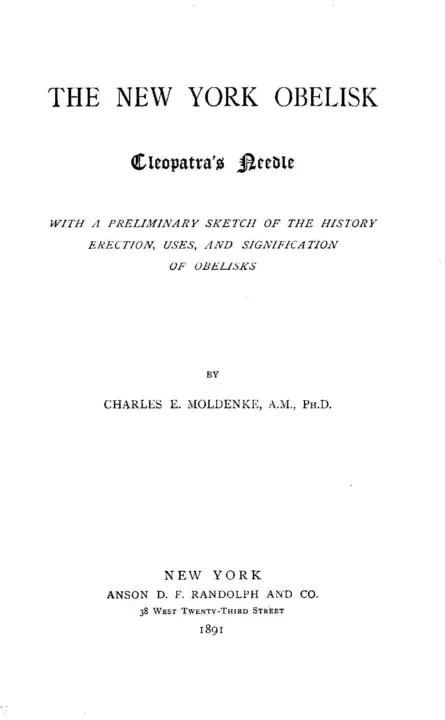
"The New York Obelisk: Cleopatra's Needle" by Charles E. Moldenke is a historical account written in the late 19th century. This work delves into the fascinating history, significance, and particulars surrounding the famous obelisk known as Cleopatra's Needle, which stands in New York City. The author presents the ancient origins of the obelisk, its transportation to America, and its cultural context within ancient Egypt. At the start of the book, Moldenke introduces the reader to the majestic obelisk and the historical backdrop from which it originates. He reflects on the obelisk's journey through time, from its erection by the Pharaohs, the pompous celebrations surrounding its creation, to its survival through invasions and natural deterioration. The opening portion sets a tone of wonder, inviting the reader to explore not just the physical structure of the monument but also the rich historical and societal narratives it embodies.
Introduction adapted from the source catalogue; source summaries may be automatically generated.
Free to read · English · 46,618 words · No account needed
MAKE TIME FOR A GOOD BOOK
On by default. Untick to stop anonymous reading totals. Each page counts after 10 seconds in view. How this works.
Anonymous counting is on unless you have switched it off.
[glyphs] RENPE·TU. Noun, plural of RENPE·T "year", hence: "years". E SOUTH ^{61} W SOUTH ^{68}
[glyphs] REKH. Verb: "to know, understand". E CENT. ^{56}
[glyphs] Same word as the preceding: "to know, understand". S EAST ^{65}
[glyphs] H
[glyphs] HAPU. Noun, plural of hap "law, judgment", hence: "laws". S
EAST ^{65}
[glyphs] HAR. Adj.: "calm, satisfied, glad". N CENT. ^{60}
[glyphs] H
[glyphs] HÂU. Noun, plural of HÂ "limb", hence: "limbs". {184}E CENT.
^{56}
[glyphs] HU. Verb: "to smite, strike". N CENT. ^{60}
[glyphs] HEB. Noun: "festival, feast". S EAST ^{65}
[glyphs] HEBU. Plural of the preceding word: "festivals". N EAST ^{69}
[glyphs] HEB. Noun: "festival". In the phrase SED-HEB "the thirty-year period". S CENT. ^{58}
[glyphs] HUN. Noun: "child, boy, youth". E NORTH ^{62}
[glyphs] HENÂ. Prep.: "with". E CENT. ^{57}
[glyphs] HER. Noun: "face". N WEST ^{70}
[glyphs] HER. "Horus" with the double crown of Egypt. E NORTH ^{62} CENT. ^{56} SOUTH ^{63} S EAST ^{65} CENT. ^{58} WEST ^{66} W NORTH ^{67} CENT. ^{59} SOUTH ^{68} N EAST ^{68} CENT. ^{60} WEST ^{70}
[glyphs] See under RÂ-HOR-KHUTI.
[glyphs] HER-NUB. "The golden Horus." E SOUTH ^{64} W SOUTH ^{68} N CENT.
^{60}
[glyphs] See under NEHEH. E CENT. ^{56}
[glyphs] HEQ. Noun: "prince, chief". PYR. SOUTH ^{51} WEST ^{52}
[glyphs] HEQU. Plural of the preceding word: "princes, chiefs". N CENT.
^{60}
{185}[glyphs] HA·T. Noun: "temple". PYR. SOUTH ^{51} WEST ^{53}
[glyphs] HA·T-Â. From the preceding word with the adjective  "great", hence: "the great temple". E CENT. ^{56}
[glyphs] HEZ. Adj.: "white". Noun: "the white crown" of Upper Egypt. N
CENT. ^{60}
[glyphs] KH
[glyphs] KHÂ. Adj.: "glorious, crowned". E CENT. ^{56} W CENT. ^{59} PYR. EAST ^{48} SOUTH ^{50} WEST ^{53} NORTH ^{55}
[glyphs] KHÂU. Noun, plural of KHÂ "crown", hence: "diadems, crowns". E
SOUTH ^{64}
[glyphs] KHU. Verb, &c.: "to be glorious; resplendent; glory, splendor". E NORTH ^{63} SOUTH ^{64}
[glyphs] KHU·T. Noun: "horizon". E NORTH ^{62}
[glyphs] KHUTI. Dual of the preceding word: "the two horizons". See under
RÂ-HOR-KHUTI.
[glyphs] KHEPERA. The god "Khepera", literally "the creator". E SOUTH
^{63}
[glyphs] KHEPESH. Noun: "strength, power, victory". N CENT. ^{60}
[glyphs] KHER. Conj. and prep.: "for". E CENT. ^{56}
[glyphs] KHERP-KHEPER-RÂ-SOTEP-EN-RÂ. The first cartouche or the royal name of Osarkon I., {186}"made governor by Ra, chosen of Ra". SMALL SIDE INSCRIPTIONS E ^{72 72} S ^{72 72} W ^{72 72} N 72 72
[glyphs] KHA·T. Noun: "belly, womb". E CENT. ^{56}
[glyphs] KHA·T. Same word as the preceding: "belly, womb". E SOUTH ^{64}
[glyphs] KHET. Noun: "thing; things". PYR. NORTH ^{54}
[glyphs] KHATF. Prep. and conj.: "for, before; since, because". N CENT.
^{60} WEST ^{70}
[glyphs] S
[glyphs] SA. Noun: "son, child, offspring". E NORTH ^{62 62} CENT. ^{56} SOUTH ^{64 64} S EAST ^{65 65} CENT. ^{58} WEST ^{66 66} W NORTH ^{67 67} CENT. ^{59} SOUTH ^{68 68} N EAST ^{69 69} CENT. ^{61} WEST ^{70 70} PYR. EAST ^{48} SOUTH ^{50} WEST ^{53} NORTH ^{55} SMALL SIDE INSCRIPTIONS E ^{72 72} S ^{72 72} W ^{72 72} N ^{72 72}
[glyphs] SA. Same word as the preceding: "son, child, offspring". E SOUTH ^{63} S WEST ^{66} W SOUTH ^{68} N WEST ^{70}
Your reading position is saved on this browser. Take it to another device with a library code. Reading pages adapt to text, rather than matching a printed edition.
BEHIND THE BOOK
This eBook is for the use of anyone anywhere in the United States and most other parts of the world at no cost and with almost no restrictions whatsoever. You may copy it, give it away or re-use it under the terms of the Project Gutenberg License included with this eBook or online at www.gutenberg.org. If you are not located in the United States, you will have to check the laws of the country where you are located before using this eBook. Read the source licence.
The original source file, including credits and licence, is retained by this library. Request an original-format copy at no charge. Please include the book title and Project Gutenberg identifier #47273.
KEEP YOUR CURIOSITY GOING
Cécile Tormay

Moritz Busch
John L. Ransom
Frances Wright
Cécile Tormay

Mabel Potter Daggett