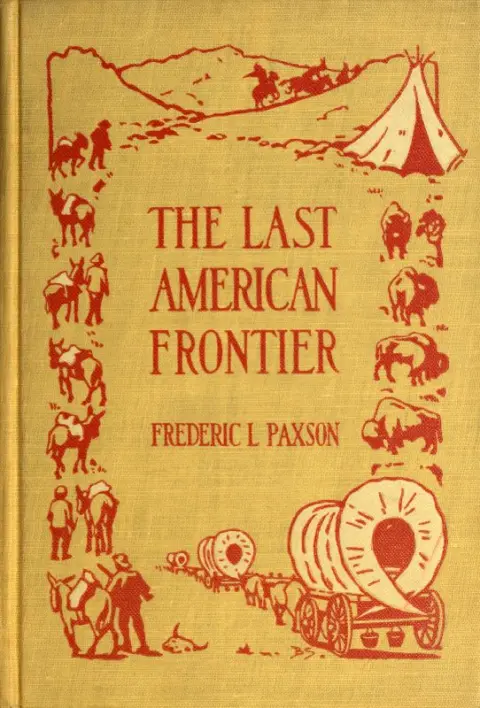
The Last American Frontier
Frederic L. (Frederic Logan) Paxson
THE CLASSIC COLLECTION · 1912
"The New Nation" by Frederic L. Paxson is a historical account written in the early 20th century. The book explores the profound changes that occurred in the United States following the Civil War, addressing the political, economic, and social transformations that shaped the nation during that period. Paxson examines how the nation's identity evolved amidst post-war reconstruction, financial upheaval, and the rise of industrial society, providing insights into the shifting dynamics between state and federal authority. The opening of "The New Nation" discusses the aftermath of the Civil War, emphasizing the complexity of the political landscape and the challenges faced by the United States in maintaining unity and governance. Paxson highlights the rise of the Republican Party and the efforts of leaders like Abraham Lincoln to foster a cohesive national identity while navigating the political turmoil of the time. The text delves into the implications of economic advancements and the changing social fabric, setting the stage for a broader analysis of how these elements defined the American experience in the decades that followed.
Introduction adapted from the source catalogue; source summaries may be automatically generated.
Free to read · English · 87,263 words · No account needed
MAKE TIME FOR A GOOD BOOK
On by default. Untick to stop anonymous reading totals. Each page counts after 10 seconds in view. How this works.
Anonymous counting is on unless you have switched it off.
The great labor problem before the Civil War had been that of getting enough laborers and meeting the competition which the abundant free lands of the West had offered. Labor organizations and strikes had been so unusual that public opinion had not yet come to regard them as normal features of society. But the manufacturing development of the sixties in iron and steel, in textiles, and in other machine industries, threw workmen together in increasing number, taught them their interests as a class, and set the scene for an outbreak of strikes when the shops shut down or reduced wages in the depression of the seventies. About 1877 these strikes shocked society by their violence. Neither had the public been educated to the strike itself, nor the labor leaders to that moderation, without which public sympathy cannot be retained or strikes won. A feeling adverse to organized labor swept the country and endangered the existence of the labor movement.
(Table and Diagram based upon Thirteenth Census, 1910, Population,
Vol. 1, pp. 129, 130.)
Total Foreign
Population. and Mixed Foreign Born.
Parentage.
1910 91,972,266 18,897,837 13,345,545 1900 75,994,575 15,646,017 10,213,817 1890 62,947,714 11,503,675 9,121,867 1880 50,155,783 8,274,867 6,559,679 1870 39,818,449 5,324,268 5,493,712 1860 31,443,321 4,096,753 1850 23,191,876 2,240,535
The Knights of Labor received the heaviest weight of disfavor. This was an industrial union, founded in 1869, embracing labor of all trades, and held together by a secret organization. Dismissal so often followed admitted membership in a union that secrecy was defensible, but secrecy mystified and frightened the public. The policy of secrecy was abandoned in 1882, after the excesses of the "Molly Maguires" had brought discredit upon all organized labor. Under the leadership of Grand Master Workman Powderly the Knights carried on an open and aggressive campaign of education for labor and inspection laws throughout the Union. The American Federation of Labor, founded in 1881 and reorganized in 1886, aided in this general work, and with the Knights helped to reconcile the public to the principle of unionism.
State bureaus of labor appeared in many States as the result of the general agitation. An eight-hour law, for federal employees, had been gained in 1868, while in 1884 a Commissioner of Labor was created in the Department of the Interior. Arthur was urged to give the post to Powderly, but selected instead an economist less actively identified with the propaganda, Carroll D. Wright, under whose direction the Bureau grew steadily in importance. Its reports became quarries for statistical information on the labor problem, and its success justified its incorporation in the new Department of Commerce and Labor in 1903.
Your reading position is saved on this browser. Take it to another device with a library code. Reading pages adapt to text, rather than matching a printed edition.
Frederic L. (Frederic Logan) Paxson
BEHIND THE BOOK
This eBook is for the use of anyone anywhere in the United States and most other parts of the world at no cost and with almost no restrictions whatsoever. You may copy it, give it away or re-use it under the terms of the Project Gutenberg License included with this eBook or online at www.gutenberg.org. If you are not located in the United States, you will have to check the laws of the country where you are located before using this eBook. Read the source licence.
The original source file, including credits and licence, is retained by this library. Request an original-format copy at no charge. Please include the book title and Project Gutenberg identifier #27953.
KEEP YOUR CURIOSITY GOING
Cécile Tormay

Moritz Busch
John L. Ransom
Frances Wright
Cécile Tormay

Mabel Potter Daggett