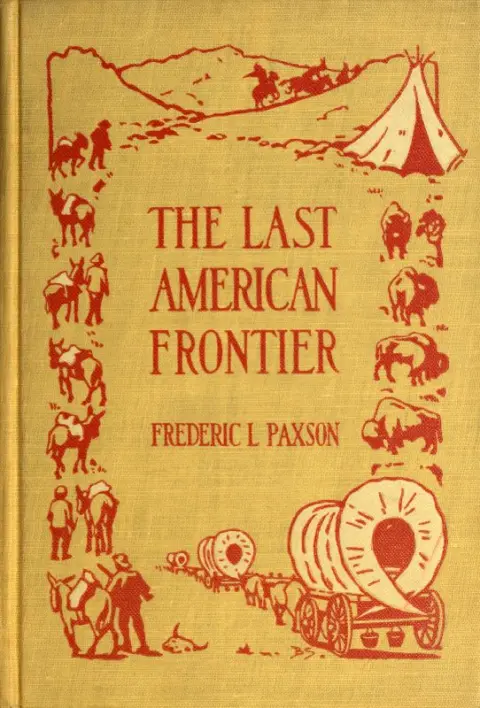
The Last American Frontier
Frederic L. (Frederic Logan) Paxson
THE CLASSIC COLLECTION · 1912
"The New Nation" by Frederic L. Paxson is a historical account written in the early 20th century. The book explores the profound changes that occurred in the United States following the Civil War, addressing the political, economic, and social transformations that shaped the nation during that period. Paxson examines how the nation's identity evolved amidst post-war reconstruction, financial upheaval, and the rise of industrial society, providing insights into the shifting dynamics between state and federal authority. The opening of "The New Nation" discusses the aftermath of the Civil War, emphasizing the complexity of the political landscape and the challenges faced by the United States in maintaining unity and governance. Paxson highlights the rise of the Republican Party and the efforts of leaders like Abraham Lincoln to foster a cohesive national identity while navigating the political turmoil of the time. The text delves into the implications of economic advancements and the changing social fabric, setting the stage for a broader analysis of how these elements defined the American experience in the decades that followed.
Introduction adapted from the source catalogue; source summaries may be automatically generated.
Free to read · English · 87,263 words · No account needed
MAKE TIME FOR A GOOD BOOK
On by default. Untick to stop anonymous reading totals. Each page counts after 10 seconds in view. How this works.
Anonymous counting is on unless you have switched it off.
Cleveland, Grover, Mayor of Buffalo and Governor of New York, 130;
favored by the Independents, 130, 131;
nominated for Presidency, 131;
his character attacked, 132;
elected and inaugurated, 133;
his Cabinet, 133;
Lowell's tribute to, 134;
meets new problems, 135;
vetoes pension bills, 137;
troubled by divided administration, 138, 139, 140;
signs "omnibus" bill for new States, 152;
his emphasis on tariff reduction, 169;
renominated, 170;
defeated by Harrison, 171;
again nominated for Presidency, 214, 215;
and elected, 215;
opposes free silver and the silver basis, 219, 229, 230;
loses influence with Western Democrats, 220;
refuses to sign Wilson Bill, 221;
sends federal troops to Chicago, 221, 222;
splits Democratic party, 223;
in Venezuela boundary dispute, 230, 231;
abandoned by his party, 235;
dies in Princeton, 236;
tries to maintain neutrality in Cuban revolt, 261, 262.
Cobden Club, and British gold, 139.
Coin's Financial School, 229.
Colfax, Schuyler, Vice-President with Grant, 37, 57, 61.
Colorado, Territory, 20;
becomes a State, 73, 74, 149.
Commissioner of Labor, 122.
Conkling, Roscoe, 81, 87;
disciplined by Hayes, 98;
fights for Grant, 99;
resigns from Senate, 103.
Conservation movement, 320, 328.
Consumers' League, the, 250.
Cooke, Jay, his connection with panic of 1873, 62, 63, 64.
Cornell, Alonzo B., 98, 103.
Cortelyou, George B., 302, 306.
Cotton, the staple crop of the Old South, 149;
hundredth anniversary of first export celebrated, 203;
overproduction, 204.
Cowboys, develop a folk-song literature, 150.
Coxey, Jacob S., 222.
Credit Mobilier, scandal of, 61.
Cripple Creek, great miners' strike at, 301.
Crisp, Charles F., 186, 220.
Cuba, insurrections in, 258;
revolutionary government in New York, 260;
number of Spanish troops in, 260;
filibustering parties, 261;
Congress favors recognition of belligerency, 262;
autonomy proposed, 263;
Congress recognizes independence of, 264;
blockaded, 267, 268;
freed from Spain, 273;
sanitary improvement in, 282;
adopts a constitution, 282;
makes reciprocity treaty with United States, 283.
Cullom, Shelby M., 158, 221.
Cummins, Gov. Albert B., 303;
leader of Insurgent Republicans, 329.
Curtis, George William, leader in civil-service reform, 112, 128;
a Mugwump, 129.
Custer, Gen. George A., 86.
Czar of Russia, calls conference on disarmament, 283.
Dakota Territory, 21;
made into two States, 152.
Darwin, Charles, his influence on religious thought, 190.
Davenport, Homer C., 252.
Davis, Judge David, 109.
Davis, Henry G., 306.
Davis, Jefferson, 83, 106.
Dawes Act, the, awarding lands to Indians in severalty, 142, 151, 319.
Day, William R., 253, 273.
Debs, Eugene V., 222;
Social Democratic candidate for President, 301, 338.
De Lesseps, Ferdinand M., 144.
DeLome, Senor, criticizes McKinley, 263, 264.
Democratic party, the, differences in, during the Civil War, 2, 3;
Chicago convention (1864), 4, 5;
nominates Seymour (1868), 31;
gains control of readmitted Southern States, 52, 54;
nominates Greeley (1872), 57;
weakened by its past, 79;
nominates Tilden (1876), 80, 81;
gets plurality of popular vote, 83;
gains control of the House (1874), 87;
nominates Hancock (1880), 99;
gains the Senate (1878), 108;
loses the House (1880), 108;
regains it (1882), 117;
elects Cleveland (1884), 130-133;
on tariff revision, 138, 220, 221;
resists demands for statehood, 152;
casts plurality of votes in 1888, but loses all branches of government, 171;
regains the House (1890), 186;
reelects Cleveland and wins the Senate (1892), 215;
split by free silver and tariff questions, 228, 229, 232;
loses both Senate and House (1894), 229;
nominates Bryan on free-silver platform (1896), 237;
denounces imperialism and renominates Bryan (1900), 279;
nominates Parker on conservative platform (1904), 305, 306;
nominates Bryan for third time (1908), 325;
regains the House (1910), 329, 330;
elects Wilson (1912), 337, 338.
Department of Agriculture, 142, 157.
Department of Commerce and Labor, 122, 302.
Dependent Pension Act, 174.
Dewey, Commodore George, 265;
destroys Spanish fleet at Manila, 267.
Your reading position is saved on this browser. Take it to another device with a library code. Reading pages adapt to text, rather than matching a printed edition.
Frederic L. (Frederic Logan) Paxson
BEHIND THE BOOK
This eBook is for the use of anyone anywhere in the United States and most other parts of the world at no cost and with almost no restrictions whatsoever. You may copy it, give it away or re-use it under the terms of the Project Gutenberg License included with this eBook or online at www.gutenberg.org. If you are not located in the United States, you will have to check the laws of the country where you are located before using this eBook. Read the source licence.
The original source file, including credits and licence, is retained by this library. Request an original-format copy at no charge. Please include the book title and Project Gutenberg identifier #27953.
KEEP YOUR CURIOSITY GOING
Cécile Tormay

Moritz Busch
John L. Ransom
Frances Wright
Cécile Tormay

Mabel Potter Daggett