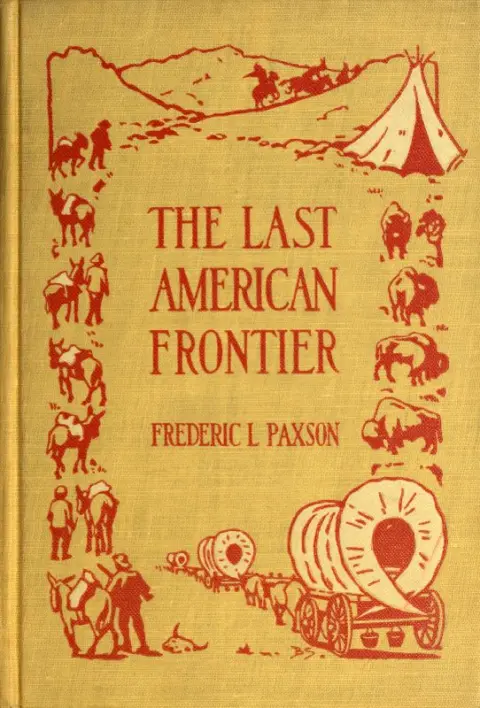
The Last American Frontier
Frederic L. (Frederic Logan) Paxson
THE CLASSIC COLLECTION · 1912
"The New Nation" by Frederic L. Paxson is a historical account written in the early 20th century. The book explores the profound changes that occurred in the United States following the Civil War, addressing the political, economic, and social transformations that shaped the nation during that period. Paxson examines how the nation's identity evolved amidst post-war reconstruction, financial upheaval, and the rise of industrial society, providing insights into the shifting dynamics between state and federal authority. The opening of "The New Nation" discusses the aftermath of the Civil War, emphasizing the complexity of the political landscape and the challenges faced by the United States in maintaining unity and governance. Paxson highlights the rise of the Republican Party and the efforts of leaders like Abraham Lincoln to foster a cohesive national identity while navigating the political turmoil of the time. The text delves into the implications of economic advancements and the changing social fabric, setting the stage for a broader analysis of how these elements defined the American experience in the decades that followed.
Introduction adapted from the source catalogue; source summaries may be automatically generated.
Free to read · English · 87,263 words · No account needed
MAKE TIME FOR A GOOD BOOK
On by default. Untick to stop anonymous reading totals. Each page counts after 10 seconds in view. How this works.
Anonymous counting is on unless you have switched it off.
The congressional election of 1914 was profoundly affected by the European war. Early in the year it appeared that conservative opposition to the Democratic program was growing, and that the Democratic majority was likely to be cut down. The Progressive party appeared to be weakening, and the control of the Republican party was settling back among those Republicans against whom the Insurgents had made their protest. But President Wilson's precise neutrality won the confidence of all parties, and although conservatives like Cannon, of Illinois, and Penrose, of Pennsylvania, won over Democrats and Progressives alike in a few cases, he retained for the Sixty-fourth Congress a working majority in the House and an enlarged majority in the Senate. His election in 1912 had been, in part, due to the dispersion of Republican strength caused by the Progressive schism; in 1914, the influence of the Progressives was negligible and the Democrats retained their power in the face of the whole Republican attack.
Between 1909 and 1914, the Outlook, to which Theodore Roosevelt had been an occasional contributor, and which had been a strong supporter of Republican policies since 1898, was the regular organ through which Mr. Roosevelt addressed the public, over his signature as Contributing Editor. In a similar way William J. Bryan reached his followers through the Commoner (1900-), and Robert M. LaFollette through his LaFollette's Weekly (1909-). Collier's Weekly became a center of the adverse criticism of President Taft. All of these, as well as the more general periodicals, are indispensable sources for the period, but are so highly partisan as to need constant correction for prejudice. The election of 1908 is treated in Stanwood's History of the Presidency from 1897 to 1909, while that of 1912 is excellently described in the New International Year Book for 1912. The theories of the new nationalism are in T. Roosevelt, The New Nationalism (1910).
Adams, Charles Francis, 55, 56.
Agricultural colleges, beginning of, 17.
Agriculture, changes in, 14, 15;
in the South after the War, 39, 40;
Department of, created, 142, 157;
main reliance of Western pioneers, 149, 151;
discontent in North and West, 178, 179, 184;
depression of, in South, 195;
diversified by decline of cotton values, 204, 205.
Aguinaldo, Emilio, 267, 278.
Alabama Claims, the, 55, 56.
Alaska, gold mines in, 241;
settlement of boundary, 284, 285.
Aldrich, Nelson W., 118, 326.
Algeciras, United States in conference at, 318.
Alger, Russell A., 253, 274.
Allison, William B., 89, 255.
Altgeld, Gov. John P., 222, 279.
Alverstone, Lord Chief Justice, 285, 286.
Amendment, the Thirteenth, 33, 42, 48.
Amendment, the Fourteenth, 42, 43, 48, 196, 197.
Amendment, the Fifteenth, 46, 47, 48, 196, 198.
American diplomacy, 286.
American Federation of Labor, 121, 183, 208.
American Railroad Union, 222.
Ames, Adelbert, 47.
Angell, James B., 60.
Anti-Contract Labor Law, 135.
Anti-imperialism, 278, 279.
Anti-monopolists, 168, 169.
Anti-trust literature, 166.
Arbitration, 255, 256;
treaties refused by Senate, 331, 332.
Arizona, a Territory, 21, 152, 154;
becomes a State, 330.
Army of the United States, at outbreak of Spanish War, 266;
in poor condition during the war, 269-72, 274;
later service in Cuba, 282.
Arrears of Pension Act, 137.
Your reading position is saved on this browser. Take it to another device with a library code. Reading pages adapt to text, rather than matching a printed edition.
Frederic L. (Frederic Logan) Paxson
BEHIND THE BOOK
This eBook is for the use of anyone anywhere in the United States and most other parts of the world at no cost and with almost no restrictions whatsoever. You may copy it, give it away or re-use it under the terms of the Project Gutenberg License included with this eBook or online at www.gutenberg.org. If you are not located in the United States, you will have to check the laws of the country where you are located before using this eBook. Read the source licence.
The original source file, including credits and licence, is retained by this library. Request an original-format copy at no charge. Please include the book title and Project Gutenberg identifier #27953.
KEEP YOUR CURIOSITY GOING
Cécile Tormay

Moritz Busch
John L. Ransom
Frances Wright
Cécile Tormay

Mabel Potter Daggett