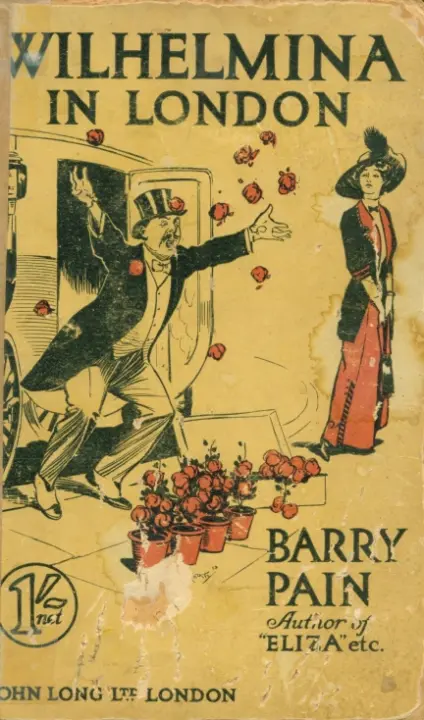
The Problem Club
Barry Pain
THE CLASSIC COLLECTION · 1913
"The New Gulliver, and Other Stories" by Barry Pain is a collection of fictional narratives likely written in the late 19th century. The stories explore themes of adventure, society, and the human experience, centering on the character Lemuel Gulliver, junior, who embarks on a journey filled with fantastical encounters in an island that challenges his perceptions of civilization. At the start of the tale, Gulliver, a shipwrecked mariner, finds himself washed ashore on the mysterious Island of Thule. His initial encounter with a peculiar humanoid being, who introduces him to the island's unique societal structure, sets the stage for his exploration of a civilization that has evolved in bizarre and unconventional ways. As Gulliver navigates his new surroundings, he learns about the inhabitants' bizarre customs, such as their complete abolition of sex and reliance on pills for nourishment, raising questions about the implications of their highly controlled and sterile society. The narrative develops into a compelling commentary on the nature of progress, the implications of a class-based society, and the existential challenges faced by the characters intertwined in this strange world.
Introduction adapted from the source catalogue; source summaries may be automatically generated.
Free to read · English · 57,015 words · No account needed
MAKE TIME FOR A GOOD BOOK
On by default. Untick to stop anonymous reading totals. Each page counts after 10 seconds in view. How this works.
Anonymous counting is on unless you have switched it off.
There stood a very ugly old pedlar with a leer on his face, and a pack on his back. He swung his pack round and took off the piece of American cloth from the top of it.
"And what can I sell you to-day, my pretty lady?" he asked.
"Nothing, thank you," said Rose.
"Don't say that," said the pedlar. "You have dealt with me before, you
know."
"Never," said Rose. "You are mistaken."
"Yes, you did," said the ugly old man stoutly. "You bought a packet of Amoricide, and those that deal with me once must deal with me again."
"What is Amoricide?" asked Rose, who began to have a feeling that after all she did recognise the pedlar's face.
"Well, well," said the pedlar, "that's telling. I don't mind owning that there is a lot of the Air of Superiority in it, and there are other things. You have no complaint to make about it, have you? It does its work all right. I guarantee that it will exterminate love absolutely. It is death to love. Have you not found it so?"
"I have found," said Rose, "that it has destroyed the love of others for me, but not the love of me for others."
The old man chuckled. "That's it. That's right. That's why the people who deal with me once must deal with me again. You must have one more little packet."
"This time I want to know what is in it."
The pedlar began to look uneasy. "Don't ask too many questions. We call it Taedium Vitae. It is a splendid thing."
Rose was highly educated, and she told him that Taedium Vitae meant life-weariness, and that she would like to know how it acted.
"You go down the hill," said the old man absent-mindedly, as if he were speaking to himself, "and then, of course, you come to the pine wood."
Rose nodded. "Yes, I know it. Through the wood is the short cut if you are going to the station. The stile is rather awkward to climb over."
"You can manage it all right. You have done it before. And you know the dark pool under the trees?"
Rose nodded. This time she did not speak.
"That's another short cut," said the old man with a chuckle. "It's soon over. The sensation of drowning is said to be quite pleasant. Then there is no more trouble--no more worrying because you have lost love, and because life has lost its savour."
Rose was rather frightened. "When do I pay you?" she asked in a husky
whisper.
"That's all right," said the old man ingratiatingly. "You don't pay me till afterwards. We give credit."
"Afterwards?"
Your reading position is saved on this browser. Take it to another device with a library code. Reading pages adapt to text, rather than matching a printed edition.
BEHIND THE BOOK
This eBook is for the use of anyone anywhere in the United States and most other parts of the world at no cost and with almost no restrictions whatsoever. You may copy it, give it away or re-use it under the terms of the Project Gutenberg License included with this eBook or online at www.gutenberg.org. If you are not located in the United States, you will have to check the laws of the country where you are located before using this eBook. Read the source licence.
The original source file, including credits and licence, is retained by this library. Request an original-format copy at no charge. Please include the book title and Project Gutenberg identifier #33542.
KEEP YOUR CURIOSITY GOING
Coulson Kernahan

Maurice Baring
Frances Wright
Cécile Tormay
Francis Greenleaf Allinson & Anne C. E. (Anne Crosby Emery) Allinson

Frederic Jesup Stimson