THE CLASSIC COLLECTION✦An outlaw’s diary: the CommuneCLASSIC FREE BOOKS
An outlaw’s diary: the Commune
Cécile Tormay
THE CLASSIC COLLECTION · 1922
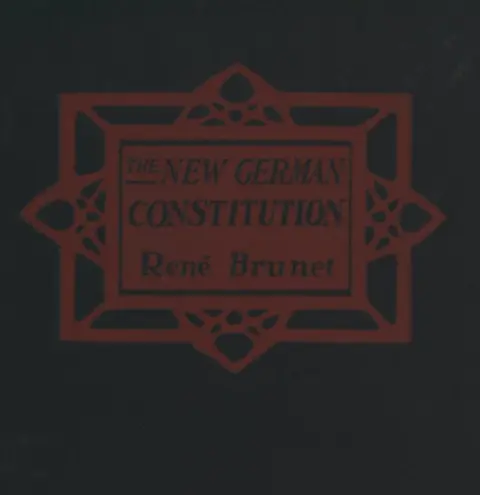
"The New German Constitution" by René Brunet is a scholarly examination of the German constitutional changes following World War I, written in the early 20th century. This treatise delves into the political upheaval that led to the establishment of the Weimar Republic, highlighting the transition from the imperial structure to a more democratic system characterized by a conflict of political forces. Brunet, a professor of constitutional law, offers a systematic analysis of the new government framework shaped by social, economic, and political pressures following the abdication of the monarchy. The beginning of the work outlines the profound impacts of the November 1918 revolution, which dismantled the old imperial regime and ushered in a new governmental structure. Brunet emphasizes the tumultuous journey from the previous Constitution of 1871 to the revolutionary changes that ultimately resulted in the creation of the Weimar Constitution. He notes the struggle between socialist factions within the newly formed Workers' and Soldiers' Councils and the Social Democrats, who sought to draft a more democratic and representative constitution. Through this exploration, the opening chapters set the stage for a detailed discussion on the complexities of the constitutional process and the nature of political power in post-war Germany.
Introduction adapted from the source catalogue; source summaries may be automatically generated.
Free to read · English · 107,459 words · No account needed
MAKE TIME FOR A GOOD BOOK
On by default. Untick to stop anonymous reading totals. Each page counts after 10 seconds in view. How this works.
Anonymous counting is on unless you have switched it off.
I.--Women already voted in January, 1919, at the elections for the National Assembly. They voted in considerable numbers. Of the women eligible to vote 83 per cent did so. The percentage among the men was 82.4, which is approximately the same as the women. But this equality disappears when we consider the proportion according to the ages of those voting. Among the male electors twenty years old only 59.6 per cent voted; whereas among the women of the same age 80.5 per cent voted. Thus the young women seemed twice as zealous to use the new privileges that had been accorded to both. Of the electors from twenty-one to twenty-five years old, 70 per cent of the men and 80.9 per cent of the women voted. But the statistics change when we come to the older groups. Past the age of twenty-five it was 84.8 per cent of men that voted, and only 82.6 per cent of women.
At the elections of June, 1921, fewer women seemed to have voted than the year before, and this time it was the men who proportionally voted in larger numbers.
But in 1920 there was tried an experiment in several districts which had not been done in 1919. The men and women of these districts voted in separate polling places, in order to determine their respective strength in the various parties. We will cite, among other facts, two instances obtained in cities of differing political complexion.
In Cologne 119,263 men and 110,364 women voted in the sections in which this experiment was carried out. The vote was distributed as follows:
Centre 32,964 men 49,154 women
Social Democrats 36,295 “ 24,134 “
People’s Party 17,768 “ 15,944 “
Independents 18,245 “ 8,973 “
Democrats 6,554 “ 4,677 “
German Nationals 3,190 “ 3,422 “
In Spandau 23,294 men voted and 23,359 women. Out of every 100 men and 100 women the different parties receive the following proportion:
Independents 35.4 men 32.6 women
Social Democrats 21.3 “ 19.3 “
German Nationals 12.8 “ 16.7 “
People’s Party 12.5 “ 14.5 “
Democrats 8.3 “ 7.5 “
Communists 6.3 “ 4.2 “
Centre 3.2 “ 5.0 “
Other parties .2 “ .2 “
Thus in the two districts women voted more for the Centre and the parties
of the Right.
Of the total vote cast for the Independent Socialist Party 33 per cent were women. In the Social Democratic party the proportion rose to 40 per cent. For the parties of the Right the percentage was 52. Whereas of the Centre women comprised 60 per cent.
The newspapers of the Left noted bitterly this irony of history, that it is precisely the parties that have always been against woman suffrage that are most strongly supported by women.
II.--The application of the automatic system has had several interesting
results.
Throughout Germany there were cast 26,017,590 votes. This gave the
Reichstag 466 members. The votes and the seats were distributed as
follows:
Parties Votes Seats
Social Democrats 5,614,456 112
Centre 3,540,830 68
Democrats 2,202,394 45
German Nationals 3,736,778 66
People’s Party 3,606,316 62
Independents 4,895,317 81
Communists 441,995 2
Bavarian Peasants’ Union 218,884 4
Guelphs 319,100 5
Christian Federalists 1,171,722 21
Your reading position is saved on this browser. Take it to another device with a library code. Reading pages adapt to text, rather than matching a printed edition.
BEHIND THE BOOK
This eBook is for the use of anyone anywhere in the United States and most other parts of the world at no cost and with almost no restrictions whatsoever. You may copy it, give it away or re-use it under the terms of the Project Gutenberg License included with this eBook or online at www.gutenberg.org. If you are not located in the United States, you will have to check the laws of the country where you are located before using this eBook. Read the source licence.
The original source file, including credits and licence, is retained by this library. Request an original-format copy at no charge. Please include the book title and Project Gutenberg identifier #54957.
KEEP YOUR CURIOSITY GOING
Cécile Tormay

Moritz Busch
John L. Ransom
Frances Wright
Cécile Tormay

Mabel Potter Daggett