
Letters to a Friend, Written to Mrs. Ezra S. Carr, 1866-1879
John Muir
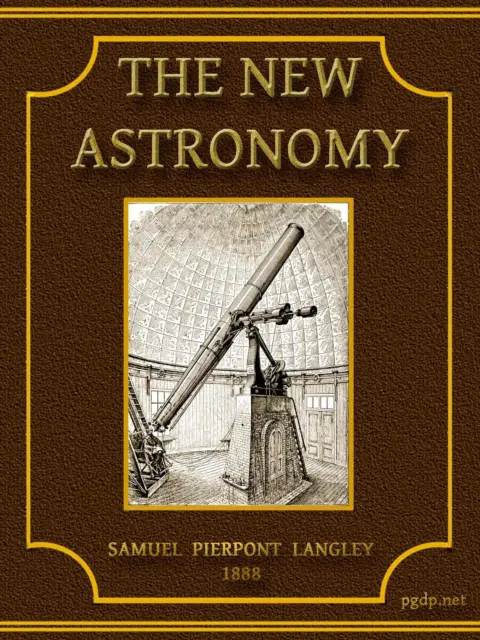
THE CLASSIC COLLECTION · 1884
"The New Astronomy" by S. P. Langley is a scientific publication written in the late 19th century. The work explores the evolving field of astronomy, particularly the new discoveries around solar and celestial physics, which extend our understanding of the sun, stars, and their effects on Earth. Langley aims to engage educated readers with this emerging scientific landscape, rather than solely addressing professional astronomers. The opening of the book sets a broad context for the development of astronomy, contrasting ancient practices, like those observed at Stonehenge, with modern techniques used in observatories such as Greenwich and Washington. Langley introduces the concept of "the New Astronomy" - a branch focused not only on measurements of celestial bodies but also on their physical nature and implications for life on Earth. He discusses early sunspot observations and hints at the complex dynamics of the sun's surface, setting the stage for deeper explorations of solar features like the corona and chromosphere in subsequent chapters.
Introduction adapted from the source catalogue; source summaries may be automatically generated.
Free to read · English · 60,787 words · No account needed
MAKE TIME FOR A GOOD BOOK
On by default. Untick to stop anonymous reading totals. Each page counts after 10 seconds in view. How this works.
Anonymous counting is on unless you have switched it off.
May we not receive even the teachings of science, as to the “Laws of Nature,” with the constant memory that all we know, even from science itself, depends on our very limited sensations, our very limited experience, and our still more limited power of conceiving anything for which this experience has not prepared us?
I have read somewhere a story about a race of ephemeral insects who live but an hour. To those who are born in the early morning the sunrise is the time of youth. They die of old age while his beams are yet gathering force, and only their descendants live on to midday; while it is another race which sees the sun decline, from that which saw him rise. Imagine the sun about to set, and the whole nation of mites gathered under the shadow of some mushroom (to them ancient as the sun itself) to hear what their wisest philosopher has to say of the gloomy prospect. If I remember aright, he first told them that, incredible as it might seem, there was not only a time in the world’s youth when the mushroom itself was young, but that the sun in those early ages was in the eastern, not in the western, sky. Since then, he explained, the eyes of scientific ephemera had followed it, and established by induction from vast experience the great “Law of Nature,” that it moved only westward; and he showed that since it was now nearing the western horizon, science herself pointed to the conclusion that it was about to disappear forever, together with the great race of ephemera for whom it was created.
What his hearers thought of this discourse I do not remember, but I have heard that the sun rose again the next morning.
Abbe, Professor, 56.
Actinism, 71.
Adams, Professor, 195.
Africa, 116.
Ages, stellar, 238.
Air:
dancing, 17;
a medium, 33;
continuous, 176;
rarefied, 179;
motes, 181;
nimble, 191.
(See Atmosphere.)
Airless Mountains, 160.
Air-wave, 185.
Aitken’s Researches, 181.
Alaska, 38.
Aldebaran, 222, 235, 236, 246.
Algot, 228.
Allegheny Observatory, 17, 19, 84, 86.
(See Langley.)
Alphonsus Ring-plain, 156.
Alps, 39, 148, 151, 167, 181.
(See Apennines, Lunar.)
American Astronomers, 227.
American Continents, 20, 21, 31.
(See South.)
Andalusia, 53.
Animalculæ, 224.
Animals:
food, 74;
fright, 42.
(See Dog.)
Antares, 238.
Ants, 223.
(See Insects.)
Apennines, 151, 153, 155, 160, 167.
(See Alps, Lunar.)
Apples, 171.
Arab Traditions, 194.
(See Moslem.)
Arago, quoted, 41, 42.
Archimedes, 94.
Archimedes Crater, 151–153, 155.
Arctic Cold, 159.
Arctic Pole, 96.
Arcturus, 208, 211.
Aristillus Crater, 151.
Aristotelian Philosophy, 8.
Arzachel, 156, 161.
Asteroids, 128.
Astrology, 127.
Astronomers and Priests, 1–3.
(See American, New, Old.)
Astronomical Day, 85, 86.
Atmosphere, 136, 180;
as a shield, 216, 220.
(See Air.)
Atolls, 152.
Auger, simile, 31.
Aurora Borealis, 35, 67, 212.
Autolycus Crater, 151.
Axis, 9, 10.
Babel, 96.
Bain Telegraph, 88.
Balloons, 176.
Bees, 124.
(See Insects.)
Berkeley’s Theory, 70.
Berlin Observatory, 233.
Bernières’s Lens, 103.
Bessemer Steel, 104–108.
Birds, 172, 196, 197.
(See Animals.)
Black Hole, 73.
Bond, Professor, 204.
Boston, Mass., 88, 132.
Bothkamp, observations at, 66.
Breadstuffs, 78, 79.
(See Grain, Sun-spots, Wheat.)
Bridges, 20, 68.
Britain, Ancient, 1, 234.
(See England.)
British Isles, 14, 25.
Brocken Spectre, 55.
Brothers, Mr., 50.
Bubbles, 168.
Your reading position is saved on this browser. Take it to another device with a library code. Reading pages adapt to text, rather than matching a printed edition.
BEHIND THE BOOK
This eBook is for the use of anyone anywhere in the United States and most other parts of the world at no cost and with almost no restrictions whatsoever. You may copy it, give it away or re-use it under the terms of the Project Gutenberg License included with this eBook or online at www.gutenberg.org. If you are not located in the United States, you will have to check the laws of the country where you are located before using this eBook. Read the source licence.
The original source file, including credits and licence, is retained by this library. Request an original-format copy at no charge. Please include the book title and Project Gutenberg identifier #64577.
KEEP YOUR CURIOSITY GOING
John Muir

Asa Gray
Asa Gray

Florence Nightingale
Elizabeth Robins Pennell
Denison Olmsted