Lady Kilpatrick
Robert Williams Buchanan
THE CLASSIC COLLECTION · 1884
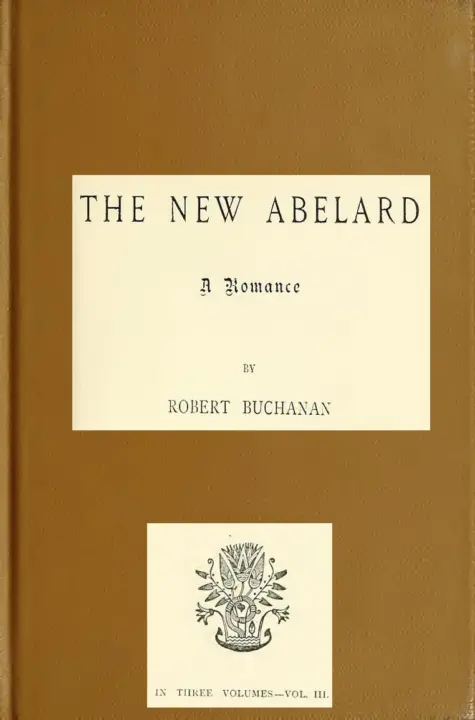
"The New Abelard: A Romance, Volume 2" by Robert Williams Buchanan is a novel written in the late 19th century. This book continues the exploration of complex relationships and societal norms, particularly focusing on Ambrose Bradley, a controversial preacher, and his connection with Alma Craik, the woman he loves. Themes of love, betrayal, and the clash between traditional beliefs and new ideologies shape the narrative as the characters navigate their intertwined destinies. At the start of the novel, the conversation between George Craik and Cholmondeley reveals deep-seated emotions surrounding Alma's engagement with Bradley, who has sparked scandal through his new church. As George grapples with his family's honor and his feelings for Alma, tensions rise when he discovers that Alma and Bradley have been seen together, sparking his jealousy and obsession. The narrative delves into the characters' backgrounds and motivations, hinting at past relationships that complicate their current situations, setting the stage for further conflict and emotional turmoil. The tense interactions between the characters foreshadow dramatic confrontations and revelations that will unfold as the story progresses.
Introduction adapted from the source catalogue; source summaries may be automatically generated.
Free to read · English · 32,366 words · No account needed
MAKE TIME FOR A GOOD BOOK
On by default. Untick to stop anonymous reading totals. Each page counts after 10 seconds in view. How this works.
Anonymous counting is on unless you have switched it off.
The fair doves of the theatre, we may remark in parenthesis, have seldom much respect for the temple in which they themselves flutter; they cannot shake from their minds the idea that it is a heathen structure, and that they themselves are, at the best, but pretty pagans.
Hence they are often disposed to receive in quite a humble spirit the ministrations of their mortal enemies, the officers of the Protestant Church.
George Craik scowled at the fair one as he had scowled at Oholmondeley.
‘You heard that man Bradley, I suppose?’
‘Yes; I think that was his name. Do you know him, George?’
‘I know no good of him. I wish the roof had fallen in, and smashed him up. Talk about something else; and look here, don’t let me catch you going there again, or we shall quarrel. I won’t have any one I know going sneaking after that humbug.’
‘All right, Georgie dear,’ replied the damsel, smiling maliciously. ‘Then it’s true, I suppose, that he’s going to marry your cousin? I saw her sitting right under him, and thought her awfully pretty.’
‘You let her alone,’ grumbled George, ‘and mind your own affairs.’
‘Why don’t you marry her yourself, Géorgie?’ persisted his tormentor. ‘I hope what I have heard isn’t true?’
‘What have you heard?’
‘That she prefers the parson!’
The young man sprang up with an oath, and Miss Dottie burst into a peal of shrill laughter. He strode off into the garden, and she followed him. Coming into the full sunlight, she looked even more like plaster of Paris, or stucco, than in the subdued light of the chamber; her hair grew more strawlike, her eyes more colourless, her whole appearance more faded and jaded.
‘I had a letter this morning from Kitty,’ she said carelessly, to change
the subject.
‘Kitty who?’
‘Kitty Montmorency. She says old Ombermere is very ill, and thinks he’s breaking up. By the way, that reminds me--Kitty’s first husband was a man named Bradley, who was to have entered the Church. I suppose it can’t be the same.’
She spoke with little thought of the consequences, and was not prepared for the change which suddenly came over her companion.
‘Her husband, did you say?’ he exclaimed, gripping her arm. ‘Were they
married?’
‘I suppose so.’
‘And the man was named Bradley--Ambrose Bradley?’
‘I’m not quite sure about the Christian name.’
‘How long was this ago?’
‘Oh, a long time--ten years,’ she replied; then with a sudden remembrance of her own claims to juvenility, which she had forgotten for a moment, she added, ‘when I was quite a child.’
Your reading position is saved on this browser. Take it to another device with a library code. Reading pages adapt to text, rather than matching a printed edition.
Robert Williams Buchanan
Robert Williams Buchanan
Robert Williams Buchanan
Robert Williams Buchanan
BEHIND THE BOOK
This eBook is for the use of anyone anywhere in the United States and most other parts of the world at no cost and with almost no restrictions whatsoever. You may copy it, give it away or re-use it under the terms of the Project Gutenberg License included with this eBook or online at www.gutenberg.org. If you are not located in the United States, you will have to check the laws of the country where you are located before using this eBook. Read the source licence.
The original source file, including credits and licence, is retained by this library. Request an original-format copy at no charge. Please include the book title and Project Gutenberg identifier #54856.
KEEP YOUR CURIOSITY GOING
Coulson Kernahan

Maurice Baring
Frances Wright
Cécile Tormay

Frederic Jesup Stimson

W. H. P. (William Henry Pope) Jarvis