THE CLASSIC COLLECTION✦The marriage verdictCLASSIC FREE BOOKS
The marriage verdict
Frank H. (Frank Hamilton) Spearman
THE CLASSIC COLLECTION · 1900
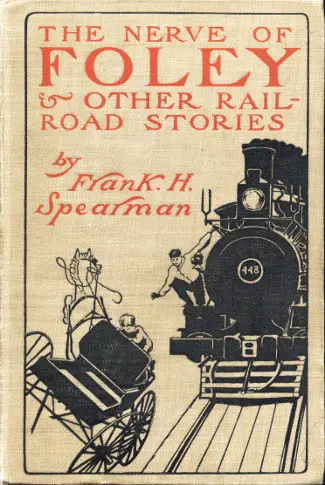
"The Nerve of Foley, and Other Railroad Stories" by Frank H. Spearman is a collection of railroad-related short stories written in the late 19th century. The tales revolve around the lives of railroad workers and the unique challenges they face, emphasizing themes of courage, camaraderie, and conflict within the industry. Central to these stories are characters such as engineer Foley, who exemplifies remarkable bravery and skill in various high-pressure situations. The opening of the first story introduces us to the tense environment of a railroad strike, where engineers are planning to walk out in protest. Among them is Andrew Cameron, a talented but headstrong engineer who has a young family to consider. As the story unfolds, we see the impact of the strike on the operations of the railroad and the arrival of Foley, a newcomer whose actions during a dangerous incident involving a runaway train not only display his exceptional nerve but also lead to a significant turning point in resolving tensions between the striking engineers and management. This compelling start sets the tone for the adventures and challenges faced by those working in the high-stakes world of railroads.
Introduction adapted from the source catalogue; source summaries may be automatically generated.
Free to read · English · 38,255 words · No account needed
MAKE TIME FOR A GOOD BOOK
On by default. Untick to stop anonymous reading totals. Each page counts after 10 seconds in view. How this works.
Anonymous counting is on unless you have switched it off.
It belongs to the Stories That Never Were Told, this of the McWilliams Special. But it happened years ago, and for that matter McWilliams is dead. It wasn't grief that killed him, either; though at one time his grief came uncommonly near killing us.
It is an odd sort of a yarn, too; because one part of it never got to headquarters, and another part of it never got from headquarters.
How, for instance, the mysterious car was ever started from Chicago on such a delirious schedule, how many men in the service know that even yet?
How, for another instance, Sinclair and Francis took the ratty old car reeling into Denver with the glass shrivelled, the paint blistered, the hose burned, and a tire sprung on one of the Five-Nine's drivers--how many headquarters slaves know that?
Our end of the story never went in at all. Never went in because it was not deemed--well, essential to the getting up of the annual report. We could have raised their hair; they could have raised our salaries; but they didn't; we didn't.
In telling this story I would not be misunderstood; ours is not the only line between Chicago and Denver: there are others, I admit it. But there is only one line (all the same) that could have taken the McWilliams Special, as we did, out of Chicago at four in the evening and put it in Denver long before noon the next day.
A communication came from a great La Salle Street banker to the president of our road. Next, the second vice-president heard of it; but in this way:
"Why have you turned down Peter McWilliams's request for a special to Denver this afternoon?" asked the president.
"He wants too much," came back over the private wire. "We can't do it."
After satisfying himself on this point the president called up La Salle
Street.
"Our folks say, Mr. McWilliams, we simply can't do it."
"You must do it."
"When will the car be ready?"
"At three o'clock."
"When must it be in Denver?"
"Ten o'clock to-morrow morning."
The president nearly jumped the wire.
"McWilliams, you're crazy. What on earth do you mean?"
The talk came back so low that the wires hardly caught it. There were occasional outbursts such as, "situation is extremely critical," "grave danger," "acute distress," "must help me out."
But none of this would ever have moved the president had not Peter McWilliams been a bigger man than most corporations; and a personal request from Peter, if he stuck for it, could hardly be refused; and for this he most decidedly stuck.
"I tell you it will turn us upside-down," stormed the president.
Your reading position is saved on this browser. Take it to another device with a library code. Reading pages adapt to text, rather than matching a printed edition.
Frank H. (Frank Hamilton) Spearman
Frank H. (Frank Hamilton) Spearman
Frank H. (Frank Hamilton) Spearman
Frank H. (Frank Hamilton) Spearman
BEHIND THE BOOK
This eBook is for the use of anyone anywhere in the United States and most other parts of the world at no cost and with almost no restrictions whatsoever. You may copy it, give it away or re-use it under the terms of the Project Gutenberg License included with this eBook or online at www.gutenberg.org. If you are not located in the United States, you will have to check the laws of the country where you are located before using this eBook. Read the source licence.
The original source file, including credits and licence, is retained by this library. Request an original-format copy at no charge. Please include the book title and Project Gutenberg identifier #33947.
KEEP YOUR CURIOSITY GOING
Coulson Kernahan

Maurice Baring
Frances Wright
Cécile Tormay

Frederic Jesup Stimson

W. H. P. (William Henry Pope) Jarvis