THE CLASSIC COLLECTION✦Among the campsCLASSIC FREE BOOKS
Among the camps
Thomas Nelson Page
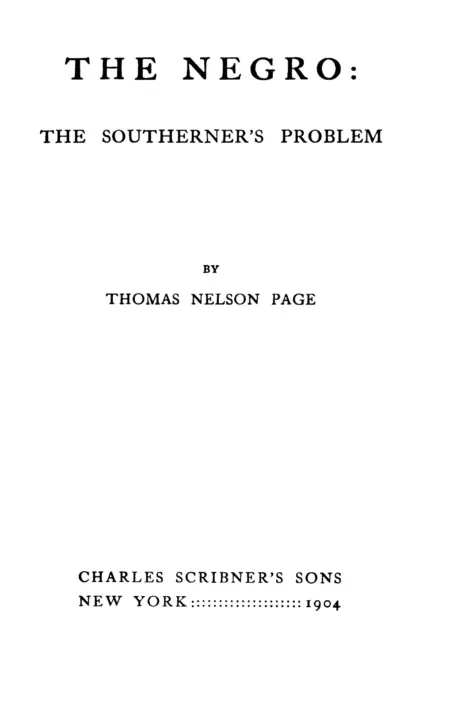
THE CLASSIC COLLECTION · 1904
"The Negro: The Southerner's Problem" by Thomas Nelson Page is a collection of essays written in the early 20th century that addresses the extensive and complex issues surrounding race relations in the post-Civil War American South. Through his writings, Page attempts to explore the historical context of the racial divide, focusing particularly on the consequences of emancipation and the ongoing challenges faced by both black and white communities in the South. The essays reflect Page's views on the inherent complexities and sensitivities involving the narrative of race in America, drawing from his experiences and observations. At the start of the text, the author lays the groundwork for a thorough examination of "The Negro Question," which he identifies as a crucial and long-standing dilemma most notably affecting Southern society. He notes that this topic has been a source of contention and misunderstanding, particularly between Southern whites who live daily with its implications and Northern whites who hold often radical views shaped by sentimental narratives. Page aims to approach this subject with candor, highlighting the historical relationships between races, the impact of slavery, and the failures and successes in attempts at integration and education for the freedmen. Through this introduction, he expresses the hope that his writings might contribute to a more informed and open dialogue about these pressing issues.
Introduction adapted from the source catalogue; source summaries may be automatically generated.
Free to read · English · 64,234 words · No account needed
MAKE TIME FOR A GOOD BOOK
On by default. Untick to stop anonymous reading totals. Each page counts after 10 seconds in view. How this works.
Anonymous counting is on unless you have switched it off.
The Reconstruction Act forced through Congress in August, 1864, by the radical wing of the Republican Party, and vetoed by Mr. Lincoln by a pocket veto, expressly limited the franchise to adult whites. The platform of the Republican Party on which Lincoln was renominated and reëlected in November, 1864, made no reference to Negro suffrage. During this year (1864) the Union people adopted new or amended old constitutions in Arkansas, Connecticut, Kansas, Louisiana, Maryland, Nevada, New York, Pennsylvania, Rhode Island, and Virginia, but no mention was made of Negro suffrage except to exclude it. Id.
In December, 1865, when the question of the establishment of Negro suffrage in the District of Columbia was submitted to the voters there, the vote stood, in Georgetown, 1 vote for and 812 votes against the measure, and in Washington, 35 votes for and 6,521 votes against the measure. Id., p. 27.
In September, 1865, the question was submitted to the voters of the
Territory of Colorado. The vote stood 476 for and 4,192 against it.
Ib.
In June, 1866, the people of Nebraska adopted a constitution which limited suffrage to whites. In October, 1867, the proposition for Negro suffrage in Ohio was voted down by over 50,000 majority. In November of that year the people of Kansas and Minnesota “voted it down by large majorities.” Id., p. 29.
In November, 1868, the people of Iowa voted to strike out the word “white” from the Constitution. In this State by the census of 1870 there were 289,162 whites and 1,542 blacks. The vote, however, on this measure was 22,000 less than that for the Republican ticket. Id., p. 39, citing Tribune Almanac for 1869, p. 75.
In November, 1868, the people of Minnesota once more voted on the measure, and this time it was carried through by only about three-fifths of the majority given the Republican ticket. By the census of 1870 there were in that State 114,344 adult white men and 246 adult Negro men. Id., p. 40.
In 1868, in Missouri, the measure was voted down by 18,000 majority.
Ib.
In Michigan, in 1868, when the Republican Party carried the State by nearly 32,000 majority, the question of Negro suffrage was voted down by nearly 39,000 majority. Ib.
In 1869 the people of New York defeated the proposed measure by over 32,000 majority, and the Legislature of that State rescinded a former act of the previous Legislature, which had, by a majority of two, ratified the Fifteenth Amendment. Id., p. 65.
On the 4th of March, 1869, in Indiana, seventeen Senators and thirty-six Representatives resigned from the Legislature to break a quorum and prevent the ratification of the amendment. Every one of these, with a single exception, was subsequently reëlected by the people. Id., p. 66-7.
Your reading position is saved on this browser. Take it to another device with a library code. Reading pages adapt to text, rather than matching a printed edition.
Thomas Nelson Page
Thomas Nelson Page
Thomas Nelson Page
Thomas Nelson Page
BEHIND THE BOOK
This eBook is for the use of anyone anywhere in the United States and most other parts of the world at no cost and with almost no restrictions whatsoever. You may copy it, give it away or re-use it under the terms of the Project Gutenberg License included with this eBook or online at www.gutenberg.org. If you are not located in the United States, you will have to check the laws of the country where you are located before using this eBook. Read the source licence.
The original source file, including credits and licence, is retained by this library. Request an original-format copy at no charge. Please include the book title and Project Gutenberg identifier #70834.
KEEP YOUR CURIOSITY GOING

David Patterson (Spirit) Hatch

David Patterson (Spirit) Hatch

David Patterson (Spirit) Hatch
Cécile Tormay

Moritz Busch
John L. Ransom