THE CLASSIC COLLECTION✦Among the campsCLASSIC FREE BOOKS
Among the camps
Thomas Nelson Page
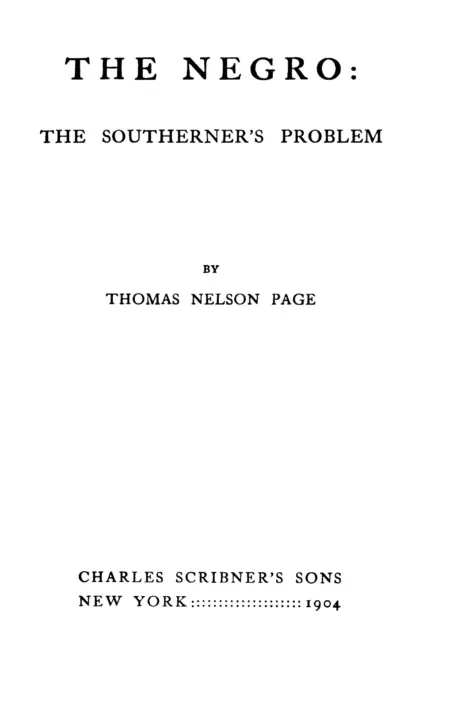
THE CLASSIC COLLECTION · 1904
"The Negro: The Southerner's Problem" by Thomas Nelson Page is a collection of essays written in the early 20th century that addresses the extensive and complex issues surrounding race relations in the post-Civil War American South. Through his writings, Page attempts to explore the historical context of the racial divide, focusing particularly on the consequences of emancipation and the ongoing challenges faced by both black and white communities in the South. The essays reflect Page's views on the inherent complexities and sensitivities involving the narrative of race in America, drawing from his experiences and observations. At the start of the text, the author lays the groundwork for a thorough examination of "The Negro Question," which he identifies as a crucial and long-standing dilemma most notably affecting Southern society. He notes that this topic has been a source of contention and misunderstanding, particularly between Southern whites who live daily with its implications and Northern whites who hold often radical views shaped by sentimental narratives. Page aims to approach this subject with candor, highlighting the historical relationships between races, the impact of slavery, and the failures and successes in attempts at integration and education for the freedmen. Through this introduction, he expresses the hope that his writings might contribute to a more informed and open dialogue about these pressing issues.
Introduction adapted from the source catalogue; source summaries may be automatically generated.
Free to read · English · 64,234 words · No account needed
MAKE TIME FOR A GOOD BOOK
On by default. Untick to stop anonymous reading totals. Each page counts after 10 seconds in view. How this works.
Anonymous counting is on unless you have switched it off.
Of late, however, several revolting instances of lynching of Negroes in its most dreadful form: burning at the stake, have occurred in regions where hitherto such forms of barbarous punishment have been unknown; and the time appears to be ripe for some efficient concert of action, to eradicate what is recognized by cool heads as a blot on our good name and a serious menace to our civilization.
In discussing the means to put an end to this barbarity, the first
essential is that the matter shall be clearly and thoroughly
understood.
The ignorance shown by much of the discussion that has grown out of these lynchings would appear to justify plain speaking.
All thoughtful men know that respect for law is the basic principle of civilization, and are agreed as to the evil of any overriding of the law. All reasonable men know that the overriding of law readily creates a spirit of lawlessness, under which progress is retarded and civilization suffers and dwindles. This is as clearly recognized at the South as at the North. To overcome this conviction and stir up rational men to a pitch where the law is trampled under foot, the officers of the law are attacked, and their prisoners taken from them and executed, there must be some imperative cause.
And yet the record of such overriding of law in the past has been a
terrible one.
The Chicago Tribune has for some time been collecting statistics on the subject of lynching, and the following table taken from that paper, showing the number of lynchings for a series of years, is assumed to be fairly accurate:
1885 184
1886 138
1887 122
1888 142
1889 176
1890 127
1891 192
1892 235
1893 200
1894 190
1895 171
1896 131
1897 166
1898 127
1899 107
1900 115
1901 135
1902 96
1903 104
1904 (to Oct. 27) 86
—————————————————————————+———————+————————+——————+—————— Total lynchings. |Whites.|Negroes.|In the|In the | | |South.|North. —————————————————————————+———————+————————+——————+—————— 1900 115 | 8 | 107 | 107 | 8 1901 135 | 26 | 107 | 121 | 14 1902 96 | 9 | 86 | 87 | 9 1903 (to Sept. 14) 76 | 13 | 63 | 66 | 10 —————————————————————————+———————+————————+——————+——————
Causes Assigned.
1900. 1901.[40] 1902.[41] 1903. Murder 39 39 37 32 Rape 18 19 19 8 Attempted rape 13 9 11 5 Race prejudice 10 9 2 3 Assaulting whites 6 — 3 3 Threats to kill 5 — 1 — Burglary 4 1 — — Attempt to murder 4 9 4 6 Informing 2 — — — Robbery (theft) 2 12 1 — Complicity in murder 2 6 3 5 Rape and murder — — — 1 Suspicion of murder 2 3 1 3 Suspicion of robbery 1 — — — No offence 1 — — — Arson 2 4 — — Suspicion of arson 1 — — — Aiding escape of murderer 1 — 1 — Insulting a white woman — 1 — — Cattle and horse stealing — 7 1 — Quarrel over profit-sharing — 5 — — Suspicion of rape — 1 — — Suspicion of rape and murder — 1 — — Unknown offences 2 6 — 4 Mistaken identity — 1 1 3
The lynchings in the various States and Territories in 1900 were as
follows:
Alabama 8
Arkansas 6
California 0
Colorado 3
Connecticut 0
Delaware 0
Florida 9
Georgia 16
Idaho 0
Illinois 0
Indiana 3
Iowa 0
Kansas 2
Kentucky 1
Louisiana 20
Maine 0
Maryland 1
Massachusetts 0
Michigan 0
Minnesota 0
Mississippi 20
Missouri 2
Montana 0
Nebraska 0
New Jersey 0
New Hampshire 0
New York 0
Nevada 0
North Carolina 3
North Dakota 0
Ohio 0
Oregon 0
Pennsylvania 0
Rhode Island 0
South Carolina 2
South Dakota 0
Tennessee 7
Texas 4
Vermont 0
Virginia 6
West Virginia 2
Wisconsin 0
Washington 0
Wyoming 0
Arizona 0
District of Columbia 0
New Mexico 0
Utah 0
Indian Territory 0
Oklahoma 0
Alaska 0
Your reading position is saved on this browser. Take it to another device with a library code. Reading pages adapt to text, rather than matching a printed edition.
Thomas Nelson Page
Thomas Nelson Page
Thomas Nelson Page

Thomas Nelson Page
BEHIND THE BOOK
This eBook is for the use of anyone anywhere in the United States and most other parts of the world at no cost and with almost no restrictions whatsoever. You may copy it, give it away or re-use it under the terms of the Project Gutenberg License included with this eBook or online at www.gutenberg.org. If you are not located in the United States, you will have to check the laws of the country where you are located before using this eBook. Read the source licence.
The original source file, including credits and licence, is retained by this library. Request an original-format copy at no charge. Please include the book title and Project Gutenberg identifier #70834.
KEEP YOUR CURIOSITY GOING

David Patterson (Spirit) Hatch

David Patterson (Spirit) Hatch

David Patterson (Spirit) Hatch
Cécile Tormay

Moritz Busch
John L. Ransom