THE CLASSIC COLLECTION✦Among the campsCLASSIC FREE BOOKS
Among the camps
Thomas Nelson Page
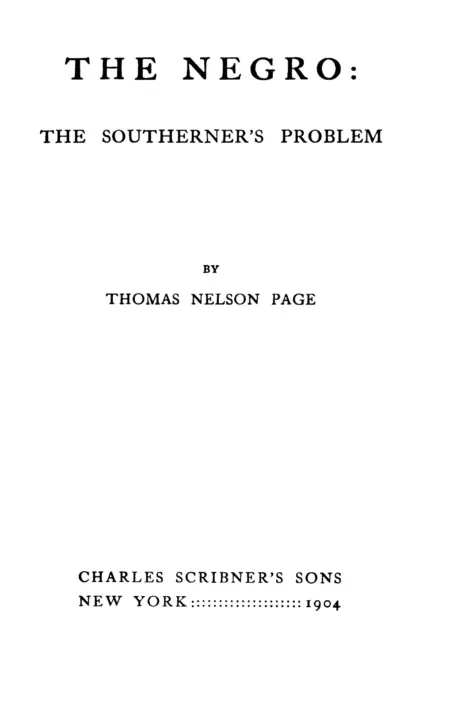
THE CLASSIC COLLECTION · 1904
"The Negro: The Southerner's Problem" by Thomas Nelson Page is a collection of essays written in the early 20th century that addresses the extensive and complex issues surrounding race relations in the post-Civil War American South. Through his writings, Page attempts to explore the historical context of the racial divide, focusing particularly on the consequences of emancipation and the ongoing challenges faced by both black and white communities in the South. The essays reflect Page's views on the inherent complexities and sensitivities involving the narrative of race in America, drawing from his experiences and observations. At the start of the text, the author lays the groundwork for a thorough examination of "The Negro Question," which he identifies as a crucial and long-standing dilemma most notably affecting Southern society. He notes that this topic has been a source of contention and misunderstanding, particularly between Southern whites who live daily with its implications and Northern whites who hold often radical views shaped by sentimental narratives. Page aims to approach this subject with candor, highlighting the historical relationships between races, the impact of slavery, and the failures and successes in attempts at integration and education for the freedmen. Through this introduction, he expresses the hope that his writings might contribute to a more informed and open dialogue about these pressing issues.
Introduction adapted from the source catalogue; source summaries may be automatically generated.
Free to read · English · 64,234 words · No account needed
MAKE TIME FOR A GOOD BOOK
On by default. Untick to stop anonymous reading totals. Each page counts after 10 seconds in view. How this works.
Anonymous counting is on unless you have switched it off.
“The value of the land in farms of all colored owners in continental United States in 1900—including the value of the supplementary land rented, which, if we assume it to be of the same average value as the rest, amounted to about $7,500,000—was $102,022,601. While some of the land is very good, most of it is poor, being often practically worn out or disadvantageously situated as regards a market.”[32]
Statistics relating to the number of farms, acreage, and value of all farm property, including land, improvements, implements, machinery, and livestock, may be found in the Twelfth Census and in the Census Bulletin No. 8, relating to Negroes in the United States in 1900, table 69, page 308.
In this table it is shown that the total number of farm-property owners including Negro, Indian, and Mongolian farmers is 174,434, owning land and improvements, implements, and machinery valued at $150,557,251, and part owners, 30,501, owning $27,358,225.
Georgia has been not infrequently cited as a State in which the Negro has thriven somewhat exceptionally. It contains more Negroes than does any other State, having, by the census of 1900, 1,034,813 Negroes. In 1860 it contained 465,698, so that the Negroes have since that time increased there at the rate of 142,279 every ten years. The Bulletin of the Department of Labor, No. 35, July 1901, contains a valuable paper by Prof. Du Bois on the Negro landholder in Georgia, based on a close study of the conditions of the Negro in that State. Among other matters he gives a table containing the assessed value of all property owned by Negroes in Georgia from 1874 to 1900:
Year. Assessed Value.
1874 $6,157,798
1875 5,393,885
1876 5,488,867
1877 5,430,844
1878 5,124,875
1879 5,182,398
1880 5,764,293
1881 6,478,951
1882 6,589,876
1883 7,582,395
1884 8,021,525
1885 8,153,390
1886 8,655,298
1887 8,963,479
1888 9,631,271
1889 10,415,330
1890 12,322,003
1891 14,196,735
1892 14,869,575
1893 14,960,675
1894 14,387,730
1895 12,941,230
1896 13,292,816
1897 13,619,690
1898 13,719,200
1899 13,447,423
1900 14,118,720
From this table it will be found that the taxable values of all the property owned by Negroes in Georgia in the year 1874 were $6,157,798. In 1890 the Negro population was 858,815. In 1892 the property valuation has risen to $14,869,575, and in 1900, when the population was 1,034,813, it was only $14,118,720, or an actual falling off, though the Negroes appear to have increased 23.9 per cent. in this time.[33]
Such is the showing of statistics as to the advance marked by the accumulation of property. It fails to bear out the claim that the Negro race has shown remarkable progress along this line. It must be further observed that in reporting the property holdings no account is taken of the mortgages and other indebtedness of the property owners.
Your reading position is saved on this browser. Take it to another device with a library code. Reading pages adapt to text, rather than matching a printed edition.
Thomas Nelson Page

Thomas Nelson Page
Thomas Nelson Page

Thomas Nelson Page
BEHIND THE BOOK
This eBook is for the use of anyone anywhere in the United States and most other parts of the world at no cost and with almost no restrictions whatsoever. You may copy it, give it away or re-use it under the terms of the Project Gutenberg License included with this eBook or online at www.gutenberg.org. If you are not located in the United States, you will have to check the laws of the country where you are located before using this eBook. Read the source licence.
The original source file, including credits and licence, is retained by this library. Request an original-format copy at no charge. Please include the book title and Project Gutenberg identifier #70834.
KEEP YOUR CURIOSITY GOING

David Patterson (Spirit) Hatch

David Patterson (Spirit) Hatch

David Patterson (Spirit) Hatch
Cécile Tormay

Moritz Busch
John L. Ransom