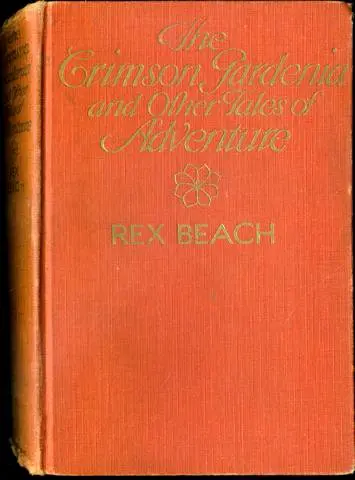
The Crimson Gardenia and Other Tales of Adventure
Rex Beach
THE CLASSIC COLLECTION · 1911
"The Ne'er-Do-Well" by Rex Beach is a novel probably written during the early 20th century. The story begins with Kirk Anthony, a charming yet irresponsible young man and the son of Darwin K. Anthony, a prominent railroad magnate. The narrative unfolds against a backdrop of youthful exuberance, scandals, and the challenges of modern life, particularly centered around Kirk's conflict with his father's expectations and his own apparent shortcomings. At the start of the book, the bustling atmosphere of Broadway sets the stage for Kirk Anthony's life, who is both celebrated and criticized for his privileged lifestyle and reckless behavior. He is caught up in the excitement of a recent football game where he played a significant coaching role, leading a team to victory despite adverse circumstances. However, alongside this admiration comes a sense of disapproval from those around him, particularly regarding his lifestyle choices and associations, especially with his dubious friend, Adelbert Higgins. As the story progresses, Kirk finds himself embroiled in an unpredictable night, leading to a mistaken identity involving a ticket that sends him on a ship to Panama, unraveling a series of events that challenge his character and ultimately affect his destiny.
Introduction adapted from the source catalogue; source summaries may be automatically generated.
Free to read · English · 116,595 words · No account needed
MAKE TIME FOR A GOOD BOOK
On by default. Untick to stop anonymous reading totals. Each page counts after 10 seconds in view. How this works.
Anonymous counting is on unless you have switched it off.
Mrs. Cortlandt nodded gravely. "You are also good company, you dress well, and you are an ornament to any hotel porch."
"Naturally, I refrained from mentioning those things, but, in addition, I smoke, drink, and swear. I am unsteady in my habits, and require a great deal of sleep. I think that completes the inventory."
"Of course, you will live beyond your salary?"
"Undoubtedly."
"Seriously, now, don't you really---?"
"Go ahead. Say it! Don't I know anything? No. I am too highly educated. You see, I took the full college course."
She drew her sharply pencilled brows together and pursed her lips in meditation, regarding him meanwhile with a look that was not all disapproval.
"Am I hopeless?" he inquired at length.
"Dear, no! Experience is a good thing, of course, and ability is even better, but neither is absolutely necessary in government work."
"Oh!"
"Provided---"
"What?"
"--You have influence. I was merely trying to think of the niche into
which you would best fit."
"When a fellow hasn't any of those qualifications, then what? Take me,
for instance."
"You have at least one."
"Which one?"
"Influence."
He shook his head. "My father wouldn't help."
"We'll have no difficulty in finding you a position."
"Jove! That's good news." He beamed at her with gratified surprise. "I had an idea I'd be going from door to door."
"How ridiculous! This is a government job; therefore it is saturated with politics. There are a great many good men on it, but there are also a large number of 'somebody's relatives.' Do you understand? Anything is possible here for a man with influence. If he has ability with it, he can go to the top. If he lacks ability--well, even then he can go to the top--it depends entirely upon the influence."
"But I haven't any--" Kirk began. Then, catching her look, he
exclaimed: "Oh, say! WILL you help me? Really? That's too good to be
true."
He shook her hand warmly, that being the natural outlet for his
gratitude, and she smiled at him. "I wonder where I'd better start in,"
he said.
"There's not the slightest choice. All paths lead up the mountain, and if you go far enough you will reach the top. It would be quite easy if you knew something about the railroad business, for instance."
"Oh, I do. I've had that drilled into me ever since I was a child. I grew up with it--was soaked in it. My father made me learn telegraphy before he gave me a motor-boat."
"Why in the world didn't you say so?"
Your reading position is saved on this browser. Take it to another device with a library code. Reading pages adapt to text, rather than matching a printed edition.
BEHIND THE BOOK
This eBook is for the use of anyone anywhere in the United States and most other parts of the world at no cost and with almost no restrictions whatsoever. You may copy it, give it away or re-use it under the terms of the Project Gutenberg License included with this eBook or online at www.gutenberg.org. If you are not located in the United States, you will have to check the laws of the country where you are located before using this eBook. Read the source licence.
The original source file, including credits and licence, is retained by this library. Request an original-format copy at no charge. Please include the book title and Project Gutenberg identifier #5405.
KEEP YOUR CURIOSITY GOING
Wilfrid Scawen Blunt
Wilfrid Scawen Blunt

E. W. (Edgar Watson) Howe
Coulson Kernahan

Maurice Baring
Frances Wright