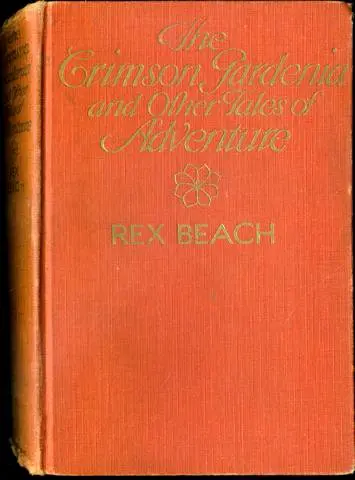
The Crimson Gardenia and Other Tales of Adventure
Rex Beach
THE CLASSIC COLLECTION · 1911
"The Ne'er-Do-Well" by Rex Beach is a novel probably written during the early 20th century. The story begins with Kirk Anthony, a charming yet irresponsible young man and the son of Darwin K. Anthony, a prominent railroad magnate. The narrative unfolds against a backdrop of youthful exuberance, scandals, and the challenges of modern life, particularly centered around Kirk's conflict with his father's expectations and his own apparent shortcomings. At the start of the book, the bustling atmosphere of Broadway sets the stage for Kirk Anthony's life, who is both celebrated and criticized for his privileged lifestyle and reckless behavior. He is caught up in the excitement of a recent football game where he played a significant coaching role, leading a team to victory despite adverse circumstances. However, alongside this admiration comes a sense of disapproval from those around him, particularly regarding his lifestyle choices and associations, especially with his dubious friend, Adelbert Higgins. As the story progresses, Kirk finds himself embroiled in an unpredictable night, leading to a mistaken identity involving a ticket that sends him on a ship to Panama, unraveling a series of events that challenge his character and ultimately affect his destiny.
Introduction adapted from the source catalogue; source summaries may be automatically generated.
Free to read · English · 116,595 words · No account needed
MAKE TIME FOR A GOOD BOOK
On by default. Untick to stop anonymous reading totals. Each page counts after 10 seconds in view. How this works.
Anonymous counting is on unless you have switched it off.
"I do not see. I am strolling in search of the cool air." She bowed and smiled at some passing friends. She seemed very careless, very flippant. She was not at all the impetuous, mischievous Chiquita he had met in the woods.
"See here!" he said, soberly. "We can't go on this way. Now that I've met your father, I'm going to explain my intentions to him, and ask his permission to call on you."
"We have a--proverb, senor, 'Ir por lana, y volver trasquilado,' which means, 'Take heed lest you find what you do not seek.' Do not be impetuous."
"There's only one thing I'm seeking."
"My father is a stern man. In his home he is entirely a Spaniard, and if he learned how we met, for instance"-even under the electric light he saw her flush-"he would create a terrible scene." She paused in her walk and leaned over the stone balustrade, staring out across the ink-black harbor.
"Trust me! I shan't tell him."
"There are so many reasons why it is useless."
"Name one."
"One!" She shrugged lightly. "In the first place I care nothing for
you. Is not that enough?"
"No, indeed. You'll get over that."
"Let us imagine, then, the contrary. You Americans are entirely different from our people. You are cold, deliberate, wicked-your social customs are not like ours. You do not at all understand us. How then could you be interested to meet a Spanish family?"
"Why, you're half American."
"Oh yes, although it is to be regretted. Even at school in your Baltimore I learned many improper things, against which I have had to struggle ever since."
"For instance?"
"Ah," she sighed, "I saw so much liberty; I heard of the shocking conduct of your American ladies, and, while I know it is quite wrong and wicked, still-it is interesting. Why, there is no other nice girl in all Panama who would have talked with you as I did in the forest that day."
"But what has all this to do with my coming to see you?"
"It is difficult to explain, since you will not understand. When a young man is accepted into a Spanish house, many things are taken for granted. Besides that, we do not know each other, you and I. Also, if you should come to see me, it would cause gossip, misunderstanding among my friends."
"I'll declare myself in advance," he promised warmly.
"No, no, no! We Spanish-Americans do not care for strangers. We have our own people and we are satisfied. You Yankees are not very nice; you are barbarous; you assume such liberties. Our young men are gentle, modest, sweet--"
Your reading position is saved on this browser. Take it to another device with a library code. Reading pages adapt to text, rather than matching a printed edition.
BEHIND THE BOOK
This eBook is for the use of anyone anywhere in the United States and most other parts of the world at no cost and with almost no restrictions whatsoever. You may copy it, give it away or re-use it under the terms of the Project Gutenberg License included with this eBook or online at www.gutenberg.org. If you are not located in the United States, you will have to check the laws of the country where you are located before using this eBook. Read the source licence.
The original source file, including credits and licence, is retained by this library. Request an original-format copy at no charge. Please include the book title and Project Gutenberg identifier #5405.
KEEP YOUR CURIOSITY GOING
Wilfrid Scawen Blunt
Wilfrid Scawen Blunt

E. W. (Edgar Watson) Howe
Coulson Kernahan

Maurice Baring
Frances Wright