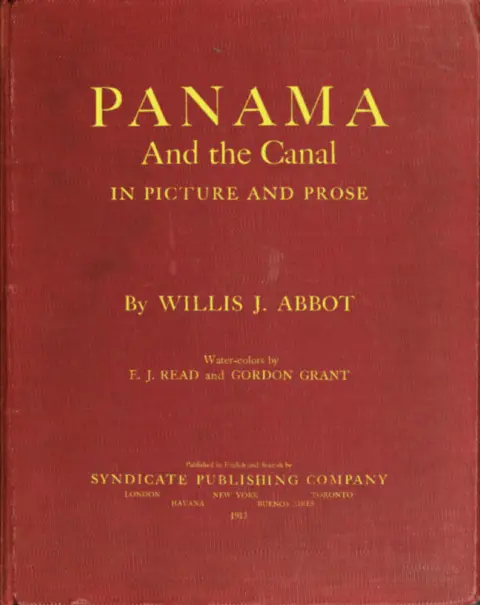
Panama and the Canal in Picture and Prose
Willis J. (Willis John) Abbot
THE CLASSIC COLLECTION · 1886
"The Naval History of the United States. Volume 1" by Willis J. Abbot is a historical account written in the late 19th century. This comprehensive work delves into the evolution of American naval history, beginning with early maritime exploits and the formative years of the U.S. Navy, particularly during significant conflicts such as the American Revolution. It likely covers the contributions and challenges faced by early American naval forces, highlighting notable figures and events that shaped naval operations. At the start of the book, the author introduces readers to early naval exploits upon American waters, referencing John Gallop's daring encounter with hostile Indigenous forces in 1636. This thrilling account serves to establish the backdrop of maritime conflict that would shape the collective naval history of the United States. Following this, the narrative explores the notorious activities of pirates and buccaneers in the Caribbean, including the violent exploits of figures such as Sir Henry Morgan and Captain Kidd, illustrating the chaotic environment in which the American colonies began to navigate. These early battles and the piracy prevalent in the region foreshadowed the significant naval challenges that would arise during the Revolutionary period, setting the stage for a deeper exploration of America's naval legacy.
Introduction adapted from the source catalogue; source summaries may be automatically generated.
Free to read · English · 167,793 words · No account needed
MAKE TIME FOR A GOOD BOOK
On by default. Untick to stop anonymous reading totals. Each page counts after 10 seconds in view. How this works.
Anonymous counting is on unless you have switched it off.
With a few inarticulate sounds, the Englishman stepped into his boat, and was pulled back to the "Saturn," whence soon returned a second boat, bearing an apology for the boarding-officer's rudeness. The boarders then searched all parts of the ship, mustered her crew on the plea that it contained British deserters, and finally released her, after having inflicted every possible humiliation upon her officers. The "Essex Junior" then proceeded to New York, where she was soon joined by Capt. Porter. The whole country united in doing honor to the officers, overlooking the defeat which closed their cruise, and regarding only the persistent bravery with which they had upheld the cause of the United States in the far-off waters of the Pacific.
Before closing the account of Porter's famous cruise, the story of the ill-fortune which befell Lieut. Gamble should be related. This officer, it will be remembered, was left at Nookaheevah with the prizes "Greenwich," "Seringapatam," and "Hammond." Hardly had the frigate disappeared below the horizon, when the natives began to grow unruly; and Gamble was forced to lead several armed expeditions against them. Then the sailors under his charge began to show signs of mutiny. He found himself almost without means of enforcing his authority, and the disaffection spread daily. The natives, incited by the half-savage Englishman who had been found upon the island, began to make depredations upon the live-stock; while the women would swim out to the ships by night, and purloin bread, aided by their lovers among the crews. To the lieutenant's remonstrances, the natives replied that "Opotee" was not coming back, and they would do as they chose; while the sailors heard his orders with ill-concealed contempt, and made but a pretext of obeying them. In the middle of April three sailors stole a boat from the "Greenwich," and, stocking it well with ammunition and provisions, deserted, and were never again seen. One month later, mutiny broke out in its worst form. Lieut. Gamble and his two midshipmen, being upon the "Seringapatam," were knocked down by the sailors, gagged, bound, and thrust into the hold. The mutineers then went ashore, spiked the guns in the fort, and then, hoisting the British colors over the captured ship, set sail. Lieut. Gamble was badly wounded in the foot by a pistol-shot fired by one of his guards. Notwithstanding his wound, he, with the two lieutenants and two loyal seamen, was turned adrift in an open boat. After long and painful exertions, they reached the shore, and returned to the bay, where the "Greenwich" still lay at anchor. The mutineers, thirteen of whom were Englishmen who had enlisted in the American service, steered boldly out to sea, and were nevermore heard of. The half-savage Englishman, Wilson, was supposed to be at the bottom of this uprising, and some days later a boat's crew from the "Greenwich" went ashore to capture him. Soon after, Gamble, anxiously watching the shore, saw a struggle upon the beach, the natives rushing down on all sides, the boat overturned in the surf, and two white men swimming towards the ship, making signals of distress. Mr. Clapp, with two men, sprang into a boat, and put off to the aid of the swimmers, leaving Gamble alone on the ship. Two large canoes loaded with savages then left the beach, and swiftly bore down towards the "Essex;" but Gamble, lamed though he was, seized a lighted brand, and hobbled along the deck of the ship, firing her guns with such effect that the savages were driven back, the beach cleared, and Mr. Clapp enabled to save the two struggling men. When the boat returned to the ship, it was learned that Midshipman Feltus and five men had been basely murdered by the savages. There were now left but seven Americans; and of these but two were well, and fit for duty. Setting the "Greenwich" on fire, this little band boarded the "Hammond," and made their way to sea. But between the Sandwich Islands and Honolulu they fell in with the "Cherub," by whom they were captured, and kept prisoners for nine months, when, peace being declared, they were released.
Your reading position is saved on this browser. Take it to another device with a library code. Reading pages adapt to text, rather than matching a printed edition.
Willis J. (Willis John) Abbot
Willis J. (Willis John) Abbot
Willis J. (Willis John) Abbot
BEHIND THE BOOK
This eBook is for the use of anyone anywhere in the United States and most other parts of the world at no cost and with almost no restrictions whatsoever. You may copy it, give it away or re-use it under the terms of the Project Gutenberg License included with this eBook or online at www.gutenberg.org. If you are not located in the United States, you will have to check the laws of the country where you are located before using this eBook. Read the source licence.
The original source file, including credits and licence, is retained by this library. Request an original-format copy at no charge. Please include the book title and Project Gutenberg identifier #22305.
KEEP YOUR CURIOSITY GOING
Cécile Tormay

Moritz Busch
John L. Ransom
Frances Wright
Cécile Tormay

Mabel Potter Daggett