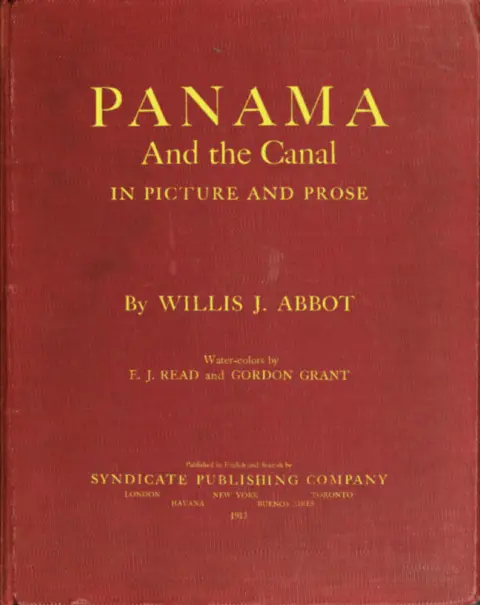
Panama and the Canal in Picture and Prose
Willis J. (Willis John) Abbot
THE CLASSIC COLLECTION · 1886
"The Naval History of the United States. Volume 1" by Willis J. Abbot is a historical account written in the late 19th century. This comprehensive work delves into the evolution of American naval history, beginning with early maritime exploits and the formative years of the U.S. Navy, particularly during significant conflicts such as the American Revolution. It likely covers the contributions and challenges faced by early American naval forces, highlighting notable figures and events that shaped naval operations. At the start of the book, the author introduces readers to early naval exploits upon American waters, referencing John Gallop's daring encounter with hostile Indigenous forces in 1636. This thrilling account serves to establish the backdrop of maritime conflict that would shape the collective naval history of the United States. Following this, the narrative explores the notorious activities of pirates and buccaneers in the Caribbean, including the violent exploits of figures such as Sir Henry Morgan and Captain Kidd, illustrating the chaotic environment in which the American colonies began to navigate. These early battles and the piracy prevalent in the region foreshadowed the significant naval challenges that would arise during the Revolutionary period, setting the stage for a deeper exploration of America's naval legacy.
Introduction adapted from the source catalogue; source summaries may be automatically generated.
Free to read · English · 167,793 words · No account needed
MAKE TIME FOR A GOOD BOOK
On by default. Untick to stop anonymous reading totals. Each page counts after 10 seconds in view. How this works.
Anonymous counting is on unless you have switched it off.
The next year was one of comparative inactivity for Jones. He enjoyed for a time the praise of all friends of the revolting colonies. He was the lion of Paris. Then came the investigation into the action of Landais at the time of the great battle. Though his course at that time was one of open treachery, inspired by his wish to have Jones strike to the "Serapis," that he might have the honor of capturing both ships, Landais escaped any punishment at the hands of his French compatriots. But he was relieved of the command of the "Alliance," which was given to Jones. Highly incensed at this action, the erratic Frenchman incited the crew of the "Alliance" to open mutiny, and, taking command of the ship himself, left France and sailed for America, leaving Commodore Jones in the lurch. On his arrival at Philadelphia, Landais strove to justify his action by blackening the character of Jones, but failed in this, and was dismissed the service. His actions should be regarded with some charity, for the man was doubtless of unsound mind. His insanity became even more evident after his dismissal from the navy; and from that time, until the time of his death, his eccentricities made him generally regarded as one mentally unsound.
Jones, having lost the "Alliance" by the mutiny of Landais, remained abroad, waiting for another ship. He travelled widely on the Continent, and was lavishly entertained by the rich and noble of every nation. Not until October, 1780, did he again tread the deck of a vessel under his own command.
The ship which the French Government finally fitted out and put in command of Paul Jones was the "Ariel," a small twenty-gun ship. This vessel the adventurous sailor packed full of powder and cannon-balls, taking only provisions enough for nine weeks, and evidently expecting to live off the prizes he calculated upon taking. He sailed from L'Orient on a bright October afternoon, under clear skies, and with a fair wind, intending to proceed directly to the coast of America. But the first night out there arose a furious gale. The wind howled through the rigging, tore the sails from the ring-bolts, snapped the spars, and seriously wrecked the cordage of the vessel. The great waves, lashed into fury by the hurricane, smote against the sides of the little craft as though they would burst through her sheathing. The ship rolled heavily; and the yards, in their grand sweep from side to side, often plunged deep into the foaming waves. At last so great became the strain upon the vessel, that the crew were set to work with axes to cut away the foremast. Balancing themselves upon the tossing, slippery deck, holding fast to a rope with one hand, while with the other they swung the axe, the gallant fellows finally cut so deep into the heart of the stout spar, that a heavy roll of the ship made it snap off short, and it fell alongside, where it hung by the cordage. The wreck was soon cleared away; and as this seemed to ease the ship somewhat, and as she was drifting about near the dreaded rock of Penmarque, the anchors were got out. But in the mean time the violent rolling of the "Ariel" had thrown the heel of the main-mast from the step; and the heavy mast was reeling about, threatening either to plough its way upward through the gun-deck, or to crash through the bottom of the ship. It was determined to cut away this mast; but, before this could be done, it fell, carrying with it the mizzen-mast, and crushing in the deck on which it fell. Thus dismasted, the "Ariel" rode out the gale. All night and all the next day she was tossed about on the angry waters. Her crew thought that their last hour had surely come. Over the shrieking of the gale, and the roaring of the waves, rose that steady, all-pervading sound, which brings horror to the mind of the sailor,--the dull, monotonous thunder of the breakers on the reef of Penmarque. But the "Ariel" was not fated to be ground to pieces on the jagged teeth of the cruel reef. Though she drifted about, the plaything of the winds and the waves, she escaped the jaws of Penmarque. Finally the gale subsided; and, with hastily devised jury-masts, the shattered ship was taken back to L'Orient to refit.
Your reading position is saved on this browser. Take it to another device with a library code. Reading pages adapt to text, rather than matching a printed edition.
Willis J. (Willis John) Abbot
Willis J. (Willis John) Abbot
Willis J. (Willis John) Abbot
BEHIND THE BOOK
This eBook is for the use of anyone anywhere in the United States and most other parts of the world at no cost and with almost no restrictions whatsoever. You may copy it, give it away or re-use it under the terms of the Project Gutenberg License included with this eBook or online at www.gutenberg.org. If you are not located in the United States, you will have to check the laws of the country where you are located before using this eBook. Read the source licence.
The original source file, including credits and licence, is retained by this library. Request an original-format copy at no charge. Please include the book title and Project Gutenberg identifier #22305.
KEEP YOUR CURIOSITY GOING
Cécile Tormay

Moritz Busch
John L. Ransom
Frances Wright
Cécile Tormay

Mabel Potter Daggett