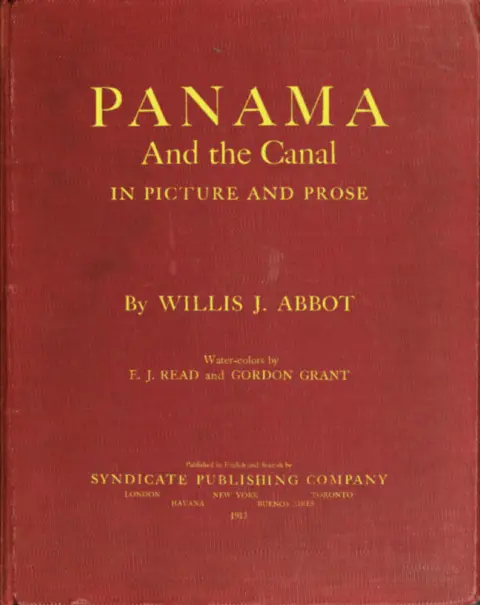
Panama and the Canal in Picture and Prose
Willis J. (Willis John) Abbot
THE CLASSIC COLLECTION · 1886
"The Naval History of the United States. Volume 1" by Willis J. Abbot is a historical account written in the late 19th century. This comprehensive work delves into the evolution of American naval history, beginning with early maritime exploits and the formative years of the U.S. Navy, particularly during significant conflicts such as the American Revolution. It likely covers the contributions and challenges faced by early American naval forces, highlighting notable figures and events that shaped naval operations. At the start of the book, the author introduces readers to early naval exploits upon American waters, referencing John Gallop's daring encounter with hostile Indigenous forces in 1636. This thrilling account serves to establish the backdrop of maritime conflict that would shape the collective naval history of the United States. Following this, the narrative explores the notorious activities of pirates and buccaneers in the Caribbean, including the violent exploits of figures such as Sir Henry Morgan and Captain Kidd, illustrating the chaotic environment in which the American colonies began to navigate. These early battles and the piracy prevalent in the region foreshadowed the significant naval challenges that would arise during the Revolutionary period, setting the stage for a deeper exploration of America's naval legacy.
Introduction adapted from the source catalogue; source summaries may be automatically generated.
Free to read · English · 167,793 words · No account needed
MAKE TIME FOR A GOOD BOOK
On by default. Untick to stop anonymous reading totals. Each page counts after 10 seconds in view. How this works.
Anonymous counting is on unless you have switched it off.
Unhappily, however, the heroic Mugford, while urging on his men to a more vigorous resistance, was struck by a musket-ball, which inflicted a mortal wound. At the moment the wound was received, he was reaching out over the quarter to catch hold of the mast of one of the barges, in the hope of upsetting her. As he fell to the deck, he called his first lieutenant, and said, "I am a dead man. Do not give up the vessel; you will be able to beat them off." Nearly forty years after, the heroic Lawrence, dying on the deck of the "Chesapeake," repeated Mugford's words, "Don't give up the ship."
For about half an hour the battle raged fiercely. The British, beaten back with great loss, returned again and again to the attack. The boats would come under the lee of the "Franklin;" but, not being provided with grappling-irons, the British were forced to lay hold of the gunwales of the enemy with their hands, which the Americans promptly lopped off with their cutlasses. Shots from the swivel guns of the Yankee soon stove in two of the boats of the enemy, which sunk, carrying down many of their crew. After nearly an hour of this desperate fighting, the British withdrew, having lost about seventy men. The only loss sustained by the Americans was that of their brave commander Mugford.
About a month after this battle, there occurred off the coast of Massachusetts a battle in which the Americans, though they fought with the most undaunted bravery, were forced to strike their colors to their adversary. The American was the privateer "Yankee Hero" of Newburyport. She sailed from that place for Boston on the 7th of June with only forty men aboard, intending to ship her full complement of one hundred and twenty at Boston. As the "Hero" rounded Cape Ann, she sighted a sail on the horizon, but in her short-handed condition did not think it worth while to give chase. The stranger, however, had caught sight of the "Hero;" and, a fresh southerly breeze springing up, she began to close with the American. As she came closer, Capt. Tracy of the "Yankee Hero" saw that she was a ship-of-war. Despite the desperate efforts of the Americans to escape, their pursuer rapidly overhauled them, and soon coming up within half a mile, opened fire with her bow chasers. The brig returned the fire with a swivel gun, which had little effect. Seeing this, Capt. Tracy ordered the firing to cease until the ships should came to close quarters. The stranger rapidly overhauled the privateer, keeping up all the time a vigorous fire. Tracy with difficulty restrained the ardor of his men, who were anxious to try to cripple their pursuer. When the enemy came within pistol-shot, Tracy saw that the time for action on his part had come, and immediately opened fire with all the guns and small-arms that could be brought to bear. The only possible chance for escape lay in crippling the big craft with a lucky shot; but broadside after broadside was fired, and still the great ship came rushing along in the wake of the flying privateer. Closer and closer drew the bulky man-of-war, until her bow crept past the stern of the "Yankee Hero," and the marines upon her forecastle poured down a destructive volley of musketry upon the brig's crowded deck. The plight of the privateer was now a desperate one. Her heavy antagonist was close alongside, and towered high above her, so that the marines on the quarter-deck and forecastle of the Englishman were on a level with the leading blocks of the Yankee. From the depressed guns of the frigate, a murderous fire poured down upon the smaller craft. For an hour and twenty minutes the two vessels continued the fight, pouring hot broadsides into each other, and separated by less than a hundred feet of water. The brisk breeze blowing carried away the clouds of smoke, and left the men on the deck of the Yankee no protection from sharp-shooters on the enemy's deck. Accordingly, the execution was frightful. Tracy, from his post on the quarter-deck, saw his men falling like sheep, while the continual volleys of the great ship had so cut the cordage of the weaker vessel that escape was impossible. At last a musket-ball struck Capt. Tracy in the thigh, and he fell bleeding to the deck. For a moment his men wavered at their guns; but he called manfully to them, from where he lay, to fight on boldly for the honor of the "Yankee Hero." Two petty officers had rushed to his assistance; and he directed them to lay him upon a chest of arms upon the quarter-deck, whence he might direct the course of the battle. But, strong though was his spirit, his body was too weak to perform the task he had allotted it; and, growing faint from pain and loss of blood, he was carried below.
Your reading position is saved on this browser. Take it to another device with a library code. Reading pages adapt to text, rather than matching a printed edition.
Willis J. (Willis John) Abbot
Willis J. (Willis John) Abbot
Willis J. (Willis John) Abbot
BEHIND THE BOOK
This eBook is for the use of anyone anywhere in the United States and most other parts of the world at no cost and with almost no restrictions whatsoever. You may copy it, give it away or re-use it under the terms of the Project Gutenberg License included with this eBook or online at www.gutenberg.org. If you are not located in the United States, you will have to check the laws of the country where you are located before using this eBook. Read the source licence.
The original source file, including credits and licence, is retained by this library. Request an original-format copy at no charge. Please include the book title and Project Gutenberg identifier #22305.
KEEP YOUR CURIOSITY GOING
Cécile Tormay

Moritz Busch
John L. Ransom
Frances Wright
Cécile Tormay

Mabel Potter Daggett