THE CLASSIC COLLECTION✦The new gas from radiumCLASSIC FREE BOOKS
The new gas from radium
Ernest Rutherford & Harriet Brooks
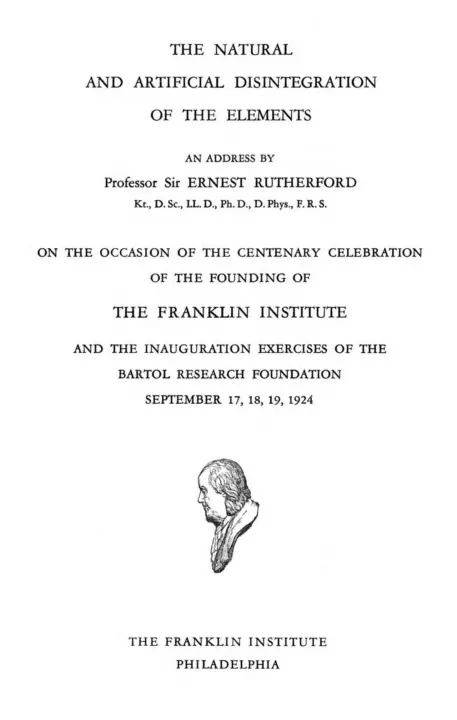
THE CLASSIC COLLECTION · 1924
"The Natural and Artificial Disintegration of the Elements" by Ernest Rutherford is a scientific publication presented as an address in the early 20th century. Written during the 1920s, the book discusses the fundamental concepts surrounding the structure of atomic nuclei, exploring both natural and artificial processes that lead to the disintegration of elements. Rutherford offers insights into radioactivity and nuclear transformations, articulating the significance of these phenomena in the broader framework of atomic theory. In this work, Rutherford delves into the properties of atomic nuclei, emphasizing that they consist of positively charged protons and negatively charged electrons. He outlines the complexities involved in studying the nucleus and describes experiments that illuminate the forces at play within it. The text covers various topics, including the dimensions of nuclei, the role of different particles during radioactive decay, and the implications of these findings for our understanding of the evolution of elements. Through a detailed examination of experimental results and theoretical frameworks, Rutherford aims to enhance our comprehension of atomic structure and the interactions that drive nuclear disintegration.
Introduction adapted from the source catalogue; source summaries may be automatically generated.
Free to read · English · 7,759 words · No account needed
MAKE TIME FOR A GOOD BOOK
On by default. Untick to stop anonymous reading totals. Each page counts after 10 seconds in view. How this works.
Anonymous counting is on unless you have switched it off.
At this stage of our knowledge it is of great importance to test whether the law of force breaks down for the distance of closest approach of an α particle to a nucleus. This can be done by comparing the observed with the calculated number of α particles scattered through angles of nearly 180°. It seems almost certain that the inverse square law must break down when swift α particles are used. This can be seen from the following argument. If an α particle, of the same speed as that ejected during the transformation of uranium, is fired directly at the uranium nucleus, it must penetrate into the nuclear structure. If a still swifter α particle is used, e. g. that from radium C, which has about twice the energy of the uranium α particle, it is clear that it must penetrate still more deeply into the nuclear structure. This is based on the assumption that the field due to a nucleus is approximately symmetrical in all directions. If this is not true, it may happen that only a fraction of the head-on collisions may be effective in penetrating the nucleus. It is hoped soon to attack this difficult problem experimentally.
We have so far dealt with collisions of an α particle with a heavy atom. We know, however, from the results of Rutherford, Chadwick and Bieler that in a collision of an α particle with the lightest atom, hydrogen, the law of the inverse square breaks down entirely when swift particles are used. Not only are the numbers of H nuclei set in swift motion much greater than is to be expected in the simple-point nucleus theory, but the change of number with the velocity of the α particle varies in the opposite way from the simple theory. Such wide departures between theory and experiment are only explicable if we assume either that the nuclei have sensible dimensions or that the inverse square law of repulsion entirely breaks down in such close collisions. If we suppose the complexity in structure and in laws of force is to be ascribed to the α particle rather than to the hydrogen nucleus, Chadwick and Bieler, as the result of a careful series of experiments, concluded that the α particle behaved as if it were a perfectly elastic body, spheroidal in shape with its minor axis 4 x 10^-13 cm. in the direction of motion and major axis 8 x 10^-13 cm. Outside this spheroidal region the forces fell off according to the ordinary inverse square law, but inside this region the forces increased so rapidly that a particle was reflected from it as from a perfectly elastic body. No doubt such a conception is somewhat artificial, but it does serve to bring out the essential points involved in the collision, viz., that when the nuclei approach within a certain critical distance of each other, forces come into play which vary more rapidly than the inverse square. It is difficult to ascribe this break-down of the law of force merely to the finite size or complexity of the nuclear structure or to its distortion, but the results rather point to the presence of new and unexpected forces which come into play at such small distances. This view has been confirmed by some recent experiments of Bieler in the Cavendish Laboratory in which he has made, by scattering methods, a detailed examination of the law of force in the neighborhood of a light nucleus like that of aluminum. For this purpose he compared the relative number of α particles scattered within the same angular limit from aluminum and from gold. For the range of angles employed, viz., up to 100°, it is assumed that the scattering of gold follows the inverse square law. He found that the ratio of the scattering in aluminum compared with that in gold depended on the velocity of the α particle. For example, for an α particle of 3.4 cms. range, the theoretical ratio was obtained for angles of deflection below 40° but was about 7 per cent lower for an average angle of deflection of 80°. On the other hand, for swifter particles of range 6.6 cms. a departure from the theoretical ratio was much more marked and amounted to 29 per cent for an angle of 80°. In order to account for these results he supposes that close to the aluminum nucleus an attractive force is superimposed on the ordinary repulsive forces. The results agreed best with the assumption that the attractive force varies according to the inverse fourth power of the distance and that the forces of attraction and repulsion balanced at about 3.4 x 10^-13 cm. from the nuclear center. Inside this critical radius the forces are entirely attractive; outside they are repulsive.
Your reading position is saved on this browser. Take it to another device with a library code. Reading pages adapt to text, rather than matching a printed edition.
Ernest Rutherford & Harriet Brooks
Ernest Rutherford
Ernest Rutherford
BEHIND THE BOOK
This eBook is for the use of anyone anywhere in the United States and most other parts of the world at no cost and with almost no restrictions whatsoever. You may copy it, give it away or re-use it under the terms of the Project Gutenberg License included with this eBook or online at www.gutenberg.org. If you are not located in the United States, you will have to check the laws of the country where you are located before using this eBook. Read the source licence.
The original source file, including credits and licence, is retained by this library. Request an original-format copy at no charge. Please include the book title and Project Gutenberg identifier #69551.
KEEP YOUR CURIOSITY GOING

John Muir

Asa Gray
Asa Gray

Florence Nightingale
Elizabeth Robins Pennell
Denison Olmsted