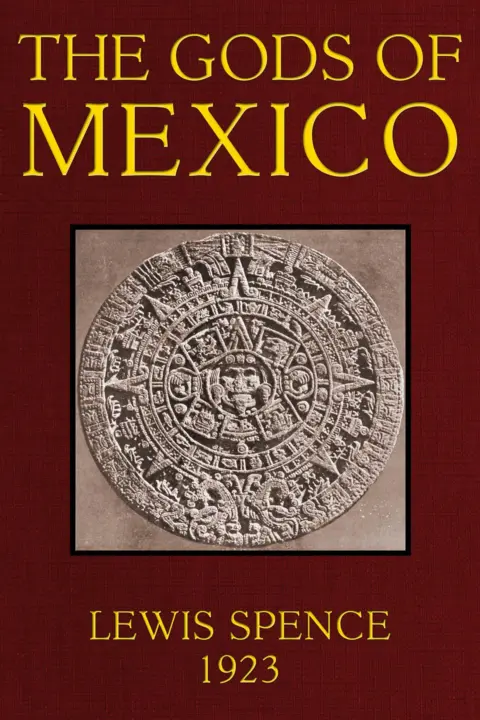
The gods of Mexico
Lewis Spence
THE CLASSIC COLLECTION · 1907
"The Mythologies of Ancient Mexico and Peru" by Lewis Spence is a historical account written in the early 20th century. The book explores the intricate mythologies of the ancient civilizations of Mexico and Peru, highlighting their unique religious beliefs, deities, and cultural practices. Spence aims to shed light on these fascinating yet often overlooked mythological systems, arguing for their significance comparable to those of other ancient cultures like Egypt and Greece. The book is divided into multiple chapters that detail various aspects of Mexican and Peruvian mythology. It begins with a discussion on the origins of these religions, tracing their development and independence from foreign influences. Spence goes on to examine major deities, rituals, and the complex social structures tied to religious practices in both civilizations. He describes gods like Huitzilopochtli, the Aztec god of war, and Quetzalcoatl, the feathered serpent, as well as the sacred rituals associated with them, which often included human sacrifice. The author emphasizes the indigenous nature of these mythologies while exploring their rich tapestry of stories and beliefs that shaped the lives of their adherents. Throughout the text, Spence places a strong emphasis on the universality of myth and the importance of understanding these ancient cultures in the context of world history.
Introduction adapted from the source catalogue; source summaries may be automatically generated.
Free to read · English · 16,607 words · No account needed
MAKE TIME FOR A GOOD BOOK
On by default. Untick to stop anonymous reading totals. Each page counts after 10 seconds in view. How this works.
Anonymous counting is on unless you have switched it off.
More convincing are the Mexican and Peruvian legends concerning the appearance of white and bearded culture-bringers. These legends are, it must be admitted, shadowy enough, but are so persistent and resemble each other so closely as to give some grounds for the supposition that at some period in the history of Mexico or Peru a member or members of the 'Caucasian' race may have stumbled into these civilisations through the accidents of shipwreck. But it is exceedingly dangerous to premise anything of the sort; and, as has been said before, the influence of such wanderers could only have been infinitesimal.
Enough, then, has been said to show that the origins of the religions of Mexico and Peru could not have been of any other than an indigenous nature. Their evolution took place wholly upon American soil, and if resemblances appear in their systems to the mythologies or religions of Asia, they are explicable by that law now so well known to anthropologists and students of comparative religion, that, given similar circumstances, and similar environments, the evolution of the religious beliefs of widely separated peoples will proceed upon similar lines.
(Those authorities marked with an asterisk are also applicable to the subject of Peruvian Mythology).
SAHAGUN, Historia General de las Cosas de Nueva Espana. (English translation edited for the Hakluyt Society by Clements R. Markham in 1880.)
TORQUEMADA, Los veynte y un libros Rituales y Monarchia Yndiana.
IXTLILXOCHITL, 'Historia Chichimeca' and 'Relaciones' in Lord Kingsborough's Mexican Antiquities, vol. ix.
PRESCOTT, Conquest of Mexico.
*HUMBOLDT, Vues des Cordilleres et Monuments des Peuples de
l'Amerique.
CLAVIGERO, Storia antica del Messico. (English translation by Charles Cullen. London, 1787.)
BRASSEUR DE BOURBOURG, Histoires des Nations civilisees du
Mexique et de l'Amerique-centrale, and Quatre Lettres sur le
Mexique.
BANCROFT, Native Races of the Pacific States of North America.
KINGSBOROUGH, Antiquities of Mexico.
*REVILLE, The Hibbert Lectures, 1884.
*PAYNE, History of the New World, vols. i. and ii.
TYLOR, Anahuac.
BRINTON, The Myths of the New World.
WINSOR, Narrative and Critical History of America.
MONTESINOS, Memoires historiques sur l'Ancien Perou. (Translated from the Spanish MS. in Ternaux-Compans, vol. xvii.)
GARCILASSO DE LA VEGA, Comentarios reales. (English translation for the Hakluyt Society by Clements R. Markham. London, 1869, 1871.)
LACROIX, 'Perou,' in vol. iv. of L'Amerique in L'Univers
Pittoresque.
HUTCHINSON, Two Years in Peru, with Explorations of its
Antiquities. London, 1873.
PRESCOTT, Conquest of Peru, 1848 (or better, Sonnenschein's new edition, or that in Everyman's Library).
MARKHAM, A History of Peru, 1892; and Rites and Laws of the Incas.
LORENTE, Historia Antigua del Peru, 1860-3.
Your reading position is saved on this browser. Take it to another device with a library code. Reading pages adapt to text, rather than matching a printed edition.
BEHIND THE BOOK
This eBook is for the use of anyone anywhere in the United States and most other parts of the world at no cost and with almost no restrictions whatsoever. You may copy it, give it away or re-use it under the terms of the Project Gutenberg License included with this eBook or online at www.gutenberg.org. If you are not located in the United States, you will have to check the laws of the country where you are located before using this eBook. Read the source licence.
The original source file, including credits and licence, is retained by this library. Request an original-format copy at no charge. Please include the book title and Project Gutenberg identifier #36386.
KEEP YOUR CURIOSITY GOING
Cécile Tormay

Moritz Busch
John L. Ransom

Maurice Baring
Frances Wright
Cécile Tormay