
Last letters from the living dead man
David Patterson (Spirit) Hatch
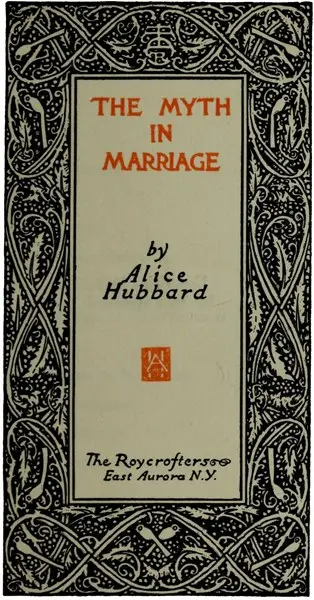
THE CLASSIC COLLECTION · 1912
"The Myth in Marriage" by Alice Hubbard is a philosophical exploration of the institution of marriage, written in the early 20th century. This book discusses the various dimensions of marital relationships, including the interplay between romance and the practical realities of shared life. It seeks to illuminate the often-overlooked aspects of marriage, presenting it as a complex partnership that demands understanding beyond the romantic idealism associated with it. In "The Myth in Marriage," Hubbard presents a critical analysis of the institution, arguing that many enter into marriage with unrealistic expectations driven by societal norms and romantic ideals. The text delves into the business aspects of marriage, emphasizing the responsibilities and economic realities that couples face after the initial romance fades. Hubbard also critiques the traditional roles and dependencies created within marriage, advocating for the recognition of individuality and mutual respect. Throughout the book, she makes a case for the need for both partners to maintain their economic independence and personal identity to ensure a healthy and lasting relationship, ultimately calling for a transformation in how society views marriage as a partnership grounded in both love and practicality.
Introduction adapted from the source catalogue; source summaries may be automatically generated.
Free to read · English · 7,674 words · No account needed
MAKE TIME FOR A GOOD BOOK
On by default. Untick to stop anonymous reading totals. Each page counts after 10 seconds in view. How this works.
Anonymous counting is on unless you have switched it off.
There is left a social situation. These two young people have had something in common, and possibly only a transitory something.
How shall they live together when she loves what he hates, and he has hopes, ambitions, desires that are nothing to her?
"He has cheated me!" "She has fooled me!" is their heart-cry.
The truth, however, is something like this: "We have been deceived. Nature said one thing to us, and we confused with it something else and thought what society said was true. We have been deceived."
There was nothing in the first attraction that made these two understand anything about hardships, disagreeable duties, discomforts, weariness, pain.
Those who are anxious to uphold church authority are saying a good deal about the divorce evil. They bring statistics to show that one out of every twelve marriages results in divorce.
They have not, however, secured any statistics as to whether the people in the other eleven marriages enjoy what our Constitution affirms to be the rights of American citizens: life, liberty and the pursuit of happiness.
The Church is talking about a "cure" for the divorce evil! One bishop earnestly recommends the Jewish anathematization, "Let neither party ever be spoken to again." But how would this remedy the social condition of the two?
This is punishment, but not cure. The cause of the trouble is not even
looked for by the bishop.
"Is marriage a failure?" According to the divorce-courts it is.
The Church concedes that one-twelfth of all marriages are failures.
I am not surprised that some make shipwreck, but that any come to
port.--Stevenson.
A social marriage is based on the idea of a high and lofty friendship, an indissoluble partnership, an intimacy of relationship unknown in any other phase of existence.
Such a marriage was not intended by Nature. A new element is introduced when a social marriage occurs of which Nature had no thought, and we should reckon with this, not without it.
This new element is the intellect. Nature does not recognize it in the cosmic urge. So the meeting of man and woman on an intellectual plane, on a basis of the sweetest friendship imaginable, is the only condition by which Nature can endure the social marriage tie--which so often binds, imprisons, and makes slaves.
Even at this time man considers that he owns a woman; that he has purchased her freedom, her will, her habits, her aspirations, her time, her love, her energies, her future, every activity of her life. She is in very truth under a master. And the woman, as well, usually considers this true.
Your reading position is saved on this browser. Take it to another device with a library code. Reading pages adapt to text, rather than matching a printed edition.
BEHIND THE BOOK
This eBook is for the use of anyone anywhere in the United States and most other parts of the world at no cost and with almost no restrictions whatsoever. You may copy it, give it away or re-use it under the terms of the Project Gutenberg License included with this eBook or online at www.gutenberg.org. If you are not located in the United States, you will have to check the laws of the country where you are located before using this eBook. Read the source licence.
The original source file, including credits and licence, is retained by this library. Request an original-format copy at no charge. Please include the book title and Project Gutenberg identifier #42760.
KEEP YOUR CURIOSITY GOING
David Patterson (Spirit) Hatch
Coulson Kernahan

Ralph Waldo Emerson
Frances Wright

Edwin Abbott Abbott

Joseph Droz