
Last letters from the living dead man
David Patterson (Spirit) Hatch
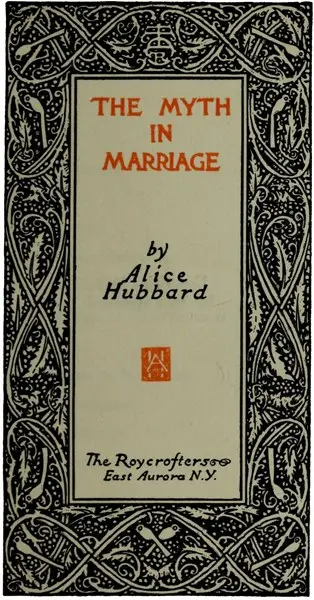
THE CLASSIC COLLECTION · 1912
"The Myth in Marriage" by Alice Hubbard is a philosophical exploration of the institution of marriage, written in the early 20th century. This book discusses the various dimensions of marital relationships, including the interplay between romance and the practical realities of shared life. It seeks to illuminate the often-overlooked aspects of marriage, presenting it as a complex partnership that demands understanding beyond the romantic idealism associated with it. In "The Myth in Marriage," Hubbard presents a critical analysis of the institution, arguing that many enter into marriage with unrealistic expectations driven by societal norms and romantic ideals. The text delves into the business aspects of marriage, emphasizing the responsibilities and economic realities that couples face after the initial romance fades. Hubbard also critiques the traditional roles and dependencies created within marriage, advocating for the recognition of individuality and mutual respect. Throughout the book, she makes a case for the need for both partners to maintain their economic independence and personal identity to ensure a healthy and lasting relationship, ultimately calling for a transformation in how society views marriage as a partnership grounded in both love and practicality.
Introduction adapted from the source catalogue; source summaries may be automatically generated.
Free to read · English · 7,674 words · No account needed
MAKE TIME FOR A GOOD BOOK
On by default. Untick to stop anonymous reading totals. Each page counts after 10 seconds in view. How this works.
Anonymous counting is on unless you have switched it off.
Politicians are interested in acquiring and holding power, in war appliances and armies. They give some assistance in the development and care of vegetables, fruits, trees, and the flora in general. They are also interested in the development of all domesticated animals, the preservation of the birds, forests and natural parks, the protection of the fish. They have game-laws which are wise and whose results are beneficial.
And the state hires and pays people to take care of all these interests. It also hires and pays people who see that the laws are respected which have been made for the protection and perpetuity of flora and fauna.
But as yet, lawmakers, politicians, reformers, and influential citizens have not made provision for the development of citizens, except as the institution of the school system assists in this work.
Thou givest man bread. Let my aim be to give man himself.--Froebel.
There was a time when women, like statesmen, were economically free. They spun and wove, manufactured, planted, harvested, cooked. Land was cheap and needs were few. The women gave a part of their time to the state in rearing citizens, but they did not give all. They were self-supporting, in great measure; therefore, self-respecting and capable.
But women lost their economic independence when industries were taken from
the home.
Farming, dairying, spinning, weaving, tailoring, laundering, baking, dressmaking, millinery, building, carpentering, are all done on a big scale, outside of the home, where the women, because they were mothers, could not follow their industries.
Women are left with the dependent occupations of working for the state and working for their husbands, for neither of which can they collect money.
Husbands' policy is: Where the treasury is, there will the wives' hearts
be also.
The welfare of the women who give their time--twenty-four hours of the day, and for twenty-five or thirty years of their lives, their prime--for the development of citizens has been left to chance.
The state has made no provision whereby potential citizens shall be
assured of the proper care.
The mother's time has been considered of no value, that is, her service is not paid for in money.
If, in her youth, a woman married a man who was able to make money, she might be assured of food, clothing and shelter for her children unless or until Fortune frowned and the property was lost.
Any woman, whose husband dies, gives her time to the care of her children, no matter how poorly equipped she may be to earn a living for them in the world. She tries to do her own work, and besides that, what her husband did--maintain the family.
Your reading position is saved on this browser. Take it to another device with a library code. Reading pages adapt to text, rather than matching a printed edition.
BEHIND THE BOOK
This eBook is for the use of anyone anywhere in the United States and most other parts of the world at no cost and with almost no restrictions whatsoever. You may copy it, give it away or re-use it under the terms of the Project Gutenberg License included with this eBook or online at www.gutenberg.org. If you are not located in the United States, you will have to check the laws of the country where you are located before using this eBook. Read the source licence.
The original source file, including credits and licence, is retained by this library. Request an original-format copy at no charge. Please include the book title and Project Gutenberg identifier #42760.
KEEP YOUR CURIOSITY GOING
David Patterson (Spirit) Hatch
Coulson Kernahan

Ralph Waldo Emerson
Frances Wright

Edwin Abbott Abbott

Joseph Droz