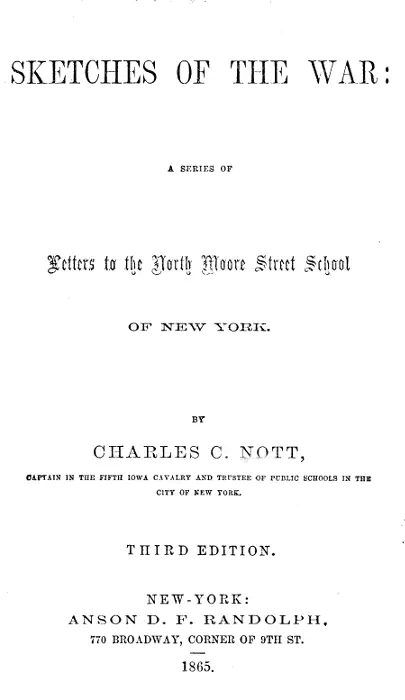
Sketches of the War A Series of Letters to the North Moore Street School of New York
Charles C. Nott
THE CLASSIC COLLECTION · 1908
"The Mystery of the Pinckney Draught" by Charles C. Nott is a historical account written in the early 20th century. The book explores the enigmatic contribution of Charles Pinckney, a lesser-known figure in the creation of the U.S. Constitution, focusing on his draught presented at the Constitutional Convention. It delves into the controversies surrounding the authenticity of the draught and its influence on the final Constitution, raising questions about authorship and credit in the founding documents of the United States. At the start of the narrative, the author introduces the central topic by recounting the historical context of Pinckney's draught, which he presented during the Convention but received little acknowledgment from contemporary observers. Nott discusses how the original records were sealed upon the Convention's conclusion, leading to a mysterious absence of the draught for decades. Eventually, intrigue surrounding the document emerges when John Quincy Adams seeks it nearly thirty years later. The initial chapters examine documents from the time and outline the key players, including James Madison, whose views and criticisms of Pinckney's work provide a nuanced perspective on the value and legacy of the draught in the broader historical narrative of American governance.
Introduction adapted from the source catalogue; source summaries may be automatically generated.
Free to read · English · 60,558 words · No account needed
MAKE TIME FOR A GOOD BOOK
On by default. Untick to stop anonymous reading totals. Each page counts after 10 seconds in view. How this works.
Anonymous counting is on unless you have switched it off.
"I am in possession of a copied draught of a federal system intended to be proposed if something nearly similar shall not precede it. Some of its principal features are taken from the New York system of government. A house of delegates and senate for a general legislature, as to the great business of the Union. The first of them to be chosen by the legislature of each State, in proportion to its number of white inhabitants, and three-fifths of all others, fixing a number for sending each representative. The second, to-wit the senate, to be elected by the delegates so returned, either from themselves or the people at large, in four great districts, into which the United States are to be divided for the purpose of forming this senate from which, when so formed, is to be divided into four classes for the purpose of an annual rotation of a fourth of the members. A president having only executive powers for seven years." (Read's Life of George Read of Delaware p. 443.)
This letter is very far from being conclusive. In the first place it does not appear that Mr. Read had seen the original of this "copied draught" or that Pinckney had given him the copy or had told him what his plan was or that any person who had seen the original draught had told him what it contained. In the second place the existence of an unauthenticated copy on the 20th of May does not conclusively prove that a different version of the same draught was not presented to the Convention on the 29th of May. Still this letter undoubtedly refers to Pinckney's draught and compels a more searching examination of the question raised than would otherwise be necessary.
In a paper which will be called, briefly, "the Observations" written by Pinckney before he left Charleston he sets forth at length a description of his plan of government. In the opening paragraph of this paper he says that he will "give each article" of his draught "that either materially varies" from the present government "or is new." He then goes on to say that "the first important alteration is that of the principle of representation." "Representation is a sign of the reality. Upon this principle, however abused, the Parliament of Great Britain is formed, and it has been universally adopted by the States in the formation of their legislatures." This is all which Pinckney, writing before the Convention began its work, had to say concerning the lower house of Congress. His Senate was new and concerning it he had much more to say, and he described it. But of the lower house, the popular body, he had nothing to say save that there would be such a house, and that it would rest upon the principle of representation "universally adopted by the States in the formation of their legislatures." The Virginia resolutions undoubtedly expressed the opinion of substantially all Americans when they said, "Resolved that the members of the first branch of the national legislature ought to be elected by the people of the several States." Assuredly if the draught which Pinckney was then describing had contained the extraordinary and novel proposition that the popular branch of the national legislature, the body which should represent the people, was not to be chosen by the people he would have had something "new" to lay before the Convention--something which did not exist in the government of any English speaking people in the world--something which "materially varied" from the belief and usage and history and traditions of the people who were to ordain this Constitution. Knowing Pinckney as we do--his general views, his adherence to the general principles of the British constitution, his attentive study of State constitutions, his outspokenness, his belief in his own devices, we know that if his draught had then contained so radical a departure from all existing constitutions as that which he subsequently proposed in the Convention, and if he had worked himself into a belief at the time when he wrote the Observations that the election of their representatives by the people was "theoretical nonsense", he could not have refrained from saying so. What is said in the Observations harmonized with the constitutions of every State in the Confederation and with the Virginia resolutions and with the views of every member of the Convention excepting the five great land owners from South Carolina.
Your reading position is saved on this browser. Take it to another device with a library code. Reading pages adapt to text, rather than matching a printed edition.
BEHIND THE BOOK
This eBook is for the use of anyone anywhere in the United States and most other parts of the world at no cost and with almost no restrictions whatsoever. You may copy it, give it away or re-use it under the terms of the Project Gutenberg License included with this eBook or online at www.gutenberg.org. If you are not located in the United States, you will have to check the laws of the country where you are located before using this eBook. Read the source licence.
The original source file, including credits and licence, is retained by this library. Request an original-format copy at no charge. Please include the book title and Project Gutenberg identifier #40904.
KEEP YOUR CURIOSITY GOING
Cécile Tormay

Moritz Busch
John L. Ransom
Frances Wright
Cécile Tormay

Mabel Potter Daggett