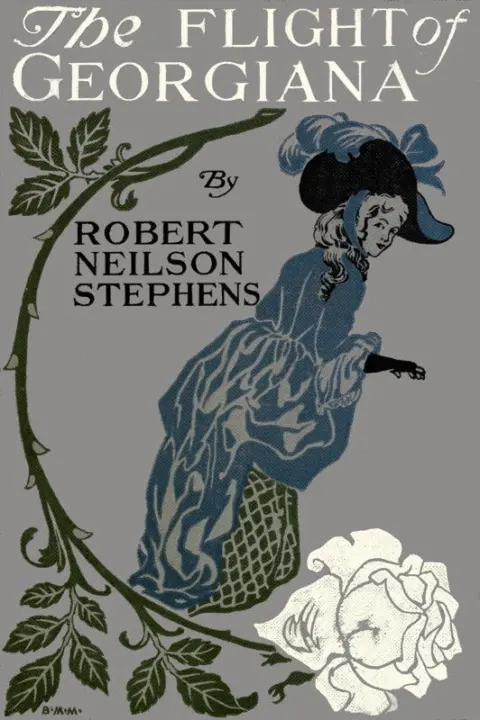
The Flight of Georgiana: A Story of Love and Peril in England in 1746
Robert Neilson Stephens
THE CLASSIC COLLECTION · 1903
"The Mystery of Murray Davenport: A Story of New York at the Present Day" by Robert Neilson Stephens is a novel set in the early 20th century. The narrative revolves around a young writer named Thomas Larcher, who becomes embroiled in a quest to uncover the life and circumstances of a man named Murray Davenport, as requested by a mysterious young woman named Edna. This quest unfolds against the vibrant backdrop of contemporary New York, blending themes of ambition, love, and the artistic struggle. The opening of the story introduces Thomas Larcher on a rainy August night in New York, where he receives an unexpected telegram from Edna, inviting him for a meeting that reveals her unusual interest in Murray Davenport, an artist and writer whose circumstances she wishes to explore. As Larcher prepares to delve into the life of Davenport, he navigates the bustling city and its eclectic characters, starting with a consultation with a friend who has connections in the art community. The beginning effectively sets the stage for a mystery intertwined with personal ambitions and complex relationships, while hinting at deeper challenges awaiting both Larcher and Davenport in their respective journeys.
Introduction adapted from the source catalogue; source summaries may be automatically generated.
Free to read · English · 62,395 words · No account needed
MAKE TIME FOR A GOOD BOOK
On by default. Untick to stop anonymous reading totals. Each page counts after 10 seconds in view. How this works.
Anonymous counting is on unless you have switched it off.
“Yes,” said Davenport, unmoved. “Just the amount of Bagley's wealth that morally belongs to me, not considering interest. I could use it, too, to very good advantage. With my skill in the art of frugal living, I could make it go far--exceedingly far. I could realize that plan of a congenial life, which I told you of one night here. There it is; here am I; and if right prevailed, it would be mine. Yet if I ventured to treat it as mine, I should land in a cell. Isn't it a silly world?”
He languidly replaced the bills between the notebook covers, and put them in the drawer. As he did so, his glance fell on a sheet of paper lying there. With a curious, half-mirthful expression on his face, he took this up, and handed it to Larcher, saying:
“You told me once you could judge character by handwriting. What do you make of this man's character?”
Larcher read the following note, which was written in a small, precise,
round hand:
“MY DEAR DAVENPORT:--I will meet you at the place and time you suggest. We can then, I trust, come to a final settlement, and go our different ways. Till then I have no desire to see you; and afterward, still less. Yours truly,
“Francis Turl,” repeated Larcher. “I never heard the name before.”
“No, I suppose you never have,” replied Davenport, dryly. “But what character would you infer from his penmanship?”
“Well,--I don't know.” Put to the test, Larcher was at a loss. “An educated person, I should think; even scholarly, perhaps. Fastidious, steady, exact, reserved,--that's about all.”
“Not very much,” said Davenport, taking back the sheet. “You merely describe the handwriting itself. Your characterization, as far as it goes, would fit men who write very differently from this. It fits me, for instance, and yet look at my angular scrawl.” He held up a specimen of his own irregular hand, beside the elegant penmanship of the note, and Larcher had to admit himself a humbug as a graphologist.
“But,” he demanded, “did my description happen to fit that particular man--Francis Turl?”
“Oh, more or less,” said Davenport, evasively, as if not inclined to give any information about that person. This apparent disinclination increased Larcher's hidden curiosity as to who Francis Turl might be, and why Davenport had never mentioned him before, and what might be between the two for settlement.
Your reading position is saved on this browser. Take it to another device with a library code. Reading pages adapt to text, rather than matching a printed edition.
Robert Neilson Stephens
Robert Neilson Stephens
Robert Neilson Stephens
Robert Neilson Stephens
BEHIND THE BOOK
This eBook is for the use of anyone anywhere in the United States and most other parts of the world at no cost and with almost no restrictions whatsoever. You may copy it, give it away or re-use it under the terms of the Project Gutenberg License included with this eBook or online at www.gutenberg.org. If you are not located in the United States, you will have to check the laws of the country where you are located before using this eBook. Read the source licence.
The original source file, including credits and licence, is retained by this library. Request an original-format copy at no charge. Please include the book title and Project Gutenberg identifier #9185.
KEEP YOUR CURIOSITY GOING
Coulson Kernahan

Maurice Baring
Frances Wright
Cécile Tormay

Frederic Jesup Stimson

W. H. P. (William Henry Pope) Jarvis