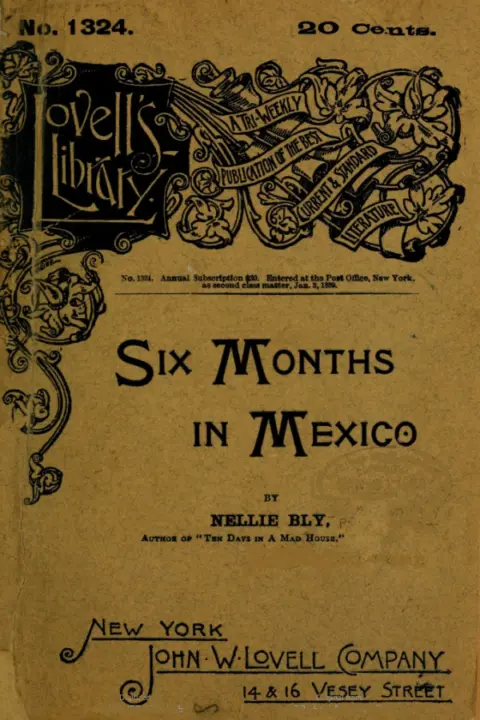
Six Months in Mexico
Nellie Bly
THE CLASSIC COLLECTION · 1889
"The Mystery of Central Park" by Nellie Bly is a novel written in the late 19th century. The story revolves around characters Dick Treadwell and Penelope Howard, who stumble upon a mysterious case involving the death of a beautiful girl found in Central Park. The narrative is rich with themes of societal class struggles and the complexities of love, as both characters navigate their feelings for each other amidst the chaos of the unsolved mystery. The opening of the book introduces Dick Treadwell and Penelope Howard as they engage in a tense conversation about their relationship while sitting on a park bench. Their discussion is abruptly disrupted when they discover a young girl lying unconscious on another bench, which leads to the shocking revelation that she is dead. As news of the mysterious death spreads, both characters find themselves at the center of public intrigue, with Dick feeling the pressure of suspicion placed upon him. The scene sets the tone for a deeper exploration of themes such as poverty, morality, and the complexities of human relationships as the story unfolds.
Introduction adapted from the source catalogue; source summaries may be automatically generated.
Free to read · English · 33,312 words · No account needed
MAKE TIME FOR A GOOD BOOK
On by default. Untick to stop anonymous reading totals. Each page counts after 10 seconds in view. How this works.
Anonymous counting is on unless you have switched it off.
“Aha! Away from yer tables durin’ work hours. I’ll pay yer fer this, I’ll dock every one of you,” yelled the foreman, who at this instant entered the workroom.
The girls, frightened, crept quietly back to their work, but Dido still continued to bathe the girl’s head.
“Here, you daisy on the floor, you’ll disobey me, hey? I’ll dock yer twice,” brutally spoke the foreman as he caught a glimpse of Dido’s head across the table.
She looked at him with scorn. If glances could kill, he would have died at her feet. Still, she managed to say, quietly:
“Maggie Williams has fainted.”
“And because a girl faints must all the shop stop work and disobey rules, eh? I’ll pay yer for this. I’ll teach yer,” he vowed, as he quitted the room.
Dido, unmindful of his brutal threats, turned her attention to Maggie, who in a short time opened her eyes and tried to rise.
“Lie still awhile yet, Maggie,” urged her self-appointed nurse. “I’ll hold your head on my knee. Don’t you feel better now?”
But the girl made no reply. Her small gray eyes stared unblinkingly, unseeingly, up at the smoked rafters of the ceiling.
“What is it, Maggie?” asked the kindly Dido, smoothing the wet, tangled hair, her slender fingers expressing the sympathy which found no utterance in words. “Are you still ill? Shall I take you home to your mother?”
The stare in the small gray eyes grew softer and softer; the corners of the mouth drew down into a pitiful curve, the under lip quivering like a tiny leaf in a strong wind; turning her face down, she sobbed vehemently.
Drawing the poor thin body into a closer embrace, Dido sought to
comfort the weeping girl.
Some of the nearest workers hearing those low, heavy sobs, started nervously, and their hands were not as cunning as usual as they covered the boxes, but they dared not go near their unhappy companion or speak the sympathy they felt.
“I’m awfully sorry, Maggie,” whispered Dido, “don’t cry so; you’ll feel better by-and-by.”
“Mother’s dead,” blurted out Maggie.
Dido was stunned into silence by this communication. She could say
nothing.
What could you say to a girl when her mother is dead?
What could console a girl at such a time?
Maggie told Dido that the dead body of her mother, who, for a year past, had been confined to her bed with consumption, was lying alone, uncared for, at home.
Your reading position is saved on this browser. Take it to another device with a library code. Reading pages adapt to text, rather than matching a printed edition.
Nellie Bly
BEHIND THE BOOK
This eBook is for the use of anyone anywhere in the United States and most other parts of the world at no cost and with almost no restrictions whatsoever. You may copy it, give it away or re-use it under the terms of the Project Gutenberg License included with this eBook or online at www.gutenberg.org. If you are not located in the United States, you will have to check the laws of the country where you are located before using this eBook. Read the source licence.
The original source file, including credits and licence, is retained by this library. Request an original-format copy at no charge. Please include the book title and Project Gutenberg identifier #69984.
KEEP YOUR CURIOSITY GOING
Coulson Kernahan

Maurice Baring
Frances Wright
Cécile Tormay

Frederic Jesup Stimson

W. H. P. (William Henry Pope) Jarvis