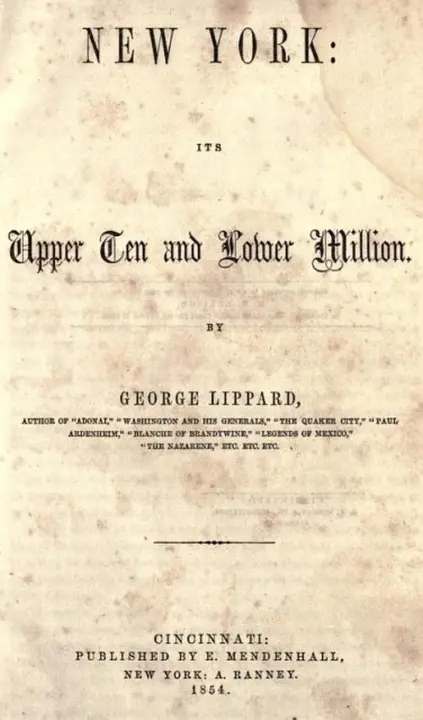
New York: Its Upper Ten and Lower Million
George Lippard
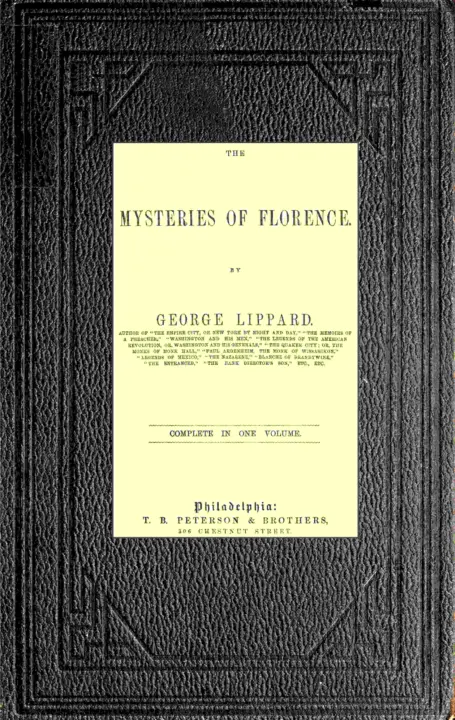
THE CLASSIC COLLECTION · 1864
"The Mysteries of Florence" by George Lippard is a historical novel written in the mid-19th century. The story is set against the backdrop of Florence and revolves around the castle of Albarone and its inhabitants, particularly the sick Count Julian, his son Adrian, and the enigmatic scholar Aldarin. The titular mysteries encompass dark family secrets, potential murder, and a web of intrigue that binds the characters together. The opening of the novel introduces readers to a picturesque yet haunting setting—an ancient castle overlooking the valley of Florence under a moonlit sky. The narrative establishes a sense of foreboding as a weary traveler reflects on the grandeur and tragedies of the castle of Albarone. As we transition into the story, we meet Robin, a rough soldier lamenting the lack of merriment in the castle, along with the jovial page Guiseppo, who hints at significant transformations in the lineage of Albarone. Tension builds with the introduction of Aldarin, who holds sway over the ailing Count Julian, further hinting at hidden motives and dark prophecies associated with a signet ring. This sets the stage for a convoluted tale of betrayal, love, and the quest for power, as familial relationships intertwine under the shadows of their ancestral home.
Introduction adapted from the source catalogue; source summaries may be automatically generated.
Free to read · English · 107,340 words · No account needed
MAKE TIME FOR A GOOD BOOK
On by default. Untick to stop anonymous reading totals. Each page counts after 10 seconds in view. How this works.
Anonymous counting is on unless you have switched it off.
There were bracelets for the wrists, there were chains for the arching neck, gems for the brow, pearls to be woven in the flowing hair; and as their bright and star-like blaze met the eye of the Ladye Annabel, she gave utterance to a cry of delight.
“I thank thee, father, I thank thee!” she exclaimed, as, clasping a bracelet of gold, bordered by pearls, around her fair and well-rounded wrist, she received it with a glance of admiration. “See, father, see! How beauteous are those pearls, how bright that gold, and the shape--how exquisite! O! father, this is kind of thee! ’Tis indeed a rich gift!”
“It is a bridal gift!” exclaimed the Count, in a low and quiet tone, and with his eyes fixed upon his daughter’s countenance, as if to note each varying expression of the fair and lovely features.
Annabel started as if an adder had stung her.
“A bridal gift? Said you not so? A bridal gift? From whom is it, my
father?”
“His grace, the Duke of Florence, sends thee this rare and costly present. He sends it with his ardent wishes for thy health. He sends these jewels with the hope that ere three days have run their sands, he may behold them shining on the brow of his fair bride--the Ladye Annabel, Duchess of Florence.”
As in a calm and determined tone he spoke these words, a deadly paleness came over the damsel’s face; her lips dropped apart, and her fair blue eyes distended with a vacant look, the slender fingers of each hand slowly straightened, unclasping their grasp of the casket, which fell heavily to the floor, as her arms dropped listlessly by her side.
The old man surveyed his child for an instant with a look which told of his deep, his yearning affection, combined with the strange fancies ruling his destiny through life. In an instant he again spoke, and his voice, as it came from the depths of his chest, sounded wild and thrilling to the maiden’s ear.
“My daughter!” said he, taking her by the hand, “thou shall wed this
man!”
Annabel replied not.
“Thou shalt, I say, wed the Lord of Florence. It must be so; therefore it were well that thou dost prepare thee for the bridal. I say it shall be so, my daughter. The word of Aldarin is passed!”
“Father,” replied the Ladye Annabel, in tremulous tones; “father, O! look not so sternly at me, your eyes chill my very heart. I would do your bidding--the Virgin and all the saints witness me, I would--but, father--”
Your reading position is saved on this browser. Take it to another device with a library code. Reading pages adapt to text, rather than matching a printed edition.
George Lippard
BEHIND THE BOOK
This eBook is for the use of anyone anywhere in the United States and most other parts of the world at no cost and with almost no restrictions whatsoever. You may copy it, give it away or re-use it under the terms of the Project Gutenberg License included with this eBook or online at www.gutenberg.org. If you are not located in the United States, you will have to check the laws of the country where you are located before using this eBook. Read the source licence.
The original source file, including credits and licence, is retained by this library. Request an original-format copy at no charge. Please include the book title and Project Gutenberg identifier #62760.
KEEP YOUR CURIOSITY GOING
Cécile Tormay

Moritz Busch
Coulson Kernahan
John L. Ransom

Maurice Baring
Frances Wright