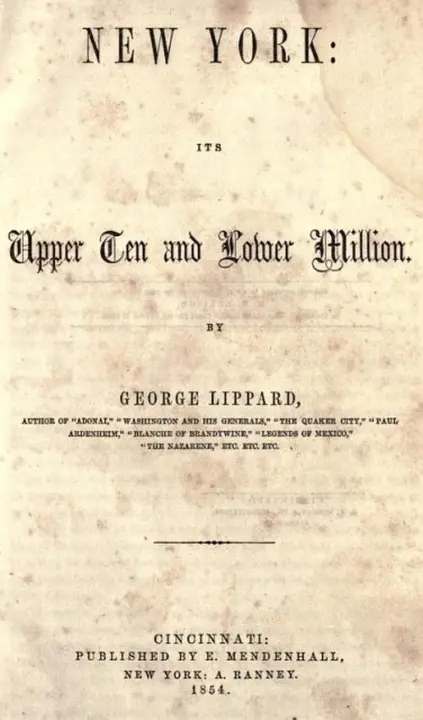
New York: Its Upper Ten and Lower Million
George Lippard
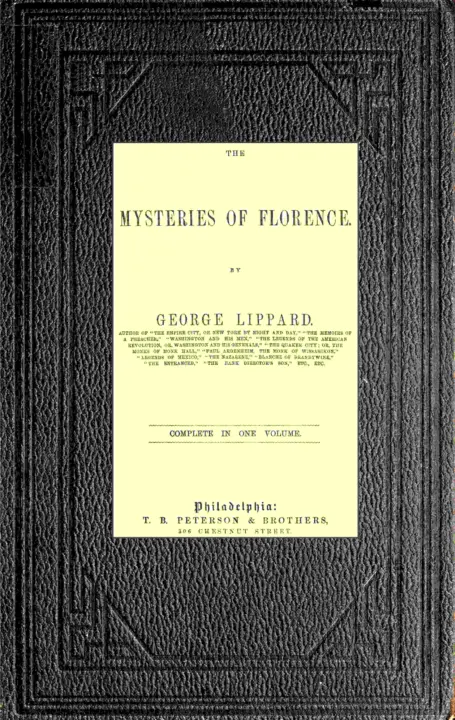
THE CLASSIC COLLECTION · 1864
"The Mysteries of Florence" by George Lippard is a historical novel written in the mid-19th century. The story is set against the backdrop of Florence and revolves around the castle of Albarone and its inhabitants, particularly the sick Count Julian, his son Adrian, and the enigmatic scholar Aldarin. The titular mysteries encompass dark family secrets, potential murder, and a web of intrigue that binds the characters together. The opening of the novel introduces readers to a picturesque yet haunting setting—an ancient castle overlooking the valley of Florence under a moonlit sky. The narrative establishes a sense of foreboding as a weary traveler reflects on the grandeur and tragedies of the castle of Albarone. As we transition into the story, we meet Robin, a rough soldier lamenting the lack of merriment in the castle, along with the jovial page Guiseppo, who hints at significant transformations in the lineage of Albarone. Tension builds with the introduction of Aldarin, who holds sway over the ailing Count Julian, further hinting at hidden motives and dark prophecies associated with a signet ring. This sets the stage for a convoluted tale of betrayal, love, and the quest for power, as familial relationships intertwine under the shadows of their ancestral home.
Introduction adapted from the source catalogue; source summaries may be automatically generated.
Free to read · English · 107,340 words · No account needed
MAKE TIME FOR A GOOD BOOK
On by default. Untick to stop anonymous reading totals. Each page counts after 10 seconds in view. How this works.
Anonymous counting is on unless you have switched it off.
Some traditions, dim and indistinct, yet fraught with wild mysteries, named the figure as the representation of the Northern-God ODIN, stating that in ages long gone by, it had been worshipped with infant sacrifice and midnight bloodshed, while the Lords of Albarone flung themselves in awe beneath its gloomy shadow.
Other legends named the rude creation of rocks as the Demon of the race of Albarone, brooding silently over the tomb of the Lords, while its heart of stone was sentient with a strange soul, its broad chest impassioned a conscious spirit, its giant limbs were instinct with a fearful life, and its eyes looked forth with an expression that froze the blood of the gazer to behold.
Such were the legends, differing in their style and incident, yet all uniting in throwing the veil of mystery and shadow over the dark, dread form of stone.
It was seen but once in the life time of a Lord of Albarone, when he celebrated the funeral rites of his predecessor, and the demon-form once seen, the cavern of the dead was never traversed by his living form again.
Thrice the funeral train passed round the tomb, the esquires bearing the upright corse, thrice they raised the wild chaunt of the battle-song of Albarone, while far and wide the depths of the cavern gave back the sound, swelling in a thousand echoes, like successive claps of August thunder.
The death-couch was then rested upon the platform of stone.
The ancient Esquires slowly raised the corse, again the battle-cry swelled through the cavern, the men-at-arms wildly clashed their swords together, while the banner streamed proudly in the torch-light.
“Men of Albarone!” spoke the solemn tones of the Azure-Knight; “The Count Julian of Albarone is laid beside his fathers!”
Louder clashed the swords, more proudly waved the banner, and higher and yet higher swelled the song as the mailed corse was placed in the cavity, side by side with its ancestors.
The figure in azure armor glanced round upon the group of men-at-arms, and exclaimed in a deep-toned voice, that thrilled to every heart--
“Fall back, vassals of Albarone. Let Aldarin, brother of the late Lord,
advance!”
Aldarin advanced with a sneer upon his pale countenance.
“Ha--ha!” he muttered to himself, “they think to frighten me with their senseless mummery--their childish mockery! Frighten Aldarin with superstition--Aldarin, who believes not in their God! Ha--ha! I am here,” he continued aloud--“What would ye with me?”
“Old man!” exclaimed the Stranger-knight, “look upon the corse of thy murdered brother.--Behold the features pale with death; the clammy brow, the sunken cheek, the livid lip--look upon that corse, and say you did not do the murder!”
Your reading position is saved on this browser. Take it to another device with a library code. Reading pages adapt to text, rather than matching a printed edition.
George Lippard
BEHIND THE BOOK
This eBook is for the use of anyone anywhere in the United States and most other parts of the world at no cost and with almost no restrictions whatsoever. You may copy it, give it away or re-use it under the terms of the Project Gutenberg License included with this eBook or online at www.gutenberg.org. If you are not located in the United States, you will have to check the laws of the country where you are located before using this eBook. Read the source licence.
The original source file, including credits and licence, is retained by this library. Request an original-format copy at no charge. Please include the book title and Project Gutenberg identifier #62760.
KEEP YOUR CURIOSITY GOING
Cécile Tormay

Moritz Busch
Coulson Kernahan
John L. Ransom

Maurice Baring
Frances Wright