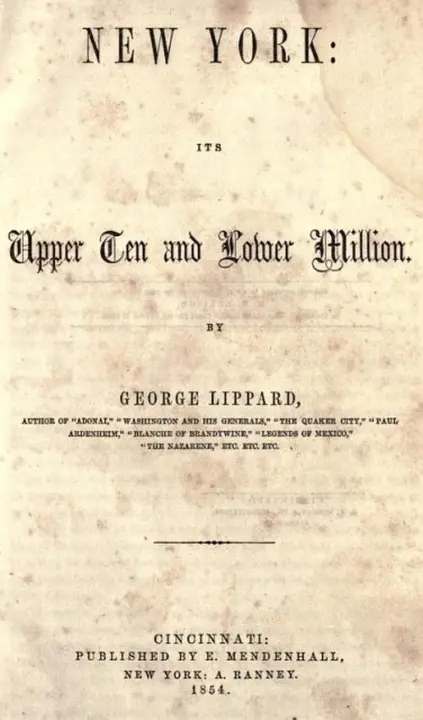
New York: Its Upper Ten and Lower Million
George Lippard
THE CLASSIC COLLECTION · 1864
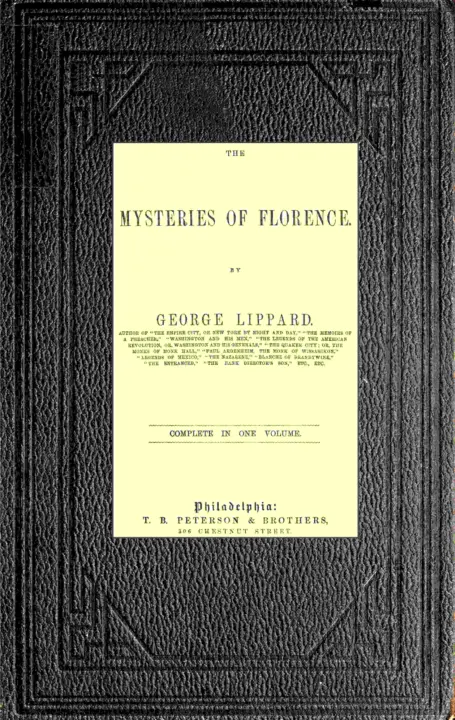
"The Mysteries of Florence" by George Lippard is a historical novel written in the mid-19th century. The story is set against the backdrop of Florence and revolves around the castle of Albarone and its inhabitants, particularly the sick Count Julian, his son Adrian, and the enigmatic scholar Aldarin. The titular mysteries encompass dark family secrets, potential murder, and a web of intrigue that binds the characters together. The opening of the novel introduces readers to a picturesque yet haunting setting—an ancient castle overlooking the valley of Florence under a moonlit sky. The narrative establishes a sense of foreboding as a weary traveler reflects on the grandeur and tragedies of the castle of Albarone. As we transition into the story, we meet Robin, a rough soldier lamenting the lack of merriment in the castle, along with the jovial page Guiseppo, who hints at significant transformations in the lineage of Albarone. Tension builds with the introduction of Aldarin, who holds sway over the ailing Count Julian, further hinting at hidden motives and dark prophecies associated with a signet ring. This sets the stage for a convoluted tale of betrayal, love, and the quest for power, as familial relationships intertwine under the shadows of their ancestral home.
Introduction adapted from the source catalogue; source summaries may be automatically generated.
Free to read · English · 107,340 words · No account needed
MAKE TIME FOR A GOOD BOOK
On by default. Untick to stop anonymous reading totals. Each page counts after 10 seconds in view. How this works.
Anonymous counting is on unless you have switched it off.
“It hath no place of repose on earth,” was the solemn answer. “Given to the invisible air, the mortal frame finds nor home, nor resting place in sacred chapel, or in wild wood glade; but mingled with the unseen winds, floating in the atmosphere of heaven; on, and on forever wanders the earthly dust of the Scholar, denied repose on earth, refused judgment by heaven, condemned to the eternal solitudes of the disembodied spirit; on, and on it wanders seeking companionship with the mighty soul of Aldarin!”
And a low and solemn voice, speaking from the invisible air, murmured the words--“It is finished,
[1] There have been one or two persons, who have made themselves merry with this passage. These persons, however, belong to that large class of literary pretenders who are always in the market, as the phrase goes, willing to edit anything, publish anything, take one side to day, another to morrow, for a little notoriety and a little bread. Their criticisms, do not demand an answer. You can have their good opinion for a dollar, and be adored by the whole tribe, for the gift of a dinner.
But, a word is due to the candid reader, in regard to the Doomsman’s description of Capital Punishment in the olden time. The author is not responsible for a single line, word, or comma. He has left a wretch, embrated, nay, demonized by spectacles of carnage, to describe the slow agonies of a horrible death, in his own way.
In the same manner, in another work, the author has introduced the Moloch of modern law,--the Hangman,--who but the cowardly instrument of a cowardly vengeance, puts a rope about his defenceless victim’s neck, and in a dark jail yard, chokes him slowly to death, while Ministers of Religion stand by, and approve the murder, with copious texts and learned references.
The author is no more responsible for the ravings of the Hangman, than he is for the ravings of the hireling critic.
[2] The word which we have written “Postillion,” in the ancient MSS. indicates a Courier, a Messenger; “one who carries letters from place to place.” This personage, whom we here designated, “Francisco the Courier,” is not unfrequently styled “Cisco the vagabond,” in the original manuscripts.
[3] With his own peculiar abruptness, (to which the reader is by this time accustomed) the Chronicler of the Ancient MSS. changes the scene to the Valley of the Bowl, noticed in Chap. 3. Book. 3.
[4] The story changes to Albarone again.
[5] It will be seen that the Chronicler of the ancient MSS. goes on to picture the events of the previous night, in the succeeding chapter.
Your reading position is saved on this browser. Take it to another device with a library code. Reading pages adapt to text, rather than matching a printed edition.
George Lippard
BEHIND THE BOOK
This eBook is for the use of anyone anywhere in the United States and most other parts of the world at no cost and with almost no restrictions whatsoever. You may copy it, give it away or re-use it under the terms of the Project Gutenberg License included with this eBook or online at www.gutenberg.org. If you are not located in the United States, you will have to check the laws of the country where you are located before using this eBook. Read the source licence.
The original source file, including credits and licence, is retained by this library. Request an original-format copy at no charge. Please include the book title and Project Gutenberg identifier #62760.
KEEP YOUR CURIOSITY GOING
Cécile Tormay

Moritz Busch
Coulson Kernahan
John L. Ransom

Maurice Baring
Frances Wright