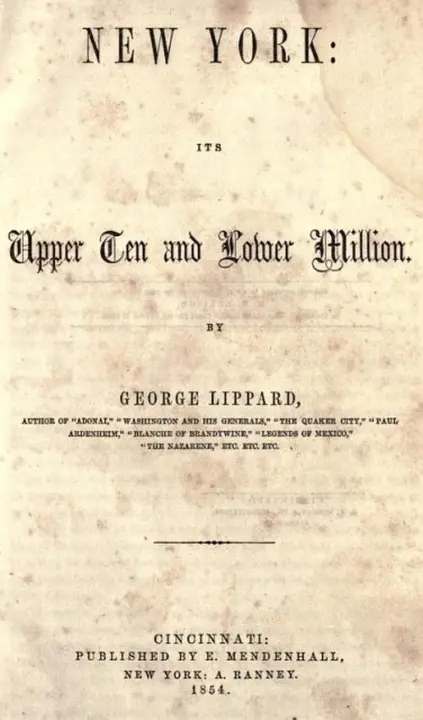
New York: Its Upper Ten and Lower Million
George Lippard
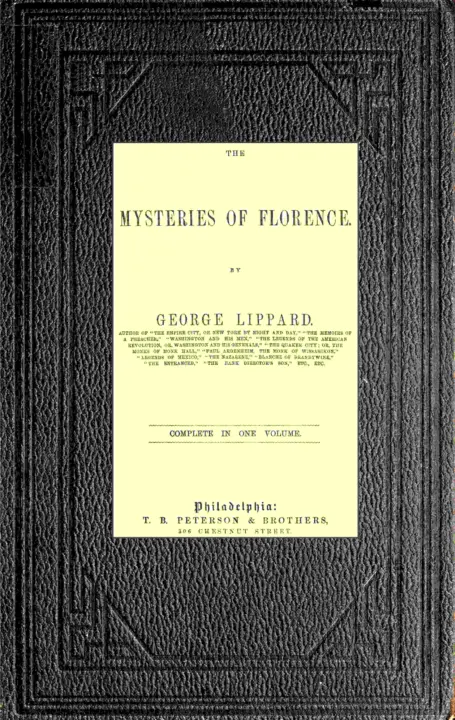
THE CLASSIC COLLECTION · 1864
"The Mysteries of Florence" by George Lippard is a historical novel written in the mid-19th century. The story is set against the backdrop of Florence and revolves around the castle of Albarone and its inhabitants, particularly the sick Count Julian, his son Adrian, and the enigmatic scholar Aldarin. The titular mysteries encompass dark family secrets, potential murder, and a web of intrigue that binds the characters together. The opening of the novel introduces readers to a picturesque yet haunting setting—an ancient castle overlooking the valley of Florence under a moonlit sky. The narrative establishes a sense of foreboding as a weary traveler reflects on the grandeur and tragedies of the castle of Albarone. As we transition into the story, we meet Robin, a rough soldier lamenting the lack of merriment in the castle, along with the jovial page Guiseppo, who hints at significant transformations in the lineage of Albarone. Tension builds with the introduction of Aldarin, who holds sway over the ailing Count Julian, further hinting at hidden motives and dark prophecies associated with a signet ring. This sets the stage for a convoluted tale of betrayal, love, and the quest for power, as familial relationships intertwine under the shadows of their ancestral home.
Introduction adapted from the source catalogue; source summaries may be automatically generated.
Free to read · English · 107,340 words · No account needed
MAKE TIME FOR A GOOD BOOK
On by default. Untick to stop anonymous reading totals. Each page counts after 10 seconds in view. How this works.
Anonymous counting is on unless you have switched it off.
Having thus spoken, in a voice that came through his clenched teeth, the murderer looked up and saw--the dogged, rough, yet honest visage of the stout yeoman peeping from among the curtains on the opposite side of the bed, his eyes steadily fixed on the corse, and a curious look of inquiry visible in every feature of his face.
The Signior drew back, trembling in every limb, and pale as death. It was a moment ere he recovered his speech, when, assuming a haughty air, he exclaimed:
“Slave, what do you here? Is it thus you intrude upon my privacy? Speak,
sir--your excuse!”
The stout yeoman replied in his usual manners speaking in the Italian, but with a sharp English accent:
“Why, most worshipful Signior, you will please to bear in mind that for twenty long years have I followed my lord, he who now lies cold and senseless, to the wars. That withered arm have I seen bearing down upon the foe in the thickest of the fight; that sunken eye have I beheld glance with the stern look of command. By his side have I fought and bled; for him did I leave my own native land--merrie, merrie England,--and I will say, a more generous, true-hearted, and valiant knight, never wore spurs, or broke a lance, than my lord, the noble Count Julian Di Albarone.”
The yeoman passed the sleeve of his blue doublet across his eyes.
“Well sirrah,” cried the Signior, “to what tends all this?”
“Marry, to this does it tend: that wishing to behold that noble face yet once more, I stole silently to this chamber, thinking to be a little while alone with my brave lord. I did not discover your presence, till I looked through the curtains and saw--”
The stout Englishman suddenly stopped; there was a curious twitch in his left eye, and a grim smile upon his lip.
“Saw what, sirrah?” hurriedly asked the scholar Aldarin.
“Marry, I saw thee, worshipful Signior, in the act of embracing the Count; and such a warm, kind, brotherly embrace as it was! By St. Withold! it did me more good than a hundred of Father Antonio’s homilies--by my faith, it did!”
The thin visage of Aldarin became white as snow and red as crimson by turns. Making an effort to conceal his agitation, he replied:
“Well, well, Robin, thou art a good fellow after all, though, to be sure, thy manners are somewhat rough. I tell thee, brave yeoman, I have long had it in my mind to advance thy condition. Follow me to the Round Room, good Robin, where I will speak further to thee of this matter.”
Your reading position is saved on this browser. Take it to another device with a library code. Reading pages adapt to text, rather than matching a printed edition.
George Lippard
BEHIND THE BOOK
This eBook is for the use of anyone anywhere in the United States and most other parts of the world at no cost and with almost no restrictions whatsoever. You may copy it, give it away or re-use it under the terms of the Project Gutenberg License included with this eBook or online at www.gutenberg.org. If you are not located in the United States, you will have to check the laws of the country where you are located before using this eBook. Read the source licence.
The original source file, including credits and licence, is retained by this library. Request an original-format copy at no charge. Please include the book title and Project Gutenberg identifier #62760.
KEEP YOUR CURIOSITY GOING
Cécile Tormay

Moritz Busch
Coulson Kernahan
John L. Ransom

Maurice Baring
Frances Wright