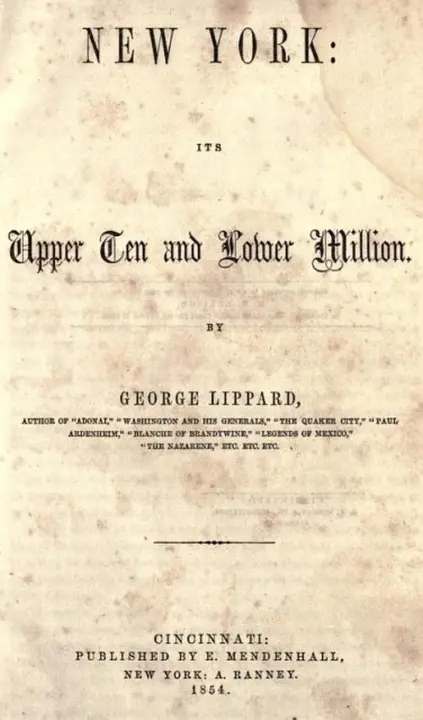
New York: Its Upper Ten and Lower Million
George Lippard
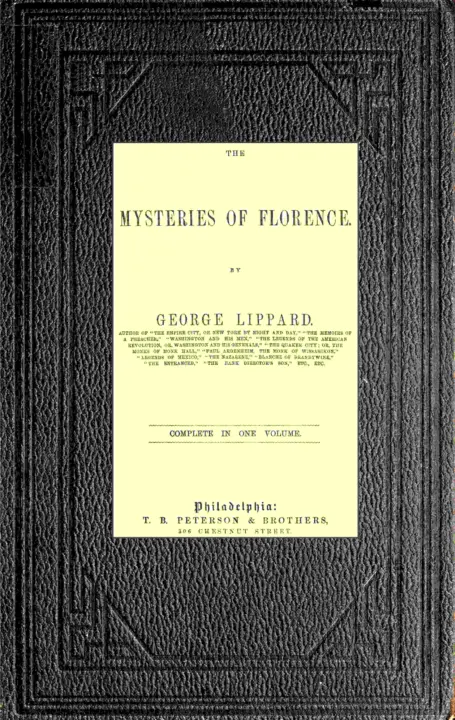
THE CLASSIC COLLECTION · 1864
"The Mysteries of Florence" by George Lippard is a historical novel written in the mid-19th century. The story is set against the backdrop of Florence and revolves around the castle of Albarone and its inhabitants, particularly the sick Count Julian, his son Adrian, and the enigmatic scholar Aldarin. The titular mysteries encompass dark family secrets, potential murder, and a web of intrigue that binds the characters together. The opening of the novel introduces readers to a picturesque yet haunting setting—an ancient castle overlooking the valley of Florence under a moonlit sky. The narrative establishes a sense of foreboding as a weary traveler reflects on the grandeur and tragedies of the castle of Albarone. As we transition into the story, we meet Robin, a rough soldier lamenting the lack of merriment in the castle, along with the jovial page Guiseppo, who hints at significant transformations in the lineage of Albarone. Tension builds with the introduction of Aldarin, who holds sway over the ailing Count Julian, further hinting at hidden motives and dark prophecies associated with a signet ring. This sets the stage for a convoluted tale of betrayal, love, and the quest for power, as familial relationships intertwine under the shadows of their ancestral home.
Introduction adapted from the source catalogue; source summaries may be automatically generated.
Free to read · English · 107,340 words · No account needed
MAKE TIME FOR A GOOD BOOK
On by default. Untick to stop anonymous reading totals. Each page counts after 10 seconds in view. How this works.
Anonymous counting is on unless you have switched it off.
The face of the ill-looking sentinel with the squinting eye, appeared among the folds of the sable curtain.
“Hugo, where is Balvardo, thy comrade--eh? Speak quickly--where is
Balvardo?”
The sinister eye of the sentinel squinted yet more fearfully; he looked confusedly round, and stammered forth:
“My Lord Duke, he is--he is--”
He paused suddenly, and finished the sentence by pointing downward with the forefinger of the right hand, with a sort of diving motion.
“Ah! I had forgotten that, good Hugo! Thou wilt attend me, vassals; and ye, sirs, shall also accompany me to this midnight ceremony.”
While he thus spoke, the monk threw open a door at the end of the apartment opposite the sable curtain, and, followed by the Duke, attended by Hugo and the two men-at-arms, with torches in their hands, he presently was traversing a long gallery, with his head still depressed and his arms still folded on his breast.
“By’r our Lady, but thou art wondrous chary of thy good looks!--eh, sir
monk?”
“It becomes not a sinner like me to be otherwise than humble. It becomes not a poor brother of St. Benedict to assume an erect port and a bold countenance before--his grace of Florence!”
“Well said, by my troth! Whither art leading me, holy father? Ha! a stairway; it extends above us as though it had no end. Ugh! how those torches glare--how gloomy these arches seem! Lead on, sir monk!”
Ascending the stairway, they found themselves in a winding gallery, with floor of stone, low arching roof, and narrow walls. Through the mazes of this passage they swiftly wound, and presently they stood at the foot of another stairway.
“By St. Peter!” exclaimed the Duke, “but these passages are like the windings of a witch’s den. How runs the night, holy father?”
“When I left the halls of the convent, the sands of the hour glass had fallen to within an half hour of midnight.”
“Ah! we shall be just in time for the trial of St. Areline’s power. Another gallery! By’r Ladye, but this is wondrous! In the name of thy patron, St. Benedict, I adjure thee, monk, tell me are we not near our journey’s end?”
“See’st thou yon oaken door that terminates the gallery? The oaken door with large panels, and topped by arches of dark stone? There an’ it please thee, my Lord Duke, must thou leave thy attendants, and alone, and in the dark, we will enter the cell of the blessed St. Areline.”
“How? Leave my attendants? ‘Alone,’ sayst thou? ‘In the dark’? Beshrew me, sir monk, but this saint of thine is somewhat difficult of audience!”
Your reading position is saved on this browser. Take it to another device with a library code. Reading pages adapt to text, rather than matching a printed edition.
George Lippard
BEHIND THE BOOK
This eBook is for the use of anyone anywhere in the United States and most other parts of the world at no cost and with almost no restrictions whatsoever. You may copy it, give it away or re-use it under the terms of the Project Gutenberg License included with this eBook or online at www.gutenberg.org. If you are not located in the United States, you will have to check the laws of the country where you are located before using this eBook. Read the source licence.
The original source file, including credits and licence, is retained by this library. Request an original-format copy at no charge. Please include the book title and Project Gutenberg identifier #62760.
KEEP YOUR CURIOSITY GOING
Cécile Tormay

Moritz Busch
Coulson Kernahan
John L. Ransom

Maurice Baring
Frances Wright