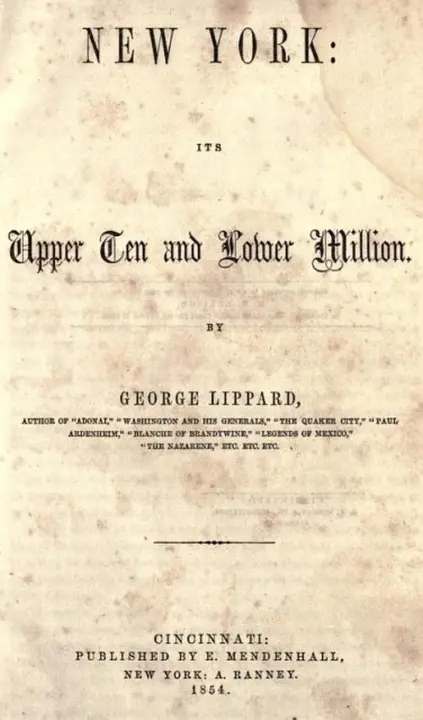
New York: Its Upper Ten and Lower Million
George Lippard
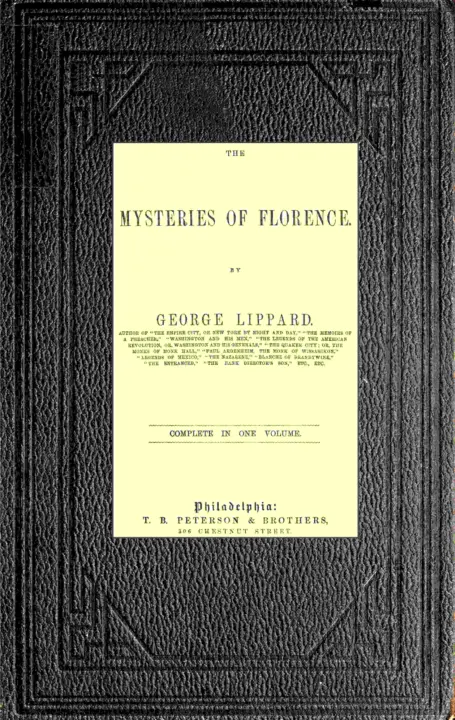
THE CLASSIC COLLECTION · 1864
"The Mysteries of Florence" by George Lippard is a historical novel written in the mid-19th century. The story is set against the backdrop of Florence and revolves around the castle of Albarone and its inhabitants, particularly the sick Count Julian, his son Adrian, and the enigmatic scholar Aldarin. The titular mysteries encompass dark family secrets, potential murder, and a web of intrigue that binds the characters together. The opening of the novel introduces readers to a picturesque yet haunting setting—an ancient castle overlooking the valley of Florence under a moonlit sky. The narrative establishes a sense of foreboding as a weary traveler reflects on the grandeur and tragedies of the castle of Albarone. As we transition into the story, we meet Robin, a rough soldier lamenting the lack of merriment in the castle, along with the jovial page Guiseppo, who hints at significant transformations in the lineage of Albarone. Tension builds with the introduction of Aldarin, who holds sway over the ailing Count Julian, further hinting at hidden motives and dark prophecies associated with a signet ring. This sets the stage for a convoluted tale of betrayal, love, and the quest for power, as familial relationships intertwine under the shadows of their ancestral home.
Introduction adapted from the source catalogue; source summaries may be automatically generated.
Free to read · English · 107,340 words · No account needed
MAKE TIME FOR A GOOD BOOK
On by default. Untick to stop anonymous reading totals. Each page counts after 10 seconds in view. How this works.
Anonymous counting is on unless you have switched it off.
The Monk Albertine, whose dark eyes had for a moment been gleaming over the shoulders of the bystanders, now advanced with a slow and measured footstep, and confronted the Signor Aldarin, with a look full of meaning and thought. Aldarin returned the look, with a keen and searching glance, and their eyes then mingled in one long and ardent gaze, as though each man wished to read the heart of his fellow.
With a look of calmness and perfect self-possession, Albertine turned to the Duke and took the goblet from his hand.
He gazed at its depths for a moment; he was about to speak, when the heart of every man in the Red Chamber was thrilled by a wild and terrific howl, more fearful even than the yell of the dying, which proceeded from among the curtains of the death-couch, and echoed around the apartment.
“That sound,” exclaimed Aldarin, with a nervous start--“That sound is from the couch of death! It means, it means--”
A ruddy glow passed over his pale countenance, and, suddenly pausing, he gazed round the group in silence.
“It is the poor hound of our good Lord;” muttered Robin the Rough, advancing. “The hound, with skin black as death, which Lord Julian brought from Palestine--he is howling over the dead corse of his master. So have I heard him howl for three days past, as the castle-bell tolled the hour of high noon, beside the panels of yonder door. Come hither, brute; come hither, Saladin.”
The hound, black as night, with an eye like fire, came leaping through the throng, and crouched, whining, at the feet of the stout yeoman.
It was, in sooth, a noble hound, with full chest, slender limbs, long neck, and tapering body, marked by all that delicacy of proportion, that beauty of shape, and grace of motion, which tradition ascribes to the bloodhounds of the Eastern lands. The head was like the head of a snake, while the eye seemed almost instinct with a human soul.
“Sir Monk,” cried the Duke, in an imperious tone, “were it not better for thee to tell us at once whether the white powder in the goblet is poison? or shall we wait thy pleasure while thou dost weary thine eyes with gazing at yonder hound?”
The monk Albertine made a solemn inclination of his head, and kneeling on the marble floor in the centre of the group, he struck the edge of the goblet upon the tesselated stone with a quick and sudden motion of his hand.
The diamond-shaped stone of black marble was strewn with the white sediment deposited in the bottom of the goblet.
Your reading position is saved on this browser. Take it to another device with a library code. Reading pages adapt to text, rather than matching a printed edition.
George Lippard
BEHIND THE BOOK
This eBook is for the use of anyone anywhere in the United States and most other parts of the world at no cost and with almost no restrictions whatsoever. You may copy it, give it away or re-use it under the terms of the Project Gutenberg License included with this eBook or online at www.gutenberg.org. If you are not located in the United States, you will have to check the laws of the country where you are located before using this eBook. Read the source licence.
The original source file, including credits and licence, is retained by this library. Request an original-format copy at no charge. Please include the book title and Project Gutenberg identifier #62760.
KEEP YOUR CURIOSITY GOING
Cécile Tormay

Moritz Busch
Coulson Kernahan
John L. Ransom

Maurice Baring
Frances Wright