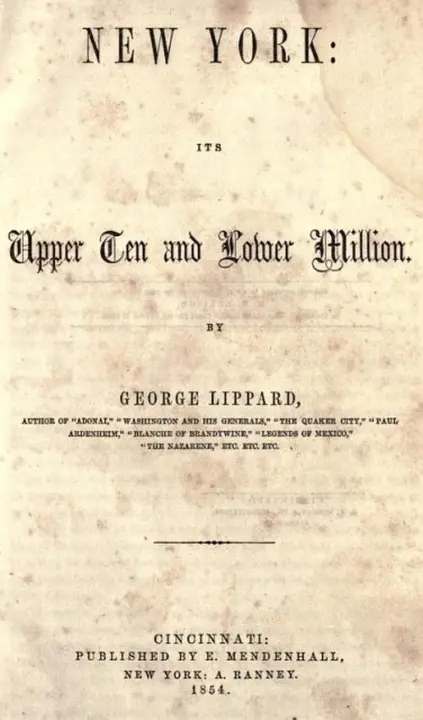
New York: Its Upper Ten and Lower Million
George Lippard
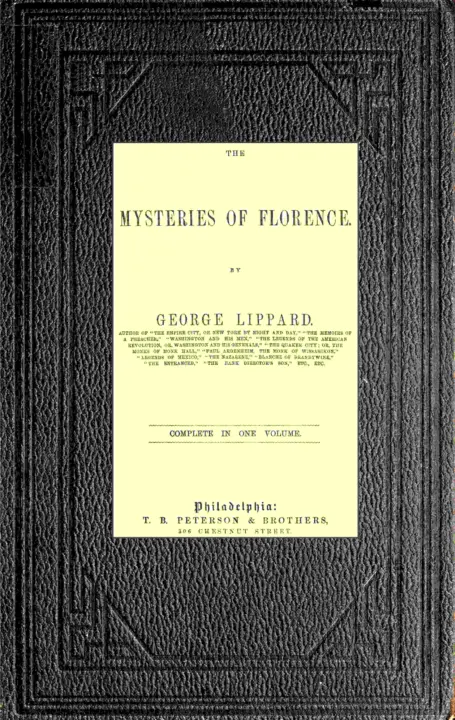
THE CLASSIC COLLECTION · 1864
"The Mysteries of Florence" by George Lippard is a historical novel written in the mid-19th century. The story is set against the backdrop of Florence and revolves around the castle of Albarone and its inhabitants, particularly the sick Count Julian, his son Adrian, and the enigmatic scholar Aldarin. The titular mysteries encompass dark family secrets, potential murder, and a web of intrigue that binds the characters together. The opening of the novel introduces readers to a picturesque yet haunting setting—an ancient castle overlooking the valley of Florence under a moonlit sky. The narrative establishes a sense of foreboding as a weary traveler reflects on the grandeur and tragedies of the castle of Albarone. As we transition into the story, we meet Robin, a rough soldier lamenting the lack of merriment in the castle, along with the jovial page Guiseppo, who hints at significant transformations in the lineage of Albarone. Tension builds with the introduction of Aldarin, who holds sway over the ailing Count Julian, further hinting at hidden motives and dark prophecies associated with a signet ring. This sets the stage for a convoluted tale of betrayal, love, and the quest for power, as familial relationships intertwine under the shadows of their ancestral home.
Introduction adapted from the source catalogue; source summaries may be automatically generated.
Free to read · English · 107,340 words · No account needed
MAKE TIME FOR A GOOD BOOK
On by default. Untick to stop anonymous reading totals. Each page counts after 10 seconds in view. How this works.
Anonymous counting is on unless you have switched it off.
“Spare my father--spare, oh! spare the weak old man!”
“Though the angels of God plead for his life, still must he die!”
“Then die, wronger and betrayer! Then die, midnight assassin and ravisher! The spirit of my mother nerves my arm and points the steel!”
And as the words fell from his lips, ere an arm could be raised, or a word of horror spoken, Guiseppo sprang to the very throat of the knight, grasping his long gray hair with one hand, while with the other he inserted the glittering dagger between the armor plates of his victim, and drove the steel down from the left shoulder to the very heart.
It was the work of a moment; the lightning flash might not be swifter, nor the thunderbolt more sudden.
One instant the spectators beheld the kneeling youth, and the warrior waving his hand with stern determination, as he turned from the prayer of mercy; the next moment their eyes were startled by the upraised dagger, and the blow of vengeance.
The knight tottered heavily to and fro, looked vacantly around, and then sank into the arms of Robin the Rough, with the haft of the dagger protruding from the armor plates of his left shoulder.
“Father!” shrieked Guiseppo, shaking wildly above his head, the right hand, the hand that winged the dagger. “Father, my mother is avenged; behold the doom of the ravisher!”
“Thou hast done well!” spoke Aldarin, in a quiet, yet trembling tone, while his lips wore an even smile. “Boy, thou hast done well! Now, Guiseppo, read, read the pacquet--the pacquet in thy bosom.”
And while the horror-stricken spectators--Robin the Rough, the figures in sable robes, the peasant-vassals, and the men-at-arms--remained awed into a fearful silence by the scene,--the silence that ever precedes the march of death,--Guiseppo thrust his hand within his bosom, drew the pacquet from its resting place, and with his trembling fingers broke the seal.
“Man of guilt and bloodshed,” exclaimed the dying knight, as he convulsively placed his hands on the wound near his heart. “I am dying--my heart grows cold, and mine eyes are dim--thy vengeance is gratified; now, now, tell me--”
“Hadst thou ever a child, Sir Geoffrey,” interrupted Aldarin, advancing to the side of the knight: “a fair-haired and soft-voiced boy, whose smile was thy joy, whose presence was thy sunshine?”
“Speak, speak--what knowest thou of my boy?” gasped the dying knight, as a look of agony passed over his face. “‘Tis sixteen years since I beheld his face in the land of his birth, the city of Jerusalem. He was torn from my embrace by an unknown hand.”
Your reading position is saved on this browser. Take it to another device with a library code. Reading pages adapt to text, rather than matching a printed edition.
George Lippard
BEHIND THE BOOK
This eBook is for the use of anyone anywhere in the United States and most other parts of the world at no cost and with almost no restrictions whatsoever. You may copy it, give it away or re-use it under the terms of the Project Gutenberg License included with this eBook or online at www.gutenberg.org. If you are not located in the United States, you will have to check the laws of the country where you are located before using this eBook. Read the source licence.
The original source file, including credits and licence, is retained by this library. Request an original-format copy at no charge. Please include the book title and Project Gutenberg identifier #62760.
KEEP YOUR CURIOSITY GOING
Cécile Tormay

Moritz Busch
Coulson Kernahan
John L. Ransom

Maurice Baring
Frances Wright