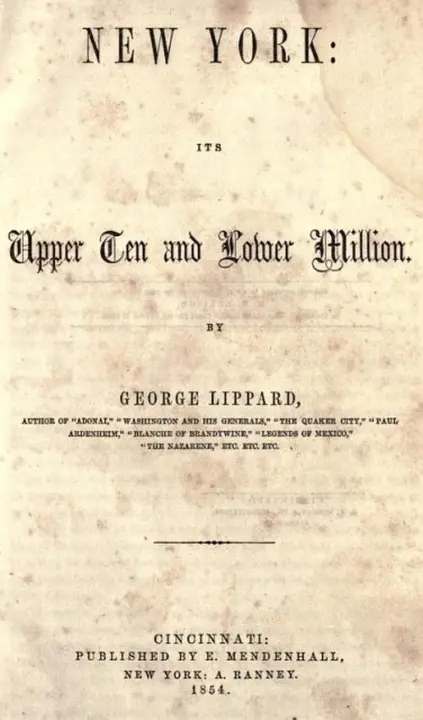
New York: Its Upper Ten and Lower Million
George Lippard
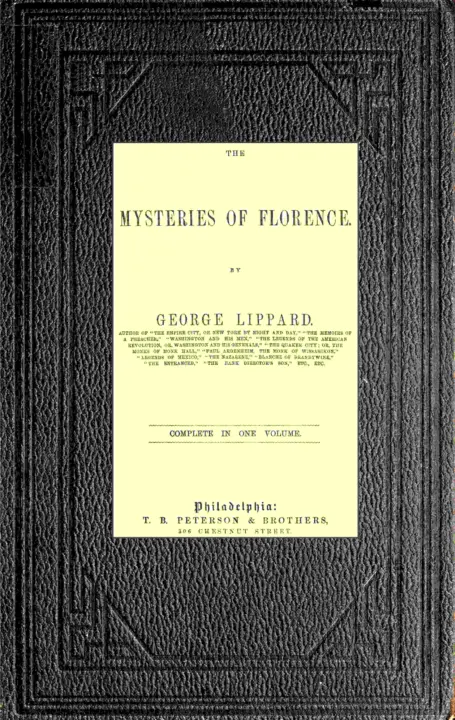
THE CLASSIC COLLECTION · 1864
"The Mysteries of Florence" by George Lippard is a historical novel written in the mid-19th century. The story is set against the backdrop of Florence and revolves around the castle of Albarone and its inhabitants, particularly the sick Count Julian, his son Adrian, and the enigmatic scholar Aldarin. The titular mysteries encompass dark family secrets, potential murder, and a web of intrigue that binds the characters together. The opening of the novel introduces readers to a picturesque yet haunting setting—an ancient castle overlooking the valley of Florence under a moonlit sky. The narrative establishes a sense of foreboding as a weary traveler reflects on the grandeur and tragedies of the castle of Albarone. As we transition into the story, we meet Robin, a rough soldier lamenting the lack of merriment in the castle, along with the jovial page Guiseppo, who hints at significant transformations in the lineage of Albarone. Tension builds with the introduction of Aldarin, who holds sway over the ailing Count Julian, further hinting at hidden motives and dark prophecies associated with a signet ring. This sets the stage for a convoluted tale of betrayal, love, and the quest for power, as familial relationships intertwine under the shadows of their ancestral home.
Introduction adapted from the source catalogue; source summaries may be automatically generated.
Free to read · English · 107,340 words · No account needed
MAKE TIME FOR A GOOD BOOK
On by default. Untick to stop anonymous reading totals. Each page counts after 10 seconds in view. How this works.
Anonymous counting is on unless you have switched it off.
“The first,” replied the Jew with a demure look, “the first ware is somewhat dull and heavy, it is labelled--Impudence--may it please thee fair Page.”
“Thou heathen hound, thou!” exclaimed Guiseppo, half amused and half angered. “How name you the second ware? Eh! Leatherface?”
“The second ware,” the Jew replied meekly, “the second ware is light and feathery. It bears the name--Self-conceit. As for the third--”
“Aye the third,” interrupted the page. “Go on my black bearded friend--go on--I’ll borrow a good oaken towel to rub you down, when you have done.”
“As for the third, it is the stuff of which the two others are made. It is heavier and duller than Impudence, and lighter and more feathery than Self-conceit, they style it Ignorance. And these three wares are the sole contents of the cob-web-hung storehouse of Sir Page’s brain. An’ it likes thee, fair sir?”
The Israelite bowed low as he spoke.
“Ha--ha--ha! fairly hit! Ho--ho--ho! The Jew turns Scholar, and preaches like a monk.--He--he--he! The trim Page is hit--fairly hit.” Such were the exclamations that went around the laughing crowd.
“Now receive thy pay, thou son of Sathanas!” exclaimed Guiseppo, brandishing an oaken staff; “here’s at thee!”
“Nay, nay!” exclaimed one of the spectators, “thou art fairly hit, sir
Guiseppo.”
“Aye, aye, fairly hit,” cried another; and “The Jew has paid thee in thine own coin,” a third shouted, throwing himself in the path of the page.
“Nay, nay, let him come!” cried the Jew, with a sneer. “Let him come. I’ll tame his pageship.”
“Dost thou mock me, thou dog!” As he spoke, the page raised his oaken staff, and whirling it around his head, he aimed with all his strength at the sconce of the Jew, who coolly turned aside the blow with his upraised arm, and in an instant he had Guiseppo by the throat.
He whispered a word in the ear of the page, and then, unloosing his hold, he began to gather up his wares.
The eyebrows of the page elevated with astonishment, and his lips parted. The bystanders gathered around Guiseppo with various expressions of their surprise at the sudden change that had passed over him.
“Why stare you so?” exclaimed a peasant maid.
“Art mad?” asked one of the yeoman of the guard.
“Perhaps moon-struck?” suggested another.
Guiseppo made no reply, but walked slowly away, while the Jew remained standing in the centre of the group, with his servitor waiting silently by his side.
Your reading position is saved on this browser. Take it to another device with a library code. Reading pages adapt to text, rather than matching a printed edition.
George Lippard
BEHIND THE BOOK
This eBook is for the use of anyone anywhere in the United States and most other parts of the world at no cost and with almost no restrictions whatsoever. You may copy it, give it away or re-use it under the terms of the Project Gutenberg License included with this eBook or online at www.gutenberg.org. If you are not located in the United States, you will have to check the laws of the country where you are located before using this eBook. Read the source licence.
The original source file, including credits and licence, is retained by this library. Request an original-format copy at no charge. Please include the book title and Project Gutenberg identifier #62760.
KEEP YOUR CURIOSITY GOING
Cécile Tormay

Moritz Busch
Coulson Kernahan
John L. Ransom

Maurice Baring
Frances Wright