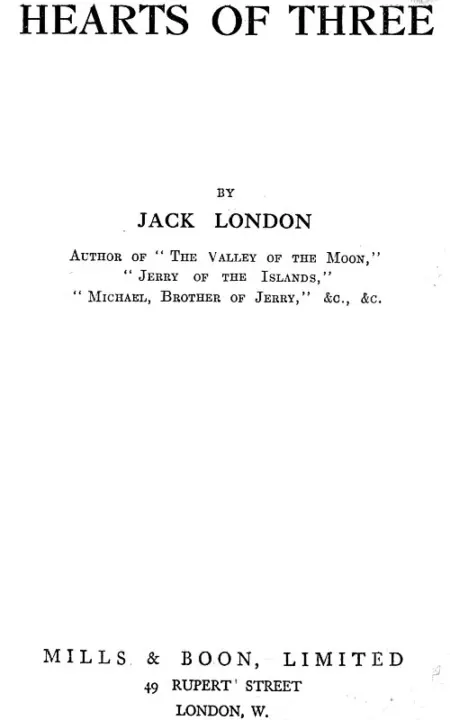
Hearts of three
Jack London
THE CLASSIC COLLECTION · 1914
"The Mutiny of the Elsinore" by Jack London is a novel written in the early 20th century, specifically in the context of maritime adventures. The story follows the protagonist, Mr. Pathurst, who embarks on a voyage aboard the sailing ship Elsinore. His anticipation for the journey quickly turns to irritation and doubt as he navigates an array of troubling circumstances—from the peculiarities of the ship's captain, Captain West, to the odd crew members he encounters, all while dealing with an unexpected canine companion. The beginning of the book sets the stage for a tumultuous sea voyage. Mr. Pathurst, facing delays and the biting cold, describes his growing displeasure with the captain's ambiguous arrangements and the questionable crew, highlighted by their unremarkable and even unkempt appearances. Meanwhile, Pathurst meets Captain West and his daughter, Margaret, who is unexpectedly accompanying them, adding another layer of complexity to his experience. The opening chapters illustrate not only the physical environment of the ship and its crew's disarray but also Pathurst's inner turmoil as he grapples with his reasons for going to sea and the unsettling notion of an impending challenge posed by both the crew's competence and his own expectations.
Introduction adapted from the source catalogue; source summaries may be automatically generated.
Free to read · English · 115,240 words · No account needed
MAKE TIME FOR A GOOD BOOK
On by default. Untick to stop anonymous reading totals. Each page counts after 10 seconds in view. How this works.
Anonymous counting is on unless you have switched it off.
The crew was divided against itself; and Isaac Chantz, the Jew, his wounded shoulder with a hunch to it, seemed to lead the revolt against the gangsters. His wound was enough to convict him in any court, and well he knew it. Beside him, and at his shoulders, clustered the Maltese Cockney, Andy Fay, Arthur Deacon, Frank Fitzgibbon, Richard Giller, and John Hackey.
In another group, still allegiant to the gangsters, were men such as Shorty, Sorensen, Lars Jacobsen, and Larry. Charles Davis was prominently in the gangster group. A fourth group was composed of Sundry Buyers, Nancy, and Tony the Greek. This group was distinctly neutral. And, finally, unaffiliated, quite by himself, stood Mulligan Jacobs—listening, I fancy, to far echoes of ancient wrongs, and feeling, I doubt not, the bite of the iron-hot hooks in his brain.
“What are you going to do with us, sir?” Isaac Chantz demanded of me, in defiance to the gangsters, who were expected to do the talking.
Bert Rhine lurched angrily toward the sound of the Jew’s voice. Chantz’s partisans drew closer to him.
“Jail you,” I answered from above. “And it shall go as hard with all of you as I can make it hard.”
“Maybe you will an’ maybe you won’t,” the Jew retorted.
“Shut up, Chantz!” Bert Rhine commanded.
“And you’ll get yours, you wop,” Chantz snarled, “if I have to do it
myself.”
I am afraid that I am not so successfully the man of action that I have been priding myself on being; for, so curious and interested was I in observing the moving drama beneath me that for the moment I failed to glimpse the tragedy into which it was culminating.
“Bombini!” Bert Rhine said.
His voice was imperative. It was the order of a master to the dog at heel. Bombini responded. He drew his knife and started to advance upon the Jew. But a deep rumbling, animal-like in its sound and menace, arose in the throats of those about the Jew.
Bombini hesitated and glanced back across his shoulder at the leader, whose face he could not see for bandages and who he knew could not see.
“’Tis a good deed—do it, Bombini,” Charles Davis encouraged.
“Shut your face, Davis!” came out from Bert Rhine’s bandages.
Kid Twist drew a revolver, shoved the muzzle of it first into Bombini’s side, then covered the men about the Jew.
Really, I felt a momentary twinge of pity for the Italian. He was caught between the mill-stones, “Bombini, stick that Jew,” Bert Rhine commanded.
Your reading position is saved on this browser. Take it to another device with a library code. Reading pages adapt to text, rather than matching a printed edition.
Jack London
Jack London
Jack London
Jack London
BEHIND THE BOOK
This eBook is for the use of anyone anywhere in the United States and most other parts of the world at no cost and with almost no restrictions whatsoever. You may copy it, give it away or re-use it under the terms of the Project Gutenberg License included with this eBook or online at www.gutenberg.org. If you are not located in the United States, you will have to check the laws of the country where you are located before using this eBook. Read the source licence.
The original source file, including credits and licence, is retained by this library. Request an original-format copy at no charge. Please include the book title and Project Gutenberg identifier #2415.
KEEP YOUR CURIOSITY GOING
Coulson Kernahan

Maurice Baring
Frances Wright
Cécile Tormay

Frederic Jesup Stimson

W. H. P. (William Henry Pope) Jarvis