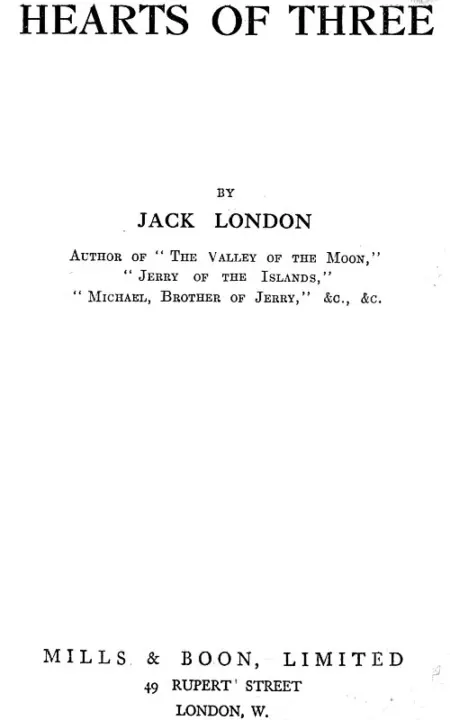
Hearts of three
Jack London
THE CLASSIC COLLECTION · 1914
"The Mutiny of the Elsinore" by Jack London is a novel written in the early 20th century, specifically in the context of maritime adventures. The story follows the protagonist, Mr. Pathurst, who embarks on a voyage aboard the sailing ship Elsinore. His anticipation for the journey quickly turns to irritation and doubt as he navigates an array of troubling circumstances—from the peculiarities of the ship's captain, Captain West, to the odd crew members he encounters, all while dealing with an unexpected canine companion. The beginning of the book sets the stage for a tumultuous sea voyage. Mr. Pathurst, facing delays and the biting cold, describes his growing displeasure with the captain's ambiguous arrangements and the questionable crew, highlighted by their unremarkable and even unkempt appearances. Meanwhile, Pathurst meets Captain West and his daughter, Margaret, who is unexpectedly accompanying them, adding another layer of complexity to his experience. The opening chapters illustrate not only the physical environment of the ship and its crew's disarray but also Pathurst's inner turmoil as he grapples with his reasons for going to sea and the unsettling notion of an impending challenge posed by both the crew's competence and his own expectations.
Introduction adapted from the source catalogue; source summaries may be automatically generated.
Free to read · English · 115,240 words · No account needed
MAKE TIME FOR A GOOD BOOK
On by default. Untick to stop anonymous reading totals. Each page counts after 10 seconds in view. How this works.
Anonymous counting is on unless you have switched it off.
The three had immediately stopped, and, though they did not look directly at one another, they seemed to be holding a silent conference. Another of the trio, in whose veins ran God alone knows what Semitic, Babylonish and Latin strains, gave a warning signal. Oh, nothing so crass as a wink or a nod. I almost doubted that I had intercepted it, and yet I knew he had communicated a warning to his fellows. More a shade of expression that had crossed his eyes, or a glint in them of sudden light—or whatever it was, it carried the message.
“Murphy,” the other answered the mate.
“Sir!” Mr. Pike snarled at him.
Murphy shrugged his shoulders in token that he did not understand. It was the poise of the man, of the three of them, the cool poise that impressed me.
“When you address any officer on this ship you’ll say ‘sir,’” Mr. Pike explained, his voice as harsh as his face was forbidding. “Did you get that?”
“Yes . . . sir,” Murphy drawled with deliberate slowness. “I gotcha.”
“Sir!” Mr. Pike roared.
“Sir,” Murphy answered, so softly and carelessly that it irritated the mate to further bullyragging.
“Well, Murphy’s too long,” he announced. “Nosey’ll do you aboard this craft. Got that?”
“I gotcha . . . sir,” came the reply, insolent in its very softness and unconcern. “Nosey Murphy goes . . . sir.”
And then he laughed—the three of them laughed, if laughter it might be called that was laughter without sound or facial movement. The eyes alone laughed, mirthlessly and cold-bloodedly.
Certainly Mr. Pike was not enjoying himself with these baffling personalities. He turned upon the leader, the one who had given the warning and who looked the admixture of all that was Mediterranean and Semitic.
“What’s your name?”
“Bert Rhine . . . sir,” was the reply, in tones as soft and careless and silkily irritating as the other’s.
“And you?”—this to the remaining one, the youngest of the trio, a dark-eyed, olive-skinned fellow with a face most striking in its cameo-like beauty. American-born, I placed him, of immigrants from Southern Italy—from Naples, or even Sicily.
“Twist . . . sir,” he answered, precisely in the same manner as the
others.
“Too long,” the mate sneered. “The Kid’ll do you. Got that?”
“I gotcha . . . sir. Kid Twist’ll do me . . . sir.”
“Kid’ll do!”
“Kid . . . sir.”
And the three laughed their silent, mirthless laugh. By this time Mr.
Pike was beside himself with a rage that could find no excuse for
action.
Your reading position is saved on this browser. Take it to another device with a library code. Reading pages adapt to text, rather than matching a printed edition.
Jack London
Jack London
Jack London
Jack London
BEHIND THE BOOK
This eBook is for the use of anyone anywhere in the United States and most other parts of the world at no cost and with almost no restrictions whatsoever. You may copy it, give it away or re-use it under the terms of the Project Gutenberg License included with this eBook or online at www.gutenberg.org. If you are not located in the United States, you will have to check the laws of the country where you are located before using this eBook. Read the source licence.
The original source file, including credits and licence, is retained by this library. Request an original-format copy at no charge. Please include the book title and Project Gutenberg identifier #2415.
KEEP YOUR CURIOSITY GOING
Coulson Kernahan

Maurice Baring
Frances Wright
Cécile Tormay

Frederic Jesup Stimson

W. H. P. (William Henry Pope) Jarvis