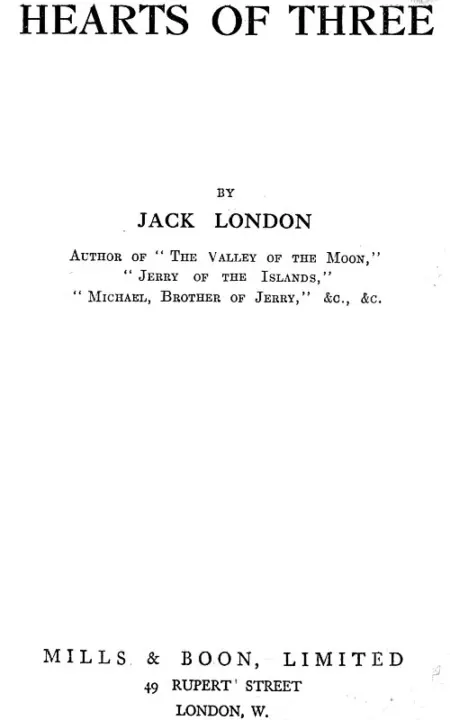
Hearts of three
Jack London
THE CLASSIC COLLECTION · 1914
"The Mutiny of the Elsinore" by Jack London is a novel written in the early 20th century, specifically in the context of maritime adventures. The story follows the protagonist, Mr. Pathurst, who embarks on a voyage aboard the sailing ship Elsinore. His anticipation for the journey quickly turns to irritation and doubt as he navigates an array of troubling circumstances—from the peculiarities of the ship's captain, Captain West, to the odd crew members he encounters, all while dealing with an unexpected canine companion. The beginning of the book sets the stage for a tumultuous sea voyage. Mr. Pathurst, facing delays and the biting cold, describes his growing displeasure with the captain's ambiguous arrangements and the questionable crew, highlighted by their unremarkable and even unkempt appearances. Meanwhile, Pathurst meets Captain West and his daughter, Margaret, who is unexpectedly accompanying them, adding another layer of complexity to his experience. The opening chapters illustrate not only the physical environment of the ship and its crew's disarray but also Pathurst's inner turmoil as he grapples with his reasons for going to sea and the unsettling notion of an impending challenge posed by both the crew's competence and his own expectations.
Introduction adapted from the source catalogue; source summaries may be automatically generated.
Free to read · English · 115,240 words · No account needed
MAKE TIME FOR A GOOD BOOK
On by default. Untick to stop anonymous reading totals. Each page counts after 10 seconds in view. How this works.
Anonymous counting is on unless you have switched it off.
“True daughter of Herodias,” I gaily gibed, “so such was the drift of your thoughts even as early as the very start. Already you were looking upon me with a considerative female eye.”
She laughed proudly, and did not reply.
“What possibly could have led you to expect that I would make love to
you?” I insisted.
“Because it is the way of young male passengers on long voyages,” she
replied.
“Then others have . . . ?”
“They always do,” she assured me gravely.
And at that instant I knew the first ridiculous pang of jealousy; but I laughed it away and retorted:
“It was an ancient Chinese philosopher who is first recorded as having said, what doubtlessly the cave men before him gibbered, namely, that a woman pursues a man by fluttering away in advance of him.”
“Wretch!” she cried. “I never fluttered. When did I ever flutter!”
“It is a delicate subject . . . ” I began with assumed hesitancy.
“When did I ever flutter?” she demanded.
I availed myself of one of Schopenhauer’s ruses by making a shift.
“From the first you observed nothing that a female could afford to miss observing,” I charged. “I’ll wager you knew as quickly as I the very instant when I first loved you.”
“I knew the first time you hated me,” she evaded.
“Yes, I know, the first time I saw you and learned that you were coming on the voyage,” I said. “But now I repeat my challenge. You knew as quickly as I the first instant I loved you.”
Oh, her eyes were beautiful, and the repose and certitude of her were tremendous, as she rested her hand on my arm for a moment and in a low, quiet voice said:
“Yes, I . . . I think I know. It was the morning of that pampero off the Plate, when you were thrown through the door into my father’s stateroom. I saw it in your eyes. I knew it. I think it was the first time, the very instant.”
I could only nod my head and draw her close to me. And she looked up at
me and added:
“You were very ridiculous. There you sat, on the bed, holding on with one hand and nursing the other hand under your arm, staring at me, irritated, startled, utterly foolish, and then . . . how, I don’t know . . . I knew that you had just come to know . . . ”
“And the very next instant you froze up,” I charged ungallantly.
“And that was why,” she admitted shamelessly, then leaned away from me, her hands resting on my shoulders, while she gurgled and her lips parted from over her beautiful white teeth.
Your reading position is saved on this browser. Take it to another device with a library code. Reading pages adapt to text, rather than matching a printed edition.
Jack London
Jack London
Jack London
Jack London
BEHIND THE BOOK
This eBook is for the use of anyone anywhere in the United States and most other parts of the world at no cost and with almost no restrictions whatsoever. You may copy it, give it away or re-use it under the terms of the Project Gutenberg License included with this eBook or online at www.gutenberg.org. If you are not located in the United States, you will have to check the laws of the country where you are located before using this eBook. Read the source licence.
The original source file, including credits and licence, is retained by this library. Request an original-format copy at no charge. Please include the book title and Project Gutenberg identifier #2415.
KEEP YOUR CURIOSITY GOING
Coulson Kernahan

Maurice Baring
Frances Wright
Cécile Tormay

Frederic Jesup Stimson

W. H. P. (William Henry Pope) Jarvis