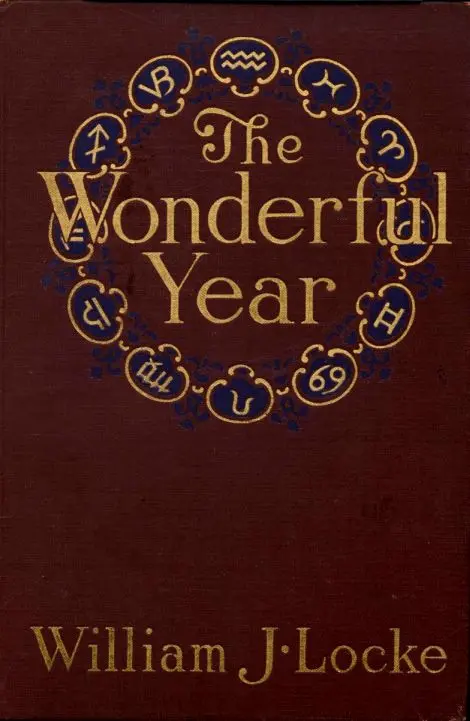
The Wonderful Year
William John Locke
THE CLASSIC COLLECTION · 1925
"The Mountebank" by William John Locke is a novel written in the post-World War I era, specifically in the early 20th century. The story introduces Brigadier-General Andrew Lackaday, who reflects on his tumultuous life, particularly the events surrounding his rise from humble beginnings and his experiences in the circus as a child. The narrative unfolds through a correspondence with a friend who has agreed to compile Lackaday's life story, highlighting his struggle with identity and his efforts to reconcile his past with his present status as a military figure. The opening of the book presents a thoughtful and introspective look at Lackaday's life, marked by a peculiar combination of comedy and tragedy. As he grapples with his past as a circus performer known as "Petit Patou," we see his attempts to transition into the world of military leadership. The reader is introduced to a whimsical yet serious tone, capturing Lackaday's charming yet awkward personality alongside his memories of the Cirque Rocambeau, where he was raised and nurtured by a clown named Ben Flint. Through engaging dialogue and vivid descriptions, the narrative sets the stage for Lackaday's journey of self-discovery, as he grapples with his identity and develops connections with other characters, including Lady Auriol, who plays a significant role in shaping his reflections on life, love, and the complexities of human existence.
Introduction adapted from the source catalogue; source summaries may be automatically generated.
Free to read · English · 93,730 words · No account needed
MAKE TIME FOR A GOOD BOOK
On by default. Untick to stop anonymous reading totals. Each page counts after 10 seconds in view. How this works.
Anonymous counting is on unless you have switched it off.
"There was a girl of that name who once brought me good luck."
The gambler, alive to superstitious intuitions, repented immediately of his
anger.
"That's worth all the tips in the world. Why didn't you tell me?"
"I don't wear my heart upon my sleeve," replied Andrew.
So peace was made. They joined the thin crowd round their booth of the Pari Mutuel, mainly composed of place winners, and when the placards of the odds went up, Bakkus gripped his companion's arm.
"My God! A hundred and three to one. Why didn't you plank on your last
penny."
"I'm very well content with two thousand francs," said Andrew. "It's something against a rainy day."
They reached the guichet and Andrew drew his money.
"Suppose the impossible animal hadn't won--you would have been rather
sick."
"No," Andrew replied, after a moment's thought. "I should have regarded my louis as a tribute to the memory of one who did me a great service."
"I believe," said Bakkus, "that if I could only turn sentimentalist, I
should make my fortune."
"Let us go and find a drink," said Andrew.
For the second time Elodie brought him luck. This time in the shape of a hundred and three louis, a goodly sum when one has to live from hand to mouth. And the time came, at the end of their engagement at La Boîte Blanche, when they lost even that precarious method of existence. For the first time in his life Andrew spent a month in vain search for employment. Dead season Paris had more variety artists than it knew what to do with. The provinces, so the rehabilitated Moignon and his confrères, the other agents, declared, in terms varying from apologetic stupor to frank brutality, had no use for Andrew-André and his unique entertainment.
"But what shall I do?" asked the anxious André.
"Wait, mon cher, we shall soon well arrange it," said Moignon.
"?" pantomimed the other agents, with shrugged shoulders and helplessly
outspread hands.
And it happened too that Bakkus, the sweet ballad-monger, found himself on the same rocks of unemployment.
"I have," said he, one evening, when the stranded pair were sitting outside a horrid little liquor retreat with a zinc bar in the Faubourg Saint-Denis--the luxury of consommations at sixty centimes on the Grands Boulevards had faded from their dreams--"I have, my dear friend, just enough to carry me on for a fortnight."
"And I too," said Andrew.
"But your hundred louis at Longchamps?"
"They're put away," said Andrew.
"Thank God," said Bakkus.
Your reading position is saved on this browser. Take it to another device with a library code. Reading pages adapt to text, rather than matching a printed edition.
William John Locke
William John Locke
William John Locke
William John Locke
BEHIND THE BOOK
This eBook is for the use of anyone anywhere in the United States and most other parts of the world at no cost and with almost no restrictions whatsoever. You may copy it, give it away or re-use it under the terms of the Project Gutenberg License included with this eBook or online at www.gutenberg.org. If you are not located in the United States, you will have to check the laws of the country where you are located before using this eBook. Read the source licence.
The original source file, including credits and licence, is retained by this library. Request an original-format copy at no charge. Please include the book title and Project Gutenberg identifier #8430.
KEEP YOUR CURIOSITY GOING
Coulson Kernahan

Maurice Baring
Frances Wright
Cécile Tormay

Frederic Jesup Stimson

W. H. P. (William Henry Pope) Jarvis