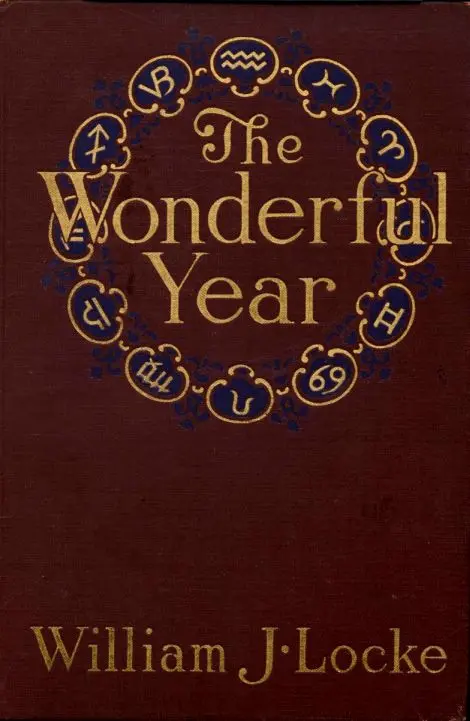
The Wonderful Year
William John Locke
THE CLASSIC COLLECTION · 1925
"The Mountebank" by William John Locke is a novel written in the post-World War I era, specifically in the early 20th century. The story introduces Brigadier-General Andrew Lackaday, who reflects on his tumultuous life, particularly the events surrounding his rise from humble beginnings and his experiences in the circus as a child. The narrative unfolds through a correspondence with a friend who has agreed to compile Lackaday's life story, highlighting his struggle with identity and his efforts to reconcile his past with his present status as a military figure. The opening of the book presents a thoughtful and introspective look at Lackaday's life, marked by a peculiar combination of comedy and tragedy. As he grapples with his past as a circus performer known as "Petit Patou," we see his attempts to transition into the world of military leadership. The reader is introduced to a whimsical yet serious tone, capturing Lackaday's charming yet awkward personality alongside his memories of the Cirque Rocambeau, where he was raised and nurtured by a clown named Ben Flint. Through engaging dialogue and vivid descriptions, the narrative sets the stage for Lackaday's journey of self-discovery, as he grapples with his identity and develops connections with other characters, including Lady Auriol, who plays a significant role in shaping his reflections on life, love, and the complexities of human existence.
Introduction adapted from the source catalogue; source summaries may be automatically generated.
Free to read · English · 93,730 words · No account needed
MAKE TIME FOR A GOOD BOOK
On by default. Untick to stop anonymous reading totals. Each page counts after 10 seconds in view. How this works.
Anonymous counting is on unless you have switched it off.
"It's the rottenest gift a man can be born with," cried Bakkus with startling vindictiveness. "It turns him into an idle, sentimental, hypocritical and dissolute hound. If I hadn't been cursed young with a voice like a Cherub, I should possibly be on the same affable terms with the Almighty as my brother, the Archdeacon, or profitably paralysing the intellects of the young like my brother, the preparatory schoolmaster."
He was a lean and rusty man of forty, with long black hair brushed back over his forehead, and cadaverous cheeks and long upper lip which all the shaving in the world could not redeem for the blue shade of the strong black beard which at midnight showed almost black. But for his black, mocking eyes, he might have been taken for the seedy provincial tragedian of the old school.
"Young man----" said he.
"My name," said Andrew, "is Lackaday."
"And you don't like people to be familiar and take liberties."
Andrew met the ironical glance. "That is so," said he quietly.
"Then, Mr. Lackaday----"
"You can omit the 'Mr.,'" said Andrew, "if you care to do so."
"You're more English than I thought," smiled Horatio Bakkus.
"I'm proud that you should say so," replied Andrew.
"I was about to remark," said Bakkus, "when you interrupted me, that I wondered why a young Englishman of obviously decent upbringing should be pursuing this contemptible form of livelihood."
"I beg your pardon," said Andrew, pausing in the act of conveying to his mouth a morsel of sandwich. He was puzzled; comrades down on their luck had cursed the profession for a sale métier and had wished they were road sweepers; but he had never heard it called contemptible. It was a totally new conception.
Bakkus repeated his words and added: "It is below the dignity of one made
in God's image."
"I am afraid I do not agree with you," replied Andrew, stiffly. "I was born in the profession and honourably bred in it and I have known no other and do not wish to know any other."
"You were born an imitator? It seems rather a narrow scheme of life."
"I was born in a circus, and whatever there could be learned in a circus I was taught. And it was, as you have guessed, a decent upbringing. By Gum, it was!" he added, with sudden heat.
"And you're proud of it?"
"I don't see that I've got anything else to be proud of," said Andrew.
"And you must be proud of something?"
"If not you had better be dead," said Andrew.
"Ah!" said Bakkus, and went on with his supper.
Your reading position is saved on this browser. Take it to another device with a library code. Reading pages adapt to text, rather than matching a printed edition.
William John Locke
William John Locke
William John Locke
William John Locke
BEHIND THE BOOK
This eBook is for the use of anyone anywhere in the United States and most other parts of the world at no cost and with almost no restrictions whatsoever. You may copy it, give it away or re-use it under the terms of the Project Gutenberg License included with this eBook or online at www.gutenberg.org. If you are not located in the United States, you will have to check the laws of the country where you are located before using this eBook. Read the source licence.
The original source file, including credits and licence, is retained by this library. Request an original-format copy at no charge. Please include the book title and Project Gutenberg identifier #8430.
KEEP YOUR CURIOSITY GOING
Coulson Kernahan

Maurice Baring
Frances Wright
Cécile Tormay

Frederic Jesup Stimson

W. H. P. (William Henry Pope) Jarvis