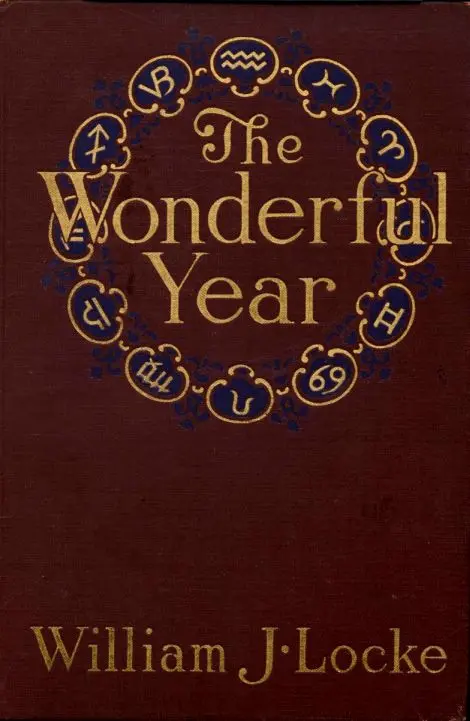
The Wonderful Year
William John Locke
THE CLASSIC COLLECTION · 1925
"The Mountebank" by William John Locke is a novel written in the post-World War I era, specifically in the early 20th century. The story introduces Brigadier-General Andrew Lackaday, who reflects on his tumultuous life, particularly the events surrounding his rise from humble beginnings and his experiences in the circus as a child. The narrative unfolds through a correspondence with a friend who has agreed to compile Lackaday's life story, highlighting his struggle with identity and his efforts to reconcile his past with his present status as a military figure. The opening of the book presents a thoughtful and introspective look at Lackaday's life, marked by a peculiar combination of comedy and tragedy. As he grapples with his past as a circus performer known as "Petit Patou," we see his attempts to transition into the world of military leadership. The reader is introduced to a whimsical yet serious tone, capturing Lackaday's charming yet awkward personality alongside his memories of the Cirque Rocambeau, where he was raised and nurtured by a clown named Ben Flint. Through engaging dialogue and vivid descriptions, the narrative sets the stage for Lackaday's journey of self-discovery, as he grapples with his identity and develops connections with other characters, including Lady Auriol, who plays a significant role in shaping his reflections on life, love, and the complexities of human existence.
Introduction adapted from the source catalogue; source summaries may be automatically generated.
Free to read · English · 93,730 words · No account needed
MAKE TIME FOR A GOOD BOOK
On by default. Untick to stop anonymous reading totals. Each page counts after 10 seconds in view. How this works.
Anonymous counting is on unless you have switched it off.
This white-haired, luminous-eyed ascetic--he drank but an orangeade through post-war straws--had kept us spellbound with his talk. I glanced at Auriol and read compliance in her eye.
"Will you accompany us ignorant people and act as cicerone?"
"With all the pleasure in life," said Bakkus.
"What time shall we start?"
"Would ten be too early?"
"Lady Auriol and I are old campaigners."
"I call for you at ten. It is agreed?"
We made the compact. I lifted my glass. He sputtered response through the post-war straws resting in the remains of his orangeade. He rose to go, pleading much correspondence before going to bed. We rose too. He accompanied us to the entrance to our hotel. At the lift, he said:
"Can you give me a minute?"
"As many as you like," said I, for it was still early.
We sped Lady Auriol upwards to her repose, and walked out through the hall into the soft August moonlight.
"May I tread," said he, "on the most delicate of grounds?"
"It all depends," said I, "on how delicately you do it."
He made a courteous movement of his hand and smiled. "I'll do my best. I take it that you're very fully admitted into Andrew Lackaday's confidence."
"To a great extent," I admitted.
"And--forgive me if I am impertinent--you have also that of the lady whom
we have just left?"
"Really, my dear Bakkus----" I began.
"It is indeed a matter of some importance," he interposed quickly. "It concerns Madame Patou--Elodie. Rightly or wrongly, she received a certain impression from your charming luncheon party of yesterday. Andrew, as you are aware, is not the man with whom a woman can easily make a scene. There was no scene. A hint. With that rat-trap air of finality with which I am, for my many failings, much more familiar than yourself, he said: 'We will cancel our engagement and go to Vichy.' This morning, as I wrote, I was called to Clermont-Ferrand. Madame Patou, you understand, has the temperament of the South. Its generosity is apt to step across the boundaries of exaggeration. In my capacity of friend of the family, I had a long interview with her. You have doubtless seen many such on the stage. I must say that Andrew, to whom the whole affair appeared exceedingly distasteful, had announced his intention of obeying the rules of common good manners and leaving his farewell card on Lady Auriol. Towards the end of our talk it entered the head of Madame Patou that she would do the same. I pointed out the anomaly of the interval between the two visits. But the head of a Marseillaise is an obstinate one. She dressed, put on her best hat--there is much that is symbolical in a woman's best hat, as doubtless a man of the world like yourself has observed--and took the tram with me to Royat. We alighted at the further entrance to the park, and came plump upon a leave-taking between Lackaday and Lady Auriol. You know there is a turn--some masking shrubs--we couldn't help seeing through them. She was for rushing forward. I restrained her. A second afterwards, Andrew ran into us. For me, at any rate, it was a most unhappy situation. If he had fallen into a rage, like ninety-nine men out of a hundred, and accused us of spying, I should have known how to reply. But that's where you can never get hold of Andrew Lackaday. He scorns such things. He said in his ramrod fashion: 'It's good of you to come to meet me, Elodie. I was kept longer than I anticipated.' He stopped the Clermont-Ferrand tram, nodded to me, and, with his hand under Elodie's elbow, helped her in."
Your reading position is saved on this browser. Take it to another device with a library code. Reading pages adapt to text, rather than matching a printed edition.
William John Locke
William John Locke
William John Locke
William John Locke
BEHIND THE BOOK
This eBook is for the use of anyone anywhere in the United States and most other parts of the world at no cost and with almost no restrictions whatsoever. You may copy it, give it away or re-use it under the terms of the Project Gutenberg License included with this eBook or online at www.gutenberg.org. If you are not located in the United States, you will have to check the laws of the country where you are located before using this eBook. Read the source licence.
The original source file, including credits and licence, is retained by this library. Request an original-format copy at no charge. Please include the book title and Project Gutenberg identifier #8430.
KEEP YOUR CURIOSITY GOING
Coulson Kernahan

Maurice Baring
Frances Wright
Cécile Tormay

Frederic Jesup Stimson

W. H. P. (William Henry Pope) Jarvis