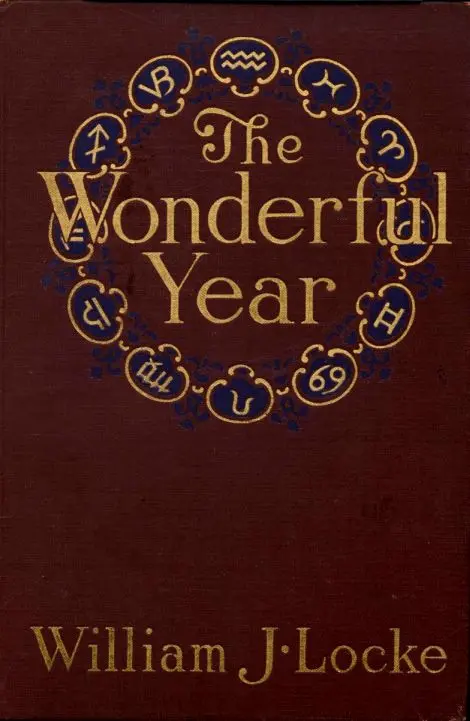
The Wonderful Year
William John Locke
THE CLASSIC COLLECTION · 1925
"The Mountebank" by William John Locke is a novel written in the post-World War I era, specifically in the early 20th century. The story introduces Brigadier-General Andrew Lackaday, who reflects on his tumultuous life, particularly the events surrounding his rise from humble beginnings and his experiences in the circus as a child. The narrative unfolds through a correspondence with a friend who has agreed to compile Lackaday's life story, highlighting his struggle with identity and his efforts to reconcile his past with his present status as a military figure. The opening of the book presents a thoughtful and introspective look at Lackaday's life, marked by a peculiar combination of comedy and tragedy. As he grapples with his past as a circus performer known as "Petit Patou," we see his attempts to transition into the world of military leadership. The reader is introduced to a whimsical yet serious tone, capturing Lackaday's charming yet awkward personality alongside his memories of the Cirque Rocambeau, where he was raised and nurtured by a clown named Ben Flint. Through engaging dialogue and vivid descriptions, the narrative sets the stage for Lackaday's journey of self-discovery, as he grapples with his identity and develops connections with other characters, including Lady Auriol, who plays a significant role in shaping his reflections on life, love, and the complexities of human existence.
Introduction adapted from the source catalogue; source summaries may be automatically generated.
Free to read · English · 93,730 words · No account needed
MAKE TIME FOR A GOOD BOOK
On by default. Untick to stop anonymous reading totals. Each page counts after 10 seconds in view. How this works.
Anonymous counting is on unless you have switched it off.
"They're the pure type of old Gaul," said Lackaday.
She put up a hand to straying hair. "I'm falling to pieces. I have but two desires in the world--a cold bath and food. Perhaps I shall see you later."
He stood unflinching, like a soldier condemned for crime. I wondered at her indifference. He said:
"Unfortunately I can't have that pleasure. My engagements take up the rest of the day, and tomorrow I leave Clermont-Ferrand. I shan't have another opportunity of seeing you."
Their eyes met and his, calm yet full of pain, dominated. She thrust her
hand through my arm.
"Very well then, let us get into the shade."
We entered the park, found an empty bench beneath the trees and sat down, Auriol between us. She said:
"Do you mean at Royat or in the world in general?"
"Perhaps the latter."
She laughed queerly. "As chance has thrown us together here, it will possibly do the same somewhere else."
"My sphere isn't yours," said he. "If it hadn't been for the accident of Hylton being here, we should not have met now."
"Captain Hylton had nothing to do with it," she said warmly. "I had no notion that you were at Clermont-Ferrand."
"I'm quite aware of that, Lady Auriol."
She flushed, vexed at having said a foolish thing.
"And Captain Hylton had no notion that I was coming."
"Perfectly," said Lackaday.
"Well?" she said after a pause.
"I came over to Royat, this morning," said Lackaday, "to call on you and
bid you good-bye."
"Why?" she asked in a low voice.
"It appeared to be ordinary courtesy."
"Was there anything particular you wanted to say to me?"
"Perhaps to supplement just the little I could tell you yesterday
afternoon."
"Captain Hylton supplemented it after you left. Oh, he was very discreet. But there were a few odds and ends that needed straightening out. If you had been frank with me from the beginning, there would have been no need of it. As it was, I had to clear everything up. If I had known exactly. I should not have gone to the circus last night."
His eyelids fluttered like those of a man who has received a bullet through him, and his mouth set grimly.
"You might have spared me that," said he. He bent forward. "Hylton, why did
you let her do it?"
"I might just as well have tried to stop the thunder," said I, seeing no reason why this young woman should not bear the blame for her folly.
Your reading position is saved on this browser. Take it to another device with a library code. Reading pages adapt to text, rather than matching a printed edition.
William John Locke
William John Locke
William John Locke
William John Locke
BEHIND THE BOOK
This eBook is for the use of anyone anywhere in the United States and most other parts of the world at no cost and with almost no restrictions whatsoever. You may copy it, give it away or re-use it under the terms of the Project Gutenberg License included with this eBook or online at www.gutenberg.org. If you are not located in the United States, you will have to check the laws of the country where you are located before using this eBook. Read the source licence.
The original source file, including credits and licence, is retained by this library. Request an original-format copy at no charge. Please include the book title and Project Gutenberg identifier #8430.
KEEP YOUR CURIOSITY GOING
Coulson Kernahan

Maurice Baring
Frances Wright
Cécile Tormay

Frederic Jesup Stimson

W. H. P. (William Henry Pope) Jarvis