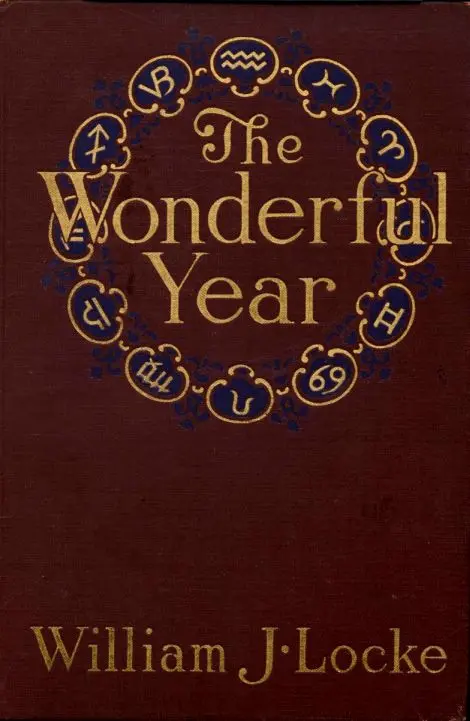
The Wonderful Year
William John Locke
THE CLASSIC COLLECTION · 1925
"The Mountebank" by William John Locke is a novel written in the post-World War I era, specifically in the early 20th century. The story introduces Brigadier-General Andrew Lackaday, who reflects on his tumultuous life, particularly the events surrounding his rise from humble beginnings and his experiences in the circus as a child. The narrative unfolds through a correspondence with a friend who has agreed to compile Lackaday's life story, highlighting his struggle with identity and his efforts to reconcile his past with his present status as a military figure. The opening of the book presents a thoughtful and introspective look at Lackaday's life, marked by a peculiar combination of comedy and tragedy. As he grapples with his past as a circus performer known as "Petit Patou," we see his attempts to transition into the world of military leadership. The reader is introduced to a whimsical yet serious tone, capturing Lackaday's charming yet awkward personality alongside his memories of the Cirque Rocambeau, where he was raised and nurtured by a clown named Ben Flint. Through engaging dialogue and vivid descriptions, the narrative sets the stage for Lackaday's journey of self-discovery, as he grapples with his identity and develops connections with other characters, including Lady Auriol, who plays a significant role in shaping his reflections on life, love, and the complexities of human existence.
Introduction adapted from the source catalogue; source summaries may be automatically generated.
Free to read · English · 93,730 words · No account needed
MAKE TIME FOR A GOOD BOOK
On by default. Untick to stop anonymous reading totals. Each page counts after 10 seconds in view. How this works.
Anonymous counting is on unless you have switched it off.
Of course, there was another alternative. I might have been responsible for the poor lady. But she was as artless as a poor lady could be. Addressing my two friends it was always André and Horace, and instinctively she used the familiar "tu." Addressing me she had affrightedly forgotten the pact of Christian names, and it was "Monsieur le Capitaine" and, of course, the "vous" which she had never dreamed of changing. Even so poor a French scholar as Lady Auriol could not be misled into such absurd paths of conjecture.
She belonged therefore, in some sort of fashion, to General Lackaday. An elderly man of the world, with his nerves on edge, has no need of wizardry to divine the psychology of such a situation.
Mistress of social forms, Lady Auriol, after sweeping Elodie into her net, caught Horatio Bakkus and through reference to her own hospital experiences during the war, wrung from him the avowal of his concerts for the wounded in Paris.
"How splendid of you! By the way, how do you spell your name? It's an
uncommon one."
"With two k's."
"I wonder if you have anything to do with an old friend of my fattier,
Archdeacon Bakkus?"
"My eldest brother."
"No, really? One of my earliest recollections is his buying a prize boar
from my father."
"Just like the dear fellow's prodigality," said Bakkus. "He had a whole Archdeaconry to his hand for nothing. I've lately spent a couple of months with him in Westmorland, so I know."
"How small the world is," said Lady Auriol to Lackaday.
"Too small," said he.
"Oh," said Auriol blankly.
"Have you seen our good friends, the Verity-Stewarts lately?"
She had. They were in perfect health. They were wondering what had become
of him.
"And indeed, General," she flashed, "what has become of you?"
"It is not good," said Elodie, in quick anticipation, "that the General should neglect his English friends."
There sounded the note of proprietorship, audible to anybody. Auriol's eyes dwelt for a second on Elodie; then she turned to Lackaday.
"Madame Patou is quite right."
Said he, with one of his rare flights into imagery, "I was but a shooting star across the English firmament."
"Encore une étoile qui file,
File, file et disparait!"
"Oh no, my dear friend," laughed Bakkus. "He can't persuade us, Lady Auriol, that he is afflicted with the morbidezza of 1830."
"Qu'est-ce que c'est que cela?" asked Elodie, sharply.
"It was a fashion long ago, my dear, for poets to assume the gaiety of a funeral. Even Béranger who wrote Le Roi d'Yvetot--you know it--"
Your reading position is saved on this browser. Take it to another device with a library code. Reading pages adapt to text, rather than matching a printed edition.
William John Locke
William John Locke
William John Locke
William John Locke
BEHIND THE BOOK
This eBook is for the use of anyone anywhere in the United States and most other parts of the world at no cost and with almost no restrictions whatsoever. You may copy it, give it away or re-use it under the terms of the Project Gutenberg License included with this eBook or online at www.gutenberg.org. If you are not located in the United States, you will have to check the laws of the country where you are located before using this eBook. Read the source licence.
The original source file, including credits and licence, is retained by this library. Request an original-format copy at no charge. Please include the book title and Project Gutenberg identifier #8430.
KEEP YOUR CURIOSITY GOING
Coulson Kernahan

Maurice Baring
Frances Wright
Cécile Tormay

Frederic Jesup Stimson

W. H. P. (William Henry Pope) Jarvis