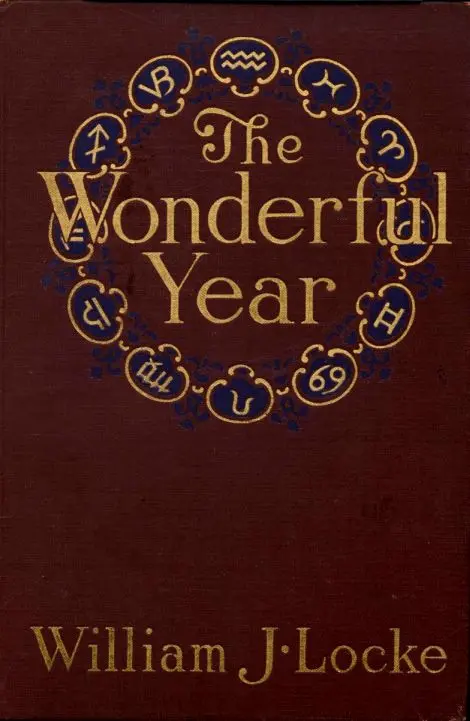
The Wonderful Year
William John Locke
THE CLASSIC COLLECTION · 1925
"The Mountebank" by William John Locke is a novel written in the post-World War I era, specifically in the early 20th century. The story introduces Brigadier-General Andrew Lackaday, who reflects on his tumultuous life, particularly the events surrounding his rise from humble beginnings and his experiences in the circus as a child. The narrative unfolds through a correspondence with a friend who has agreed to compile Lackaday's life story, highlighting his struggle with identity and his efforts to reconcile his past with his present status as a military figure. The opening of the book presents a thoughtful and introspective look at Lackaday's life, marked by a peculiar combination of comedy and tragedy. As he grapples with his past as a circus performer known as "Petit Patou," we see his attempts to transition into the world of military leadership. The reader is introduced to a whimsical yet serious tone, capturing Lackaday's charming yet awkward personality alongside his memories of the Cirque Rocambeau, where he was raised and nurtured by a clown named Ben Flint. Through engaging dialogue and vivid descriptions, the narrative sets the stage for Lackaday's journey of self-discovery, as he grapples with his identity and develops connections with other characters, including Lady Auriol, who plays a significant role in shaping his reflections on life, love, and the complexities of human existence.
Introduction adapted from the source catalogue; source summaries may be automatically generated.
Free to read · English · 93,730 words · No account needed
MAKE TIME FOR A GOOD BOOK
On by default. Untick to stop anonymous reading totals. Each page counts after 10 seconds in view. How this works.
Anonymous counting is on unless you have switched it off.
For a while, like a Knight in the Venusberg, he gave himself up to the delight of her. Then suddenly he pulled himself together, and, putting down his teacup, he said what he had come to say:--
"This is the last time that I shall ever see you."
She started.
"What on earth do you mean? Are you going off to the other end of the
world?"
"I'm going back to France."
"When?"
"To-morrow morning."
She twisted round in her chair, her elbow on the arm and her chin in her
hand and looked at him.
"That's sudden, isn't it?"
He smiled rather sadly. "When once you've made up your mind, it's best to act, instead of hanging on."
"You're sure there's no hope in this country?"
"I know I'm as useful as a professional wine-taster will soon be in the
United States."
They laughed, resumed the discussion of many previous meetings. Had he tried this, that or the other opening? He had tried everything. No one wanted him.
"So," said he, "I'm making a clean cut and returning to France."
"I'm sorry." She sighed. "Very sorry. You know I am. I hoped you would remain in England and find some occupation worthy of you--but, after all--France isn't Central China. We shall still be next-door neighbours. The Channel can be easily crossed by one of us. You used the word 'ever,' you know," she added with an air of challenge.
"I did."
"Why?"
"That would take a lot of telling," said Andrew grimly.
"We've got hours, if you choose, in front of us."
"It's not a question of time," said he.
"Then, my good Andrew, what are you talking about?"
"Only that I must return to the place I came from, my dear friend. Let it
rest at that."
She lit a cigarette. "Rather fatalistic, isn't it?"
"Four years of fighting make one so."
"You speak," said she, after a little reflection occasioning knitting of the brows, "you speak like the Mysterious Unknown of the old legends--the being sent from Hell or Heaven or any other old place to the earth to accomplish a mission. You know what I mean. He lives the life of the world into which he is thrown and finds it very much to his liking. But when the mission is fulfilled--the Powers that sent him say: 'Your time is up. Return whence you came.' And the poor Make-believe of a human has got to vanish."
"You surely aren't jesting?" he asked.
"No," she said. "God forbid! I've too deep a regard for you. Besides, I believe the parable is applicable. Otherwise how can I understand your 'for ever'?"
Your reading position is saved on this browser. Take it to another device with a library code. Reading pages adapt to text, rather than matching a printed edition.
William John Locke
William John Locke
William John Locke
William John Locke
BEHIND THE BOOK
This eBook is for the use of anyone anywhere in the United States and most other parts of the world at no cost and with almost no restrictions whatsoever. You may copy it, give it away or re-use it under the terms of the Project Gutenberg License included with this eBook or online at www.gutenberg.org. If you are not located in the United States, you will have to check the laws of the country where you are located before using this eBook. Read the source licence.
The original source file, including credits and licence, is retained by this library. Request an original-format copy at no charge. Please include the book title and Project Gutenberg identifier #8430.
KEEP YOUR CURIOSITY GOING
Coulson Kernahan

Maurice Baring
Frances Wright
Cécile Tormay

Frederic Jesup Stimson

W. H. P. (William Henry Pope) Jarvis