Walker of the Secret Service
Melville Davisson Post
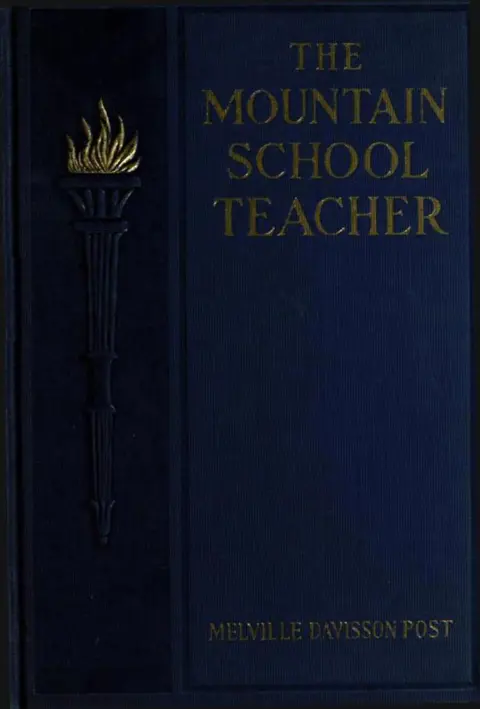
THE CLASSIC COLLECTION · 1922
"The Mountain School-Teacher" by Melville Davisson Post is a novel written in the early 20th century. The story revolves around a young and idealistic schoolteacher as he navigates life in a remote mountain community, facing challenges and forming bonds with its residents, including a small boy named David. The narrative seems to highlight themes of innocence, community, and the contrast between civilization and the wilderness. The opening of the novel introduces the setting through a description of a rugged mountain landscape, where a path has been nearly reclaimed by nature. A young man, who is the schoolteacher, is seen traversing this landscape, embodying the youthful vitality and optimism as he approaches the mountain road. Meanwhile, a small boy named David struggles with a sack of corn on an ancient ox, showcasing the simplicity and struggles of rural life. The schoolteacher's encounter with David, as he helps the boy with his burden, establishes a warm connection that hints at the nurturing relationships he will develop within this mountain community. The chapter effectively sets the stage for the themes of mentorship and community that are likely to unfold throughout the story.
Introduction adapted from the source catalogue; source summaries may be automatically generated.
Free to read · English · 25,619 words · No account needed
MAKE TIME FOR A GOOD BOOK
On by default. Untick to stop anonymous reading totals. Each page counts after 10 seconds in view. How this works.
Anonymous counting is on unless you have switched it off.
“It ain't so much the floor,” continued the old man. “It's the sills. The sills might be rotten.”
“I have examined the sills,” replied the School-teacher. “The sills are
sound.”
“Well,” said the old man, “failin' weather's comin' on. I think the school had better stop anyway.”
He turned a little and put his stick out on the path into the leaves as though he would go down the hill a shorter way to the road.
The School-teacher read his intent in the moving of the cane.
“You would better stay in the path,” he said. “If you get out of the path you will fall.”
The old man turned back into the path before the School-teacher.
There was come now a certain dogged expression into his face.
“If you want to know,” he said, “there's been some complaint about you.”
“Who has complained of me?” said the School-teacher.
“Good men have complained.”
“What good men?”
“Why, men as good as the minister. Why, men as good as the doctor.”
Then he looked out sharp at the Schoolteacher.
“Ain't that hussy, Yaller Mag, up there with you at Nicholas Parks' house?” The School-teacher regarded the old man standing before him.
“Do you think this woman ought to be sent away?”
“Yes, I do,” replied the old man.
“Then some one ought to tell her to go.”
“Yes, they ought.”
“It's a difficult thing to do,” said the School-teacher.
“To find some one to tell her?”
“Yes,” said the School-teacher, “that is it, to find some one to tell
her.”
“If that's all,” said the old man, “I'm goin' home by Nicholas Park's house, that's my shortest way. I'll stop an' tell her myself.”
“But have you thought how difficult it will be to tell her?” inquired
the Schoolteacher.
“What's the trouble about tellin' her?”
“Well,” replied the School-teacher, his eyes resting on the old man's swollen scrofuletic leg, “the trouble is that the one who goes to tell her ought to be better than she is. He ought, himself, to have lived a clean life.... Perhaps you have, perhaps you can tell her.”
The old man thought that the Schoolteacher saw something lying on the ground, for he stooped over and his finger moved in the dust of the path. And while he remained thus, the old man hurried along to the road. The mare stood facing in the direction of the way over the mountain by Nicholas Parks' house.
The old man took her by the bridle and turned her around in the road.
Your reading position is saved on this browser. Take it to another device with a library code. Reading pages adapt to text, rather than matching a printed edition.
Melville Davisson Post
Melville Davisson Post
Melville Davisson Post
Melville Davisson Post
BEHIND THE BOOK
This eBook is for the use of anyone anywhere in the United States and most other parts of the world at no cost and with almost no restrictions whatsoever. You may copy it, give it away or re-use it under the terms of the Project Gutenberg License included with this eBook or online at www.gutenberg.org. If you are not located in the United States, you will have to check the laws of the country where you are located before using this eBook. Read the source licence.
The original source file, including credits and licence, is retained by this library. Request an original-format copy at no charge. Please include the book title and Project Gutenberg identifier #51958.
KEEP YOUR CURIOSITY GOING
Coulson Kernahan

Maurice Baring
Frances Wright
Cécile Tormay

Frederic Jesup Stimson

W. H. P. (William Henry Pope) Jarvis