Walker of the Secret Service
Melville Davisson Post
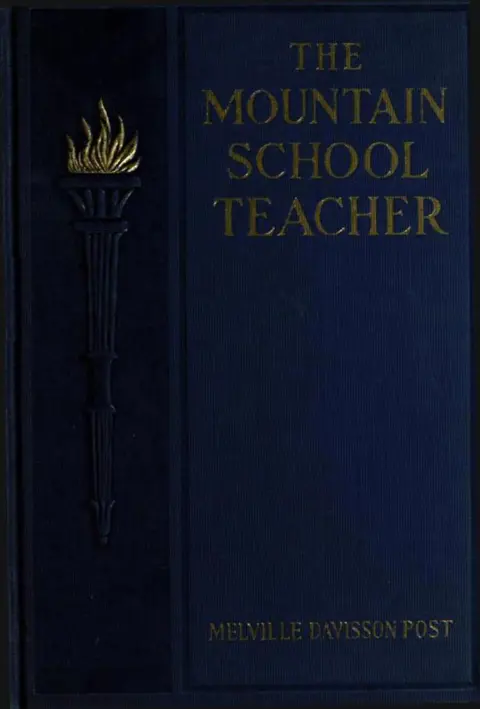
THE CLASSIC COLLECTION · 1922
"The Mountain School-Teacher" by Melville Davisson Post is a novel written in the early 20th century. The story revolves around a young and idealistic schoolteacher as he navigates life in a remote mountain community, facing challenges and forming bonds with its residents, including a small boy named David. The narrative seems to highlight themes of innocence, community, and the contrast between civilization and the wilderness. The opening of the novel introduces the setting through a description of a rugged mountain landscape, where a path has been nearly reclaimed by nature. A young man, who is the schoolteacher, is seen traversing this landscape, embodying the youthful vitality and optimism as he approaches the mountain road. Meanwhile, a small boy named David struggles with a sack of corn on an ancient ox, showcasing the simplicity and struggles of rural life. The schoolteacher's encounter with David, as he helps the boy with his burden, establishes a warm connection that hints at the nurturing relationships he will develop within this mountain community. The chapter effectively sets the stage for the themes of mentorship and community that are likely to unfold throughout the story.
Introduction adapted from the source catalogue; source summaries may be automatically generated.
Free to read · English · 25,619 words · No account needed
MAKE TIME FOR A GOOD BOOK
On by default. Untick to stop anonymous reading totals. Each page counts after 10 seconds in view. How this works.
Anonymous counting is on unless you have switched it off.
The woman recalled with the word, the morning when, to wean him, she had blackened her breast with charcoal, and the child had pushed away the blackened breast with his little hand and said, “nim bugala.”
“And he calls everything else to eat 'A B.' Now why would he call milk 'bugala' an' bread an' butter 'A B'?”
The School-teacher saw that this mystery attaching to the child was dear to the woman, and he could not disturb it.
“Little children are very wonderful,” he said.
“They are wonderful,” the woman continued. “Just think of the things they learn when they are real little.”
She jerked her head toward the dog remaining behind her in the road.
“Why, he learned Jim's name when he was awful little. He called him 'Nim' an' that's purty near right.”
Her face again became deeply thoughtful.
“I'd like to know if his word 'nim,' like he says 'nun bugala,' has anything to do with Jim's name. It sounds like it, but I don't see how it could be, because 'nim' means something that he don't like, an' he does like Jim. He's powerful fond of Jim.”
The School-teacher thoughtfully considered the problem.
“It might be that he has watched you give Jim the things that you did not want to eat yourself, and so he came to the conclusion that all such food belonged to Jim. It would not mean that he did not like Jim. It would only mean that the things that did not taste right to him ought to be given to Jim. They were not good things, they were 'nim' things.”
The woman's mouth opened.
“Dear me,” she said, “just think of him putting things together like that, an' him so little?”
Then she looked up at the man with a sort of wonder.
“Why, you understand him better than I do, an' I'm his mother. Maybe you're married an' got a little boy of your own.”
“I was never married,” replied the man.
“Then maybe you've got a little baby brother.”
“No.”
“Was there never any little children at your house?”
“My father's house,” replied the School-teacher, “is full of little
children.”
“Just little children that he takes care of?”
“Yes.”
“Then you've been with 'em a lot.”
“I am always with them,” replied the School-teacher.
“I could a-told that,” said the woman, “by the way Sonny takes to you. I could a-told that you was used to little children, an' that you liked them.” She indicated the tiny boy with a bob of the head. “He knows it right away; babies and dogs allers knows it right away.”
Your reading position is saved on this browser. Take it to another device with a library code. Reading pages adapt to text, rather than matching a printed edition.
Melville Davisson Post
Melville Davisson Post
Melville Davisson Post
Melville Davisson Post
BEHIND THE BOOK
This eBook is for the use of anyone anywhere in the United States and most other parts of the world at no cost and with almost no restrictions whatsoever. You may copy it, give it away or re-use it under the terms of the Project Gutenberg License included with this eBook or online at www.gutenberg.org. If you are not located in the United States, you will have to check the laws of the country where you are located before using this eBook. Read the source licence.
The original source file, including credits and licence, is retained by this library. Request an original-format copy at no charge. Please include the book title and Project Gutenberg identifier #51958.
KEEP YOUR CURIOSITY GOING
Coulson Kernahan

Maurice Baring
Frances Wright
Cécile Tormay

Frederic Jesup Stimson

W. H. P. (William Henry Pope) Jarvis