THE CLASSIC COLLECTION✦The ocean wireless boys of the iceberg patrolCLASSIC FREE BOOKS
The ocean wireless boys of the iceberg patrol
John Henry Goldfrap
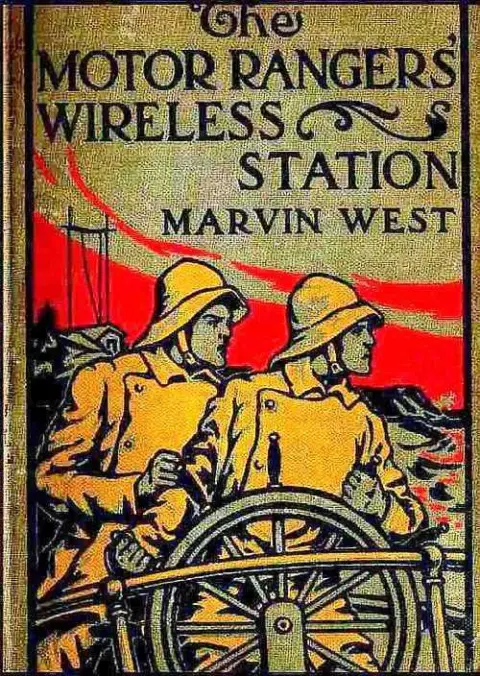
THE CLASSIC COLLECTION · 1913
"The Motor Rangers' Wireless Station" by Marvin West is an adventure novel written in the early 20th century. The story features a group of young boys known as the Motor Rangers—Nat Trevor, Joe Hartley, and Ding-dong Bell—who embark on a thrilling quest involving wireless communication and rescue missions. The narrative encompasses themes of friendship, ingenuity, and adventure, positioning the boys in a scenario where they must respond to an urgent wireless distress signal. At the start of the book, the Motor Rangers are enjoying a seemingly peaceful vacation on Goat Island, where they have set up a wireless station for experimental purposes. Their tranquility is interrupted by an urgent message from the steamer Iroquois, which informs them of a critically injured passenger needing immediate assistance. The boys, spurred by their sense of duty, eagerly prepare to navigate their vessel, the Nomad, into the tumultuous sea to answer the call for help. However, they soon find themselves embroiled in a series of unexpected challenges, including navigating a storm and confronting sinister characters, revealing a deeper plot entwined with danger and intrigue.
Introduction adapted from the source catalogue; source summaries may be automatically generated.
Free to read · English · 49,710 words · No account needed
MAKE TIME FOR A GOOD BOOK
On by default. Untick to stop anonymous reading totals. Each page counts after 10 seconds in view. How this works.
Anonymous counting is on unless you have switched it off.
“In 1888 a Professor Hertz began the first attempts to utilize these waves to send messages through the air. In a crude way he succeeded, and paved the way for his followers along these lines. Hertz found that heat and light are all electric waves. The waves that he set in motion from his apparatus bear his name, Hertzian waves.”
“Then all the air is full of waves?” asked Hank, looking about him in a rather scared sort of way, as if he rather expected to be engulfed in some atmospheric disturbance at any time and was preparing to swim for his life.
“That’s it, Hank, you’re catching on fine. But understand, the waves require some force to agitate them. It’s like a mill pond, the air is, quite smooth till you chuck a stone into it, and then waves begin spreading out in all directions.”
Hank nodded as if he quite understood this homely illustration.
“Heave ahead,” he said, settling back in his seat.
“All right,” smiled Joe. “Now you see my detector here,—quite an elaborate bit of mechanism, isn’t it?”
“Yep, that’s what bit me,” muttered Hank, rubbing his arm once more at
the recollection.
“Well, Hertz had to make his detector just out of a circle of wire with a gap in it. A screw adjustment lengthened or shortened the distance between the ends of the wire, making the gap larger or smaller. The waves, as they came in, were registered on this detector in the form of minute sparks. Is this all clear to you?”
“Oh, as clear as mud,” was the non-committal reply, with a wave of the
hand.
“In 1895, Sir Oliver Lodge detected waves from an oscillator over a distance of forty yards, using a filings tube coherer, a galvanometer and a cell.”
“Hey, hey, hard aport there!” cried Hank. “You’re out of soundings,
mate.”
“Well, that is a little technical, I’ll admit,” smiled Joe. “I’ll try and get down to plainer language.”
“Yep, my head ain’t tough enough to take in all that. It’s swimming now as if you’d chucked a dictionary at it,” growled Hank. “Tell me the names of them biting jiggers on the table thar, and what they’re supposed to do.”
“Very well. This,” touching it, “is the coil or transformer. That produces the spark that slips up into the aerials, those wires over our heads, and sends it shooting off into space just like that stone you might chuck in the pond.”
“Um-hum, that’s all clear enough. Heave ahead.”
Your reading position is saved on this browser. Take it to another device with a library code. Reading pages adapt to text, rather than matching a printed edition.
John Henry Goldfrap
John Henry Goldfrap
John Henry Goldfrap
John Henry Goldfrap
BEHIND THE BOOK
This eBook is for the use of anyone anywhere in the United States and most other parts of the world at no cost and with almost no restrictions whatsoever. You may copy it, give it away or re-use it under the terms of the Project Gutenberg License included with this eBook or online at www.gutenberg.org. If you are not located in the United States, you will have to check the laws of the country where you are located before using this eBook. Read the source licence.
The original source file, including credits and licence, is retained by this library. Request an original-format copy at no charge. Please include the book title and Project Gutenberg identifier #50260.
KEEP YOUR CURIOSITY GOING
Coulson Kernahan

Maurice Baring
Frances Wright
Cécile Tormay

Frederic Jesup Stimson

W. H. P. (William Henry Pope) Jarvis